

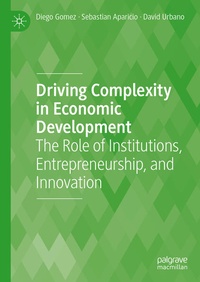
Driving Complexity in Economic Development
Description

This book analyzes the role of institutions in conditioning entrepreneurship and innovation to achieve economic development.
Set against the backdrop of populism, this book is based on the premise that formal and informal institutional factors and entrepreneurship are closely linked and that studying the economic development of both developed and emerging economies can help us disentangle the role of entrepreneurship and innovation in developing countries.
Using institutional economics as a main theoretical framework and the sociotechnical subsystems as a complementary approach, the authors present a detailed literature review to demonstrate that it is possible to identify the true role of entrepreneurship and innovation in the economic development process. The book embraces complexity to better measure and comprehend economic development, bringing a more compelling perspective on the importance of entrepreneurship and innovation for different dimensions ofdevelopment.
A valuable resource for students, scholars, and policymakers, the authors offer clear recommendations for developing countries.
More details
Other editions
Additional editions
Persons
Diego Gomez is the Executive Director of Fundación ECSIM (Economic Center for Simulation and Modelling) in Medellin, Colombia. Diego's research explores the complexity involved in the economic development process, taking into consideration the existence of interrelated systems and the role of innovation and entrepreneurship in boosting such relationships.
Sebastian Aparicio is a Serra Hunter Fellow in the Department of Business at Universitat Autònoma de Barcelona (UAB). He is also a Researcher at the Centre for Entrepreneurship and Social Innovation Research (CREIS) and at the Centre for University Entrepreneurship (CIEU-UAB). His research explores the effects of entrepreneurship on economic development.
David Urbano
is a Professor of Entrepreneurship at the Department of Business and ICREA-Academia research fellow. Also, he is Director at the Centre for Entrepreneurship and Social Innovation Research (CREIS) (Universitat Autònoma de Barcelona). His research focuses on the analysis of factors affecting entrepreneurship in different contexts, using the institutional approach.
Content
Chapter 3: A Review of Economic Development Thinking and the Role of Innovative Entrepreneurship: Past, Present, and Future.- Chapter 4: Why Do Some Nations Succeed While Others Fail? The Role of Culture and Regulations in Entrepreneurship and Innovation.- Chapter 5: Diagnosing the Dynamics of Economic Growth.- Chapter 6: Taxes and Economic Growth: The Role of the Central Government.- Chapter 7: The Effects of the Internal Rate of Return on Economic Development: A Country-Level Study.- Chapter 8: Entrepreneurship Crossing Borders: The Multilevel Relationship Between Institutional Obstacles and Firm's Export.- Chapter 9: From Micro to Macro: Entrepreneurial Choice and Economic Growth Across Cities in a Developing Country.- Chapter 10: Does Company Size Matter for Economic Growth? An Analysis Across OECD, Latin American, and Caribbean Countries.- Chapter 11: Understating (Under)Development Through Inequality and Poverty: A Principal Component Analysis.- Chapter 12: A Sociotechnical Approach to Economic Development: The Role of Entrepreneurship and Innovation.- Chapter 13: General Conclusions.
