

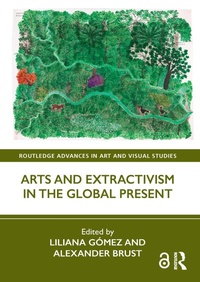
Arts and Extractivism in the Global Present
1st Edition
Published on 6. May 2026
236 pages
978-1-040-71546-8 (ISBN)
Description

Through the lens of contemporary art, this book focuses on social ecologies and those spaces that are characterized, on the one hand, by a high degree of biodiversity and, on the other, by a long history of the extraction of resources, (neo)colonial relationships, and extractivism.
Contributors discuss the importance of ignored knowledge practices and systems as well as alternative designs of the world that reach beyond simply thinking about progress. Chapters posit that contemporary art and ethnographic objects reflect extractive practices and the potential for regeneration in very different ways. In dialogue with one another, both art and the ethnographic object reveal alternative perspectives of agency, critical historiographies, and possible forms of living together in a new way. Foregrounding emerging environmental aesthetics, the book also critically engages the historical documents and artifacts collected by museums that bear witness today to knowledge gaps and the politics of resource transfer.
The book will be of interest to scholars working in art history, environmental humanities, ecocriticism, ethnology, exhibition, and museum studies.
Chapter 3 of this book is freely available as a downloadable Open Access PDF at http://www.taylorfrancis.com under a Creative Commons [Attribution-Non Commercial-No Derivatives (CC BY-NC-ND)] 4.0 license.
Contributors discuss the importance of ignored knowledge practices and systems as well as alternative designs of the world that reach beyond simply thinking about progress. Chapters posit that contemporary art and ethnographic objects reflect extractive practices and the potential for regeneration in very different ways. In dialogue with one another, both art and the ethnographic object reveal alternative perspectives of agency, critical historiographies, and possible forms of living together in a new way. Foregrounding emerging environmental aesthetics, the book also critically engages the historical documents and artifacts collected by museums that bear witness today to knowledge gaps and the politics of resource transfer.
The book will be of interest to scholars working in art history, environmental humanities, ecocriticism, ethnology, exhibition, and museum studies.
Chapter 3 of this book is freely available as a downloadable Open Access PDF at http://www.taylorfrancis.com under a Creative Commons [Attribution-Non Commercial-No Derivatives (CC BY-NC-ND)] 4.0 license.
More details
Series
Edition
1. Auflage
Language
English
Place of publication
London
United Kingdom
Publishing group
Taylor & Francis Ltd
Target group
College/higher education
Product notice
Reflowable
Illustrations
20 Halftones, color; 36 Halftones, black and white; 20 Illustrations, color; 36 Illustrations, black and white
File size
48,47 MB
ISBN-13
978-1-040-71546-8 (9781040715468)
Copyright in bibliographic data and cover images is held by Nielsen Book Services Limited or by the publishers or by their respective licensors: all rights reserved.
Schweitzer Classification
Other editions
Additional editions

Liliana Gomez | Alexander Brust
Arts and Extractivism in the Global Present
Book
05/2026
1st Edition
Routledge
€215.77
Shipment within 10-20 days
Persons
Liliana Gomez is Professor of Art and Society at University of Kassel/Kunsthochschule Kassel, documenta Institut, Germany.
Alexander Brust is Head of the American Department and Curator at the Museum der Kulturen Basel, Switzerland.
Alexander Brust is Head of the American Department and Curator at the Museum der Kulturen Basel, Switzerland.
Content
1. Introduction: Arts After Extractivism Part I: Aesthetics and Extractivism 2. Inmundo: Unspecific Aesthetics and the Arts of Survivance 3. Pharmakon: Aesthetic Practices, Submerged Modes, and Plant-Human Entanglements 4. Sensing Extraction: Visualizing the New Geography of Extractivism in Venezuela Part II: Ethnographies Otherwise 5. Fieldwork Notebooks 6. Creating Pluriversities: Education to Protect the Earth: A Conversation Between Hernando Chindoy and Cristina Rodriguez 7. The Encounter of Two Feather Cloaks: A Conversation Between Gliceria Tupinamba and Alexander Brust 8. To Feather the Shock: Extraction, Copying, and Rebreeding of Ethnographic Materials for Museum Collections Part III: New Ecologies and the Arts 9. Poetic Postnatures: Pyropoetry and New Ecologies of Megafires in the Parana Delta 10. Towards a Pedagogy of Healing and Reparations 11. Learning From Artemisia: A Conversation Between Uriel Orlow, Liliana Gomez, and Alexander Brust Epilogue 12. Cultural Extractivism: A Few Comments on a Key Document
