

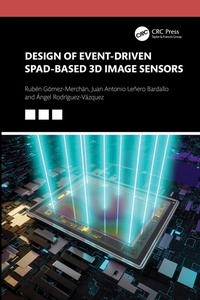
Design of Event-Driven SPAD-Based 3D Image Sensors
1st Edition
Published on 20. December 2024
234 pages
978-1-040-15701-5 (ISBN)
Description

The book presents a top-down circuit description for the implementation of asynchronous vision sensors based on Single-Photon Avalanche Diodes (SPADs). It provides design considerations to convey the SPADs pulses through a channel shared by all the pixels. The book also presents architectures where dynamic vision sensors and SPADs converge.
Design of Event-Driven SPAD-Based 3D Image Sensors provides detailed technical insights about novel image sensor architectures with SPADs with asynchronous operation. At the sensor level, the book provides asynchronous circuitry to read and arbiter the pixel outputs. The authors explore new LiDAR architectures with asynchronous operation and provide insights into their design. A detailed benchmark of modern and competitive LiDAR systems is also presented. At the pixel level, the book provides design considerations to convey the SPADs pulses through a channel shared by all the pixels. At the sensor level, the book provides asynchronous circuitry to read and arbiter the pixel outputs. Finally, experimental results of very novel LiDAR systems with asynchronous operation will be provided and analyzed.
The book is written for professionals who want to explore new tendencies on the design of image sensors for the implementation of LiDAR systems.
Design of Event-Driven SPAD-Based 3D Image Sensors provides detailed technical insights about novel image sensor architectures with SPADs with asynchronous operation. At the sensor level, the book provides asynchronous circuitry to read and arbiter the pixel outputs. The authors explore new LiDAR architectures with asynchronous operation and provide insights into their design. A detailed benchmark of modern and competitive LiDAR systems is also presented. At the pixel level, the book provides design considerations to convey the SPADs pulses through a channel shared by all the pixels. At the sensor level, the book provides asynchronous circuitry to read and arbiter the pixel outputs. Finally, experimental results of very novel LiDAR systems with asynchronous operation will be provided and analyzed.
The book is written for professionals who want to explore new tendencies on the design of image sensors for the implementation of LiDAR systems.
More details
Edition
1. Auflage
Language
English
Place of publication
London
United Kingdom
Publishing group
Taylor & Francis Ltd
Target group
Professional and scholarly
College/higher education
Illustrations
18 Tables, black and white; 38 Line drawings, black and white; 145 Halftones, black and white; 183 Illustrations, black and white
File size
14,40 MB
ISBN-13
978-1-040-15701-5 (9781040157015)
Copyright in bibliographic data and cover images is held by Nielsen Book Services Limited or by the publishers or by their respective licensors: all rights reserved.
Schweitzer Classification
Other editions
Additional editions
Ruben Gomez-Merchan | Juan Antonio Lenero-Bardallo | Angel Rodriguez-Vazquez
Design of Event-Driven SPAD-Based 3D Image Sensors
Book
approx. 07/2026
1st Edition
CRC Press
€66.00
Not yet published
Ruben Gomez-Merchan | Juan Antonio Lenero-Bardallo | Angel Rodriguez-Vazquez
Design of Event-Driven SPAD-Based 3D Image Sensors
Book
12/2024
1st Edition
CRC Press
€183.10
Shipment within 10-20 days
Persons
Dr. Ruben Gomez Merchan received an M.S. (Hons.) degree in microelectronics and the Ph.D. degree in physics- electronics from the University of Seville (US), Seville, Spain, in 2020 and 2024, respectively. From 2018 to 2019, he was with the Department of Electronic Engineering, US, where his main research interests were dc/ dc converters and PV systems. In 2019, he was granted by the Spanish National Research Council (CSIC), starting his activity at the Instituto de Microelectronica de Sevilla (IMSE), US. From September 2022 to December 2022, he was a visiting researcher at Sony Europe Design Center, in Oslo, Norway. His main research interests include smart CMOS sensors and address event representation (AER) vision systems.
Dr. Juan Antonio Lenero- Bardallo (Senior Member, IEEE) received an M.Sc. in telecommunications engineering and a Ph.D. in microelectronics from the University of Seville, Seville, Spain, in 2005 and 2010, respectively. After completing his Ph.D., he served in several academic institutions and worked for the semiconductor industry. He was a Postdoctoral Associate at Yale University, New Haven (USA), and the University of Oslo (Norway). Since February 2018, he has been an Associate Professor at the University of Seville, Spain. For more than 20 years, he has been involved in designing Address Event Representation (AER) vision sensors in many application scenarios such as space instrumentation, navigation systems, surveillance, and biomedical systems.
Dr. Angel Rodriguez-Vazquez (Life Fellow, IEEE), received a Ph.D. in physicselectronics from the University of Seville in 1982. After stays at the University of California at Berkeley and Texas A&M University, he became a Full Professor of electronics at the University of Seville in 1995. He co- founded the Instituto de Microelectronica de Sevilla. In 2001, he was the Main Promotor of AnaFocus Ltd., and served as its CEO until June 2009, when the company reached maturity as a worldwide provider of smart CMOS imagers. He has also participated in the foundation of the Hungarian start- up AnaLogic Ltd. He has ten patents filed; AnaFocus started based on his patents on vision chip architectures. His lab designed many high- performance mixed- signal chips in the framework of Spanish, European, and USA research and development programs. These included three generations of vision chips, analog front- ends for XDSL MoDems, ADCs for wireless communications, ADCs for automotive sensors, chaotic signals generators, and complete MoDems for power- line communications. His research embraces smart imagers, vision chips, and biomedical circuits, always with an emphasis on system integration. He is on the committee of several international journals and conferences. He has chaired several international IEEE and SPIE conferences.
Dr. Juan Antonio Lenero- Bardallo (Senior Member, IEEE) received an M.Sc. in telecommunications engineering and a Ph.D. in microelectronics from the University of Seville, Seville, Spain, in 2005 and 2010, respectively. After completing his Ph.D., he served in several academic institutions and worked for the semiconductor industry. He was a Postdoctoral Associate at Yale University, New Haven (USA), and the University of Oslo (Norway). Since February 2018, he has been an Associate Professor at the University of Seville, Spain. For more than 20 years, he has been involved in designing Address Event Representation (AER) vision sensors in many application scenarios such as space instrumentation, navigation systems, surveillance, and biomedical systems.
Dr. Angel Rodriguez-Vazquez (Life Fellow, IEEE), received a Ph.D. in physicselectronics from the University of Seville in 1982. After stays at the University of California at Berkeley and Texas A&M University, he became a Full Professor of electronics at the University of Seville in 1995. He co- founded the Instituto de Microelectronica de Sevilla. In 2001, he was the Main Promotor of AnaFocus Ltd., and served as its CEO until June 2009, when the company reached maturity as a worldwide provider of smart CMOS imagers. He has also participated in the foundation of the Hungarian start- up AnaLogic Ltd. He has ten patents filed; AnaFocus started based on his patents on vision chip architectures. His lab designed many high- performance mixed- signal chips in the framework of Spanish, European, and USA research and development programs. These included three generations of vision chips, analog front- ends for XDSL MoDems, ADCs for wireless communications, ADCs for automotive sensors, chaotic signals generators, and complete MoDems for power- line communications. His research embraces smart imagers, vision chips, and biomedical circuits, always with an emphasis on system integration. He is on the committee of several international journals and conferences. He has chaired several international IEEE and SPIE conferences.
Content
0. Front Matter. 1. Introduction and Challenges. 2. A SAER Vision System. 3. The SAER Vision Sensor. 4. The SAER Pixel. 5. Characterization of the SAER Vision System. 6. Conclusions and Future Work. End Matter. References.
