

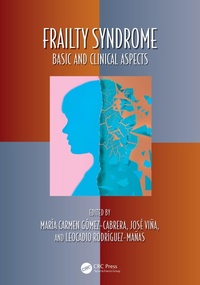
Frailty Syndrome
Basic and Clinical Aspects
1st Edition
Published on 21. October 2025
244 pages
978-1-040-41804-8 (ISBN)
Description

Frailty, a geriatric syndrome with a defined phenotype, was introduced by Linda Fried and Jeremy Walston; it is widely cited. The importance of this syndrome cannot be overstated: Frailty has an enormous relevance in clinical settings, and there are clear biological bases behind its phenotype. This book covers both biological and clinical aspects, including interactions with diseases like diabetes.
Key Features:
Summarizes the history and recognition of the Frailty Syndrome
Provides an update and summary of a fast-growing field
Describes how free radical and oxidative stress contributed to current theories
Documents the impact that nutrition and physical activity play in the emergence of frailty
Key Features:
Summarizes the history and recognition of the Frailty Syndrome
Provides an update and summary of a fast-growing field
Describes how free radical and oxidative stress contributed to current theories
Documents the impact that nutrition and physical activity play in the emergence of frailty
More details
Series
Edition
1. Auflage
Language
English
Place of publication
London
United Kingdom
Publishing group
Taylor & Francis Ltd
Target group
Professional and scholarly
Illustrations
14 Tables, black and white; 22 Line drawings, color; 3 Line drawings, black and white; 22 Illustrations, color; 3 Illustrations, black and white
File size
3,12 MB
ISBN-13
978-1-040-41804-8 (9781040418048)
Copyright in bibliographic data and cover images is held by Nielsen Book Services Limited or by the publishers or by their respective licensors: all rights reserved.
Schweitzer Classification
Other editions
Additional editions
Maria Carmen Gomez-Cabrera | Jose Vina | Leocadio Rodriguez-Manas
Frailty Syndrome
Basic and Clinical Aspects
Book
10/2025
1st Edition
CRC Press
€202.90
Shipment within 10-20 days
Persons
Jose Vina (ORCID 0000-0001-9709-0089) studied Medicine at the University of Valencia. He obtained his doctorate with Hans Krebs in Oxford, Professor of Physiology Valencia, and leads the FRESHAGE group that works on healthy aging, exercise and Alzheimer's disease. He has received two honorary doctorates from the Universities of Buenos Aires and Rennes. President of the International Society of Free Radicals (SFRR-I) Dr. Vina has been cited more than 21.000 times, resulting in an h-index of 79 (data taken from: https://exaly.com/author/ 2255005/jose-vina/rankings)
Maria Carmen Gomez Cabrera ORCID: 0000-0003-4000-1684 is a full professor in the Department of Physiology at the Faculty of Medicine, University of Valencia. Her research focuses on the physiology of skeletal muscle and the mechanisms underlying muscle dysfunction, including the loss of strength and muscle mass associated with aging, periods of immobilisation or physical inactivity, and certain pathological conditions. Maria Carmen is the author of over 140 peer-reviewed international publications. Her contributions to exercise redox biology, healthy aging, frailty and sarcopenia have garnered over 14,000 citations, reflecting an h-index of 50.
Leocadio Rodriguez Manas (ORCID: 0000-0002-6551-1333). Head of the Geriatrics Service of the Getafe University Hospital (Madrid) and Scientific Director of the Spanish Center for Biomedical Research on Frailty and Healthy Aging (CIBERFES) (Ministry of Science and Innovation and Ministry of Health). Coordinator of the Toledo Study of Healthy Aging. His research has been mainly focused on frailty and functional decline and diabetes in older people, the mechanisms involved, its operational definition (diagnostics tools) and its management (RCTs), including the use of the technology in the covering of the different requirements of the older frail people or at risk of frailty. He has participated in the preparation of technical reports on these topics for national and international organizations
Maria Carmen Gomez Cabrera ORCID: 0000-0003-4000-1684 is a full professor in the Department of Physiology at the Faculty of Medicine, University of Valencia. Her research focuses on the physiology of skeletal muscle and the mechanisms underlying muscle dysfunction, including the loss of strength and muscle mass associated with aging, periods of immobilisation or physical inactivity, and certain pathological conditions. Maria Carmen is the author of over 140 peer-reviewed international publications. Her contributions to exercise redox biology, healthy aging, frailty and sarcopenia have garnered over 14,000 citations, reflecting an h-index of 50.
Leocadio Rodriguez Manas (ORCID: 0000-0002-6551-1333). Head of the Geriatrics Service of the Getafe University Hospital (Madrid) and Scientific Director of the Spanish Center for Biomedical Research on Frailty and Healthy Aging (CIBERFES) (Ministry of Science and Innovation and Ministry of Health). Coordinator of the Toledo Study of Healthy Aging. His research has been mainly focused on frailty and functional decline and diabetes in older people, the mechanisms involved, its operational definition (diagnostics tools) and its management (RCTs), including the use of the technology in the covering of the different requirements of the older frail people or at risk of frailty. He has participated in the preparation of technical reports on these topics for national and international organizations
Content
Chapter 01 Unveiling Vulnerability: Frailty in the Lens of Intrinsic Capacity
Chapter 02 Clinical management of frailty: Advances and Challenges
Chapter 03 Biomarkers of frailty
Chapter 04 Physical activity and exercise in the prevention and treatment of frailty
Chapter 05 Nutrition and Frailty: Epidemiological and Clinical Facts
Chapter 06 Physical functionbased programs in frailty
Chapter 07 Diabetes and frailtyinteractions and clinical implications
Chapter 08 Complexity and Disentanglement of Frailty: The biopsychosocial model of frailty and resilience
Chapter 09 The Impact of Polyphenol Intake on Cognitive Decline: Insights from Plasma and Urine Biomarker Analysis
Chapter 10 The role of the microbiota in aging and frailty
Chapter 11 Frailty in Experimental Animals: Models and Scores
Chapter 02 Clinical management of frailty: Advances and Challenges
Chapter 03 Biomarkers of frailty
Chapter 04 Physical activity and exercise in the prevention and treatment of frailty
Chapter 05 Nutrition and Frailty: Epidemiological and Clinical Facts
Chapter 06 Physical functionbased programs in frailty
Chapter 07 Diabetes and frailtyinteractions and clinical implications
Chapter 08 Complexity and Disentanglement of Frailty: The biopsychosocial model of frailty and resilience
Chapter 09 The Impact of Polyphenol Intake on Cognitive Decline: Insights from Plasma and Urine Biomarker Analysis
Chapter 10 The role of the microbiota in aging and frailty
Chapter 11 Frailty in Experimental Animals: Models and Scores
