

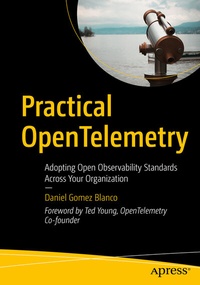
Practical OpenTelemetry
Adopting Open Observability Standards Across Your Organization
Published on 2. March 2023
XIX, 241 pages
978-1-4842-9075-0 (ISBN)
Description

Learn the value that OpenTelemetry can bring to organizations that aim to implement observability best practices, and gain a deeper understanding of how different building blocks interact with each other to bring out-of-the-box, vendor-neutral instrumentation to your stack. With examples in Java, this book shows how to use OpenTelemetry APIs and configure plugins and SDKs to instrument services and produce valuable telemetry data. You'll learn how to maximize adoption of OpenTelemetry and encourage the change needed in debugging workflows to reduce cognitive load for engineers troubleshooting production workloads.
Adopting observability best practices across an organization is challenging. This book begins with a discussion of how operational monitoring processes widely followed for decades fall short at providing the insights needed for debugging cloud-native, distributed systems in production. The book goes on to show how the Cloud Native Computing Foundation's OpenTelemetry project helps you standardize instrumentation and transport of telemetry signals, providing a common language for all observability tooling.
You Will Learn
Who This Book Is For
Software engineers familiar with cloud-native technologies and operational monitoring who want to instrument and export telemetry data from their services; observability leads who want to roll out OpenTelemetry standards and bestpractices across their organizations; and Java developers who want a book with OpenTelemetry examples in that language
Adopting observability best practices across an organization is challenging. This book begins with a discussion of how operational monitoring processes widely followed for decades fall short at providing the insights needed for debugging cloud-native, distributed systems in production. The book goes on to show how the Cloud Native Computing Foundation's OpenTelemetry project helps you standardize instrumentation and transport of telemetry signals, providing a common language for all observability tooling.
You Will Learn
- Why observability is a necessity in modern distributed systems
- The value of OpenTelemetry for engineers and organizations
- OpenTelemetry component specification and general design
- Tracing, metrics, and logs APIs and SDKs, with examples in Java
- OpenTelemetry Collectors and recommended transport and processing pipelines
- How to adopt observability standards across an organization
Who This Book Is For
Software engineers familiar with cloud-native technologies and operational monitoring who want to instrument and export telemetry data from their services; observability leads who want to roll out OpenTelemetry standards and bestpractices across their organizations; and Java developers who want a book with OpenTelemetry examples in that language
More details
Series
Edition
First Edition
Language
English
Place of publication
Berkeley
United States
Publishing group
APRESS
Target group
Professional and scholarly
Product notice
Reflowable
Illustrations
XIX, 241 p. 44 illus.
File size
8,78 MB
ISBN-13
978-1-4842-9075-0 (9781484290750)
DOI
10.1007/978-1-4842-9075-0
Schweitzer Classification
Other editions
Additional editions
Daniel Gomez Blanco
Practical OpenTelemetry
Adopting Open Observability Standards Across Your Organization
Book
03/2023
APress
€58.84
Shipment within 15-20 days
Person
Daniel Gomez Blanco
is a Principal Engineer at Skyscanner, leading their observability transformation across hundreds of services to ensure that travelers get a reliable and performant experience when booking their next holiday. He is an advocate of open standards and CNCF projects such as OpenTelemetry to back the instrumentation and collection of operational data. Daniel has experience working in organizations of all sizes, from international institutions such as CERN in Geneva, to London startups such as SKIPJAQ. His main focus has always been building software and adopting solutions to minimize the cognitive load required for engineers to support and operate production services.
Content
Part I. The Need for Observability with OpenTelemetry.-
1. The Need for Observability.- 2. How OpenTelemetry Enables Observability.-
Part II. OpenTelemetry Components and Best Practices.-
3. OpenTelemetry Fundamentals.- 4. Auto-Instrumentation.- 5. Context, Baggage, and Propagators.- 6. Tracing.- 7. Metrics.- 8. Logging.- 9. Protocol and Collector.- 10. Sampling and Common Deployment Models.-
Part III. Rolling Out OpenTelemetry Across Your Organization.-
11. Maximizing Adoption by Minimizing Friction.- 12. Adopting Observability.
