

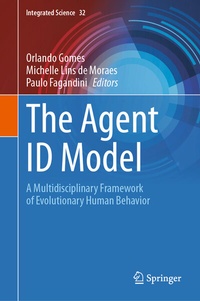
The Agent ID Model
Description

This book presents a comprehensive model that simulates human behavior in society, meticulously selecting and analyzing fundamental determinants such as skills and productivity, connectivity and network formation, psychological biases, moral behavior, consumption preferences, institutional arrangements, and political choices. Each agent in the model is characterized by a unique profile, and the aggregate outcomes emerge from the interactions of these diverse agents. The model is codified and simulated, and its results are compared with empirical evidence. This work offers an elegant and stylized approach to understanding complex outcomes resulting from simple interaction rules, making a significant contribution to the literature on complexity and agent-based computational economics. The model developed here serves as a transdisciplinary framework, providing an integrated and holistic perspective on human behavior.
More details
Other editions
Additional editions
Persons
Orlando Gomes is a Full Professor of Economics at the Lisbon Accounting and Business School (ISCAL) of the Lisbon Polytechnic Institute. He earned his Ph.D. from the Lisbon University Institute in 2002. His research interests encompass macroeconomics, economic growth, behavioral economics, complexity dynamics, and agent-based models.
Michelle Lins de Moraes is a Professor of Economics at ISCAL. She holds a Ph.D. in Economics and Public Policy from Università degli Studi di Ferrara (Italy) and Universidade Federal do Maranhão (Brazil). She has extensive international experience as a researcher and lecturer. Her research focuses on behavioral economics, sustainability, and innovation.
Paulo Fagandini Ruiz is a Professor of Economics at ISCAL. He earned his Ph.D. in Economics from Nova School of Business and Economics, where he also teaches Master's and Doctoral summer courses. His research specializes in applied microeconomic theory and empirical microeconomics. Additionally, he has experience as a private sector consultant.
Content
Chaper 1. A Holistic Approach to Human Behavior (Orlando Gomes).- Chapter 2. Complexity and the World of Heterogeneous People (Orlando Gomes).- Chapter 3. Innovation and Skills: a Contamination Lab Experience in Higher Education Institutions (Subhankar Das).- Chapter 4. Networks and Connectivity: Metrics and Models (Luís Cavique).- Chapter 5. Insights on Animal Spirits (Vitor Moutinho).- Chapter 6. On the Economics of Moral Behavior (Michelle Lins de Moraes).- Chapter 7. The Influence of Space and Environment on Crime and Economic Indicators: A Systematic Literature Review (João Santos).- Chapter 8. Behavioral economics and electronic voting (Michelle Lins de Moraes).- Chapter 9. The Agent ID Model: Motivation and Formal Presentation (Orlando Gomes).- Chapter 10. Implementing the Agent ID Model and Simulation Results (Paulo Fagandini).- Chapter 11. Epilogue: Agent-based Transdisciplinarity (Orlando Gomes).
