

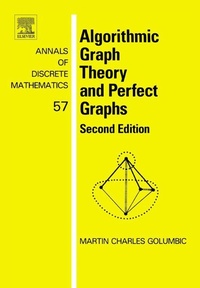
Algorithmic Graph Theory and Perfect Graphs
Second Edition
2nd Edition
Published on 4. February 2004
340 pages
978-0-08-052696-6 (ISBN)
Description

Algorithmic Graph Theory and Perfect Graphs, first published in 1980, has become the classic introduction to the field. This new Annals edition continues to convey the message that intersection graph models are a necessary and important tool for solving real-world problems. It remains a stepping stone from which the reader may embark on one of many fascinating research trails.
The past twenty years have been an amazingly fruitful period of research in algorithmic graph theory and structured families of graphs. Especially important have been the theory and applications of new intersection graph models such as generalizations of permutation graphs and interval graphs. These have lead to new families of perfect graphs and many algorithmic results. These are surveyed in the new Epilogue chapter in this second edition.
- New edition of the "Classic" book on the topic
- Wonderful introduction to a rich research area
- Leading author in the field of algorithmic graph theory
- Beautifully written for the new mathematician or computer scientist
- Comprehensive treatment
More details
Other editions
Additional editions
Book
02/2004
2nd Edition
North-Holland
€73.50
Shipment within 15-20 days
Previous edition
Martin Charles Golumbic | Werner Rheinboldt
Algorithmic Graph Theory and Perfect Graphs
E-Book
05/2014
1st Edition
Academic Press
€54.95
Available for download
Content
- Cover
- Algorithmic Graph Theory and Perfect Graphs
- Copyright
- Dedication
- Contents
- Foreword 2004
- Foreword
- Preface
- Acknowledgments
- List of Symbols
- Corrections and Errata
- Chapter 1 Graph Theoretic Foundations
- 1. Basic Definitions and Notations
- 2. Intersection Graphs
- 3. Interval Graphs-A Sneak Preview of the Notions Coming Up
- 4. Summary
- Exercises
- Bibliography
- Chapter 2 The Design of Efficient Algorithms
- 1. The Complexity of Computer Algorithms
- 2. Data Structures
- 3. How to Explore a Graph
- 4. Transitive Tournaments and Topological Sorting
- Exercises
- Bibliography
- Chapter 3 Perfect Graphs
- 1. The Star of the Show
- 2. The Perfect Graph Theorem
- 3. p-Critical and Partitionable Graphs
- 4. A Polyhedral Characterization of Perfect Graphs
- 5. A Polyhedral Characterization of p-Critical Graphs
- 6. The Strong Perfect Graph Conjecture
- Exercises
- Bibliography
- Chapter 4 Triangulated Graphs
- 1. Introduction
- 2. Characterizing Triangulated Graphs
- 3. Recognizing Triangulated Graphs by Lexicographic Breadth-First Search
- 4. The Complexity of Recognizing Triangulated Graphs
- 5. Triangulated Graphs as Intersection Graphs
- 6. Triangulated Graphs Are Perfect
- 7. Fast Algorithms for the COLORING, CLIQUE, STABLE SET, and CLIQUE-COVER Problems on Triangulated Graphs
- Exercises
- Bibliography
- Chapter 5 Comparability Graphs
- 1. G-Chains and Implication Classes
- 2. Uniquely Partially Orderable Graphs
- 3. The Number of Transitive Orientations
- 4. Schemes and G-Decompositions-An Algorithm for Assigning Transitive Orientations
- 5. The G*-Matroid of a Graph
- 6. The Complexity of Comparability Graph Recognition
- 7. Coloring and Other Problems on Comparability Graphs
- 8. The Dimension of Partial Orders
- Exercises
- Bibliography
- Chapter 6 Split Graphs
- 1. An Introduction to Chapters 6-8: Interval, Permutation, and Split Graphs
- 2. Characterizing Split Graphs
- 3. Degree Sequences and Split Graphs
- Exercises
- Bibliography
- Chapter 7 Permutation Graphs
- 1. Introduction
- 2. Characterizing Permutation Graphs
- 3. Permutation Labelings
- 4. Applications
- 5. Sorting a Permutation Using Queues in Parallel
- Exercises
- Bibliography
- Chapter 8 Interval Graphs
- 1. How It All Started
- 2. Some Characterizations of Interval Graphs
- 3. The Complexity of Consecutive 1's Testing
- 4. Applications of Interval Graphs
- 5. Preference and Indifference
- 6. Circular- Arc Graphs
- Exercises
- Bibliography
- Chapter 9. Superperfect Graphs
- 1. Coloring Weighted Graphs
- 2. Superperfection
- 3. An Infinite Class of Superperfect Noncomparability Graphs
- 4. When Does Superperfect Equal Comparability?
- 5. Composition of Superperfect Graphs
- 6. A Representation Using the Consecutive 1's Property
- Exercises
- Bibliography
- Chapter 10 Threshold Graphs
- 1. The Threshold Dimension
- 2. Degree Partition of Threshold Graphs
- 3. A Characterization Using Permutations
- 4. An Application to Synchronizing Parallel Processes
- Exercises
- Bibliography
- Chapter 11 Not So Perfect Graphs
- 1. Sorting a Permutation Using Stacks in Parallel
- 2. Intersecting Chords of a Circle
- 3. Overlap Graphs
- 4. Fast Algorithms for Maximum Stable Set and Maximum Clique of These Not So Perfect Graphs
- 5. A Graph Theoretic Characterization of Overlap Graphs
- Exercises
- Bibliography
- Chapter 12 Perfect Gaussian Elimination
- 1. Perfect Elimination Matrices
- 2. Symmetric Matrices
- 3. Perfect Elimination Bipartite Graphs
- 4. Chordal Bipartite Graphs
- Exercises
- Bibliography
- Appendix
- A. A Small Collection of NP-complete Problems
- B. An Algorithm for Set Union, Intersection, Difference, and Symmetric Difference of Two Subsets
- C. Topological Sorting: An Example of Algorithm 2.4
- D. An Illustration of the Decomposition Algorithm
- E. The Properties P.E.B., C.B., (P.E.B.)', (C .B.)' Illustrated
- F. The Properties C, C, T, T Illustrated
- Epilogue 2004
- Index
