

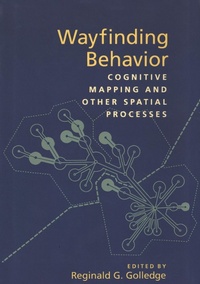
Wayfinding Behavior
Cognitive Mapping and Other Spatial Processes
Published on 11. March 1999
448 pages
978-1-4214-0289-5 (ISBN)
Description

The metaphor of a "cognitive map"has attracted wide interest since it was first proposed in the late 1940s. Researchers from fields as diverse as psychology, geography, and urban planning have explored how humans process and use spatial information, often with the view of explaining why people make wayfinding errors or what makes one person a better navigator than another. Cognitive psychologists have broken navigation down into its component steps and shown it to be an interplay of neurocognitive functions, such as "spatial updating"and "reference frames"or "perception-action couplings."But there has also been an intense debate among biologists over whether animals have cognitive maps or have other forms of internal spatial representations that allow them to behave as if they did. Yet until now, little has been done to relate research on human and non-human subjects in this area.
In Wayfinding Behavior: Cognitive Mapping and Other Spatial Processes Reginald Golledge brings together a distinguished group of scholars to offer a unique and comprehensive survey of current research in these diverse fields. Among the common themes they discover is the psychologists' "black box"approach, in which the internal mechanisms of spatial perception and route planning are modeled or constructed, like metaphors, based on the behavioral evidence. Cognitive neuroscientists, on the other hand, have attempted to discover the neurocognitive basis for spatial behavior. (They have shown, for example, that damage in the hippocampus system invariably impairs the ability of animals and humans to learn about, remember, and navigate through environments, and studies in humans show that neurons in this system code for location, direction, and distance, thereby providing the elements needed for a mapping system.) Artificial intelligence and robotics theorists attempt to construct intelligent mapping systems using computer technology. In these areas, there is growing evidence that, as in human wayfinding processes, useful representations cannot be achieved without sacrificing completeness and precision.
Wayfinding Behavior: Cognitive Mapping and Other Spatial Processes offers not only state-of-the-art knowledge about "wayfinding, "but also represents a point of departure for future interdisciplinary studies. "The more we know," concludes volume editor Reginald Golledge, "about how humans or other species can navigate, wayfind, sense, record and use spatial information, the more effective will be the building of future guidance systems, and the more natural it will be for human beings to understand and control those systems."
In Wayfinding Behavior: Cognitive Mapping and Other Spatial Processes Reginald Golledge brings together a distinguished group of scholars to offer a unique and comprehensive survey of current research in these diverse fields. Among the common themes they discover is the psychologists' "black box"approach, in which the internal mechanisms of spatial perception and route planning are modeled or constructed, like metaphors, based on the behavioral evidence. Cognitive neuroscientists, on the other hand, have attempted to discover the neurocognitive basis for spatial behavior. (They have shown, for example, that damage in the hippocampus system invariably impairs the ability of animals and humans to learn about, remember, and navigate through environments, and studies in humans show that neurons in this system code for location, direction, and distance, thereby providing the elements needed for a mapping system.) Artificial intelligence and robotics theorists attempt to construct intelligent mapping systems using computer technology. In these areas, there is growing evidence that, as in human wayfinding processes, useful representations cannot be achieved without sacrificing completeness and precision.
Wayfinding Behavior: Cognitive Mapping and Other Spatial Processes offers not only state-of-the-art knowledge about "wayfinding, "but also represents a point of departure for future interdisciplinary studies. "The more we know," concludes volume editor Reginald Golledge, "about how humans or other species can navigate, wayfind, sense, record and use spatial information, the more effective will be the building of future guidance systems, and the more natural it will be for human beings to understand and control those systems."
More details
Language
English
Place of publication
Baltimore
United States
Target group
Professional and scholarly
Illustrations
83 s/w Abbildungen
83 Illustrations, black and white
File size
6,11 MB
ISBN-13
978-1-4214-0289-5 (9781421402895)
DOI
10.56021/9780801859939
Copyright in bibliographic data and cover images is held by Nielsen Book Services Limited or by the publishers or by their respective licensors: all rights reserved.
Schweitzer Classification
Other editions
Additional editions
Book
03/1999
Johns Hopkins University Press
€109.50
Article not available for order
Person
Reginald G. Golledge is a professor of geography at the University of California, Santa Barbara. His many books include Spatial Behavior: A Geographic Perspective and Spatial and Temporal Reasoning in Geographic Information Systems.
Content
Preface
Acknowledgments
Part I: Human Cognitive Maps and Wayfinding
1. Human Wayfinding and Cognitive Maps
2. Spatial Abilities, Cognitive Maps, and Wayfinding: Bases for Individual Difference in Spatial Cognition and Behavior
3. Human Information Processing in Sequential Spatial Choice
4. Environmental Congnition and Decision Making in Urban Navigation
Part II: Perceptual and Cognitive Processing of Environmental Information
5. Human Navigation by Path Integration
6. A Neaurocognitive Approach to Human Navigation
7. Dynamic Spatial Orientation and the Coupling of Representation
Part III: Wayfinding and Cognitive Maps in Nonhuman Species
8. Dead Reckoning (Path Integration), Landmarks, and Representation of Space in a Comparative Perspective
9. On the Fine Structure of View-Based Navigation in Insects
10. Compass Orientation as a Basic Element in Avian Orientation and Navigation
11. Spatial Processing in Animals and Humans: The Organizing Function of Representations for Information Gathering
Part IV: The Naural and Computational Bases of Wayfinding and Cognitive Maps
12. Neural Mechanisms of Spatial Orientation and Wayfindings: An Overview
13. Dissociation bewteen Distance and Direction during Locomotor Navigation
14. Error Tolerance and Generalization in Cognitive Maps: Performance without Precision
References
Contributors
Index
Acknowledgments
Part I: Human Cognitive Maps and Wayfinding
1. Human Wayfinding and Cognitive Maps
2. Spatial Abilities, Cognitive Maps, and Wayfinding: Bases for Individual Difference in Spatial Cognition and Behavior
3. Human Information Processing in Sequential Spatial Choice
4. Environmental Congnition and Decision Making in Urban Navigation
Part II: Perceptual and Cognitive Processing of Environmental Information
5. Human Navigation by Path Integration
6. A Neaurocognitive Approach to Human Navigation
7. Dynamic Spatial Orientation and the Coupling of Representation
Part III: Wayfinding and Cognitive Maps in Nonhuman Species
8. Dead Reckoning (Path Integration), Landmarks, and Representation of Space in a Comparative Perspective
9. On the Fine Structure of View-Based Navigation in Insects
10. Compass Orientation as a Basic Element in Avian Orientation and Navigation
11. Spatial Processing in Animals and Humans: The Organizing Function of Representations for Information Gathering
Part IV: The Naural and Computational Bases of Wayfinding and Cognitive Maps
12. Neural Mechanisms of Spatial Orientation and Wayfindings: An Overview
13. Dissociation bewteen Distance and Direction during Locomotor Navigation
14. Error Tolerance and Generalization in Cognitive Maps: Performance without Precision
References
Contributors
Index
