

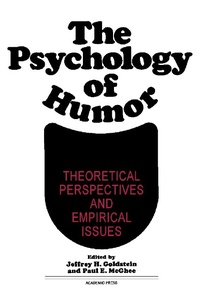
The Psychology of Humor
Theoretical Perspectives and Empirical Issues
1st Edition
Published on 22. October 2013
294 pages
978-1-4832-8854-3 (ISBN)
Description

The Psychology of Humor: Theoretical Perspectives and Empirical Issues examines theoretical perspectives and empirical issues concerning the psychology of humor. Theoretical views of humor range from the physiological to the sociological and anthropological. The relations between humor, laughter, and smiling are considered, along with the connection between collative variables and arousal. Comprised of 13 chapters, this book begins with an introduction to the history of thought and major theoretical issues on humor, followed by a description of models of different aspects of humor. The next section deals with empirical issues in which selected research areas are given detailed attention. The relations between humor, laughter, and smiling, on the one hand, and collative variables and arousal, on the other, are analyzed. Subsequent chapters explore the cognitive origins of incongruity humor by comparing fantasy assimilation and reality assimilation; a two-stage model for the appreciation of jokes and cartoons; and the social functions and physiological correlates of humor. The relationship between arousal potential and funniness of jokes is also explored, together with humor judgments as a function of reference groups and identification classes. The final chapter presents an annotated bibliography of published papers on humor in the research literature and an analysis of trends between 1900 and 1971. This monograph will be of interest to psychologists, sociologists, anthropologists, and behavioral scientists.
More details
Other editions
New editions
E-Book
07/2018
2nd Edition
Academic Press
€57.95
Available for download
Additional editions

Jeffrey H. Goldstein | Paul E. Mcghee
The Psychology of Humour
Theoretical Perspectives and Empirical Issues
Book
10/1997
Academic Press
€59.52
Article exhausted; check different version
Content
List of ContributorsForewordPrefacePart I Introduction Chapter 1. Early Conceptions of Humor: Varieties and Issues I. Introduction II. Varieties of Early Humor Theory III. Issues Arising from Earlier Humor Theories IV. Conclusion ReferencesPart II Theoretical Perspectives Chapter 2. Humor and Its Kin I. Affinities of Humor II. Collative Variables and Pleasure III. Experiments on Collative Variables and Humor IV. Laughter V. The Smile VI. How Does Humor Differ? VII. Conclusion References Chapter 3. On the Cognitive Origins of Incongruity Humor: Fantasy Assimilation Versus Reality Assimilation I. Introduction II. Stimulus Discrepancy and Affective Arousal III. Fantasy Assimilation Versus Reality Assimilation IV. The Development of Fantasy Assimilation V. Humor in Infancy? VI. Factors Influencing Mode of Assimilation VII. Mode of Assimilation and Affectively Salient Humor VIII. Summary References Chapter 4. A Two-Stage Model for the Appreciation of Jokes and Cartoons: An Information-Processing Analysis I. Introduction II. The Basis of Joke and Cartoon Humor III. Comparison with Other Cognitive Theories IV. Suggestions for Research V. Conclusion References Chapter 5. A Model of the Social Functions of Humor I. Introduction II. A Progress Report III. A Model of the Social Functions of Humor IV. Conclusion ReferencesPart III Empirical Issues Chapter 6. Physiological Correlates of Humor I. Introduction II. The Essence of Humor III. Arousal: Humor and Curiosity IV. An Experimental Study V. Discussion References Chapter 7. The Relationship Between Arousal Potential and Funniness of Jokes I. Arousal and Appreciation of Humor II. Measurement III. The Experiment IV. Summary References Chapter 8. Enjoyment of Specific Types of Humor Content: Motivation or Salience? I. Introduction II. Experiment I: Salience and Drive in Humor Appreciation III. Experiment II: Salience and Appreciation for Variations in Humor Thema IV. Discussion and Conclusions References Chapter 9. On Being Witty: Causes, Correlates, and Consequences I. Introduction II. A Paradigm for the Problem III. The Literature: What Do We Know? IV. Adding Evidence: Empirical Explorations V. For the Future References Chapter 10. Humor Judgments as a Function of Reference Groups and Identification Classes I. Problems and Paradoxes II. Review of Experimental Literature III. Reasons Why IC's Construct Is Preferable to KG IV. Conclusion References Chapter 11. Humor, Laughter, and Smiling: Some Preliminary Observations of Funny Behaviors I. Introduction II. Naturalistic Observations of Audience Laughter: In the Wilds of Knoxville and Elsewhere III. Laboratory Studies: Cosby and Diller, and Cambridge Too IV. Conclusion: Future Directions and Speculations ReferencesPart IV Overview and Conclusions Chapter 12. Advances Toward an Understanding of Humor: Implications for the Future I. Contributions of the Present Volume II. An Overview ReferencesAppendix Chapter 13. An Annotated Bibliography of Published Papers on Humor in the Research Literature and an Analysis of Trends: 1900-1971 I. Introduction II. A Survey of Methodology in Empirical Studies: 1950-1971 III. An Annotated Bibliography of Published Papers on Humor in the Research Literature: 1900-1971Author IndexSubject Index
