

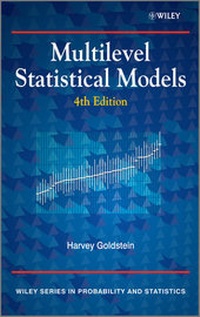
Multilevel Statistical Models
Description

Reviews / Votes
"This book is suitable as a comprehensive text forpostgraduate courses, as well as a general reference guide. Appliedstatisticians in the social sciences, economics, biological andmedical disciplines will find this book beneficial. See the reviewof the third edition." (Zentralblatt MATH, 1December 2013) "This book would also serve as an outstanding general referenceon multilevel models, since it offers concise and easy to followdescriptions of the various multilevel models and theirapplications, in addition to the references on which this work isbased. I really enjoyed reading this book, and am sure that otherswill have a similar pleasurable experience." (Journal ofBiopharmaceutical Statistics (JBS), 2012)More details
Other editions
Additional editions
Person
Content
Chapter 2 The 2-level model 2.1 Introduction 2.2 The 2-level model 2.3 Parameter estimation 2.4 Maximum likelihood estimation using Iterative Generalised Least Squares (IGLS) 2.5 Marginal models and Generalized Estimating Equations (GEE) 2.6 Residuals 2.7 The adequacy of Ordinary Least Squares estimates. 2.8 A 2-level example using longitudinal educational achievement data 2.9 General model diagnostics 2.10 Higher level explanatory variables and compositional effects 2.11 Transforming to normality 2.12 Hypothesis testing and confidence intervals 2.13 Bayesian estimation using Markov Chain Monte Carlo (MCMC) 2.14 Data augmentation Appendix 2.1 The general structure and maximum likelihood estimation for a multilevel model Appendix 2.2 Multilevel residuals estimation Appendix 2.3 Estimation using profile and extended likelihood Appendix 2.4 The EM algorithm Appendix 2.5 MCMC sampling
Chapter 3. Three level models and more complex hierarchical structures. 3.1 Complex variance structures 3.2 A 3-level complex variation model example. 3.3 Parameter Constraints 3.4 Weighting units 3.5 Robust (Sandwich) Estimators and Jacknifing 3.6 The bootstrap 3.7 Aggregate level analyses 3.8 Meta analysis 3.9 Design issues
Chapter 4. Multilevel Models for discrete response data 4.1 Generalised linear models 4.2 Proportions as responses 4.3 Examples 4.4 Models for multiple response categories 4.5 Models for counts 4.6 Mixed discrete - continuous response models 4.7 A latent normal model for binary responses 4.8 Partitioning variation in discrete response models Appendix 4.1. Generalised linear model estimation
Appendix 4.2 Maximum likelihood estimation for generalised linear models
Appendix 4.3 MCMC estimation for generalised linear models
Appendix 4.4. Bootstrap estimation for generalised linear models
Chapter 5. Models for repeated measures data 5.1 Repeated measures data 5.2 A 2-level repeated measures model 5.3 A polynomial model example for adolescent growth and the prediction of adult height 5.4 Modelling an autocorrelation structure at level 1. 5.5 A growth model with autocorrelated residuals 5.6 Multivariate repeated measures models 5.7 Scaling across time 5.8 Cross-over designs 5.9 Missing data 5.10 Longitudinal discrete response data
Chapter 6. Multivariate multilevel data 6.1 Introduction 6.2 The basic 2-level multivariate model 6.3 Rotation Designs 6.4 A rotation design example using Science test scores 6.5 Informative response selection: subject choice in examinations 6.6 Multivariate structures at higher levels and future predictions 6.7 Multivariate responses at several levels 6.8 Principal Components analysis
Appendix 6.1 MCMC algorithm for a multivariate normal response model with constraints
Chapter 7. Latent normal models for multivariate data 7.1 The normal multilevel multivariate model 7.2 Sampling binary responses 7.3 Sampling ordered categorical responses 7.4 Sampling unordered categorical responses 7.5 Sampling count data 7.6 Sampling continuous non-normal data 7.7 Sampling the level 1 and level 2 covariance matrices 7.8 Model fit 7.9 Partially ordered data 7.10 Hybrid normal/ordered variables 7.11 Discussion
Chapter 8. Multilevel factor analysis, structural equation and mixture models
8.1 A 2-stage 2-level factor model
8.2 A general multilevel factor model
8.3 MCMC estimation for the factor model
8.4 Structural equation models
8.5 Discrete response multilevel structural equation models
8.6 More complex hierarchical latent variable models
8.7 Multilevel mixture models
Chapter 9. Nonlinear multilevel models 9.1 Introduction 9.2 Nonlinear functions of linear components 9.3 Estimating population means 9.4 Nonlinear functions for variances and covariances 9.5 Examples of nonlinear growth and nonlinear level 1 variance Appendix 9.1 Nonlinear model estimation
Chapter 10. Multilevel modelling in sample surveys 10.1 Sample survey structures 10.2 Population structures 10.3 Small area estimation Chapter 11 Multilevel event history and survival models 11.1 Introduction 11.2 Censoring 11.3 Hazard and survival funtions 11.4 Parametric proportional hazard models 11.5 The semiparametric Cox model 11.6 Tied observations 11.7 Repeated events proportional hazard models 11.8 Example using birth interval data 11.9 Log duration models 11.10 Examples with birth interval data and children's activity episodes 11.11 The grouped discrete time hazards model 11.12 Discrete time latent normal event history models
Chapter 12. Cross classified data structures 12.1 Random cross classifications 12.2 A basic cross classified model 12.3 Examination results for a cross classification of schools 12.4 Interactions in cross classifications 12.5 Cross classifications with one unit per cell 12.6 Multivariate cross classified models 12.7 A general notation for cross classifications 12.8 MCMC estimation in cross classified models Appendix 12.1 IGLS Estimation for cross classified data.
Chapter 13 Multiple membership models 13.1 Multiple membership structures 13.2 Notation and classifications for multiple membership structures 13.3 An example of salmonella infection 13.4 A repeated measures multiple membership model 13.5 Individuals as higher level units 13.5.1 Example of research grant awards 13.6 Spatial models 13.7 Missing identification models
Appendix 13.1 MCMC estimation for multiple membership models.
Chapter 14 Measurement errors in multilevel models 14.1 A basic measurement error model 14.2 Moment based estimators 14.3 A 2-level example with measurement error at both levels. 14.4 Multivariate responses 14.5 Nonlinear models 14.6 Measurement errors for discrete explanatory variables 14.7 MCMC estimation for measurement error models Appendix 14.1 Measurement error estimation 14.2 MCMC estimation for measurement error models
Chapter 15. Smoothing models for multilevel data. 15.1 Introduction 15.2. Smoothing estimators 15.3 Smoothing splines 15.4 Semi parametric smoothing models 15.5 Multilevel smoothing models 15.6 General multilevel semi-parametric smoothing models 15.7 Generalised linear models 15.8 An example Fixed Random 15.9 Conclusions
Chapter 16. Missing data, partially observed data and multiple imputation 16.1 Creating a completed data set 16.2 Joint modelling for missing data 16.3 A two level model with responses of different types at both levels. 16.4 Multiple imputation 16.5 A simulation example of multiple imputation for missing data 16.6 Longitudinal data with attrition 16.7 Partially known data values 16.8 Conclusions
Chapter 17 Multilevel models with correlated random effects 17.1 Non-independence of level 2 residuals 17.2 MCMC estimation for non-independent level 2 residuals 17.3 Adaptive proposal distributions in MCMC estimation 17.4 MCMC estimation for non-independent level 1 residuals 17.5 Modelling the level 1 variance as a function of explanatory variables with random effects 17.6 Discrete responses with correlated random effects 17.7 Calculating the DIC statistic 17.8 A growth data set 17.9 Conclusions
Chapter 18. Software for multilevel modelling
References
Author index
Subject index
