

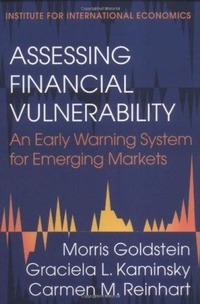
Assessing Financial Vulnerability
Description

The European currency crises of 1992-93, the Mexican crisis of 1994-95, and especially the Asian/global crisis of 1997-98, have all contributed to a heightened interest in the early warning signals of financial crises. This pathbreaking study presents a comprehensive battery of empirical tests on the performance of alternative early warning indicators for emerging-market economies that should prove useful in the construction of a more effective global warning system.
Not only are the authors able to draw conclusions about which specific indicators have sent the most reliable early warning signals of currency and banking crises in emerging economies, they also test the out-of-sample performance of the model during the Asian crisis and find that it does a good job of identifying the most vulnerable economies. In addition, they show how the early warning system can be used to construct a "composite" crisis indicator to weigh the importance of alternative channels of cross-country "contagion" of crises, and to generate information about the recovery path from crises.
This timely study comes on the eve of impending changes at the International Monetary Fund as that institution reexamines how it reacts to financial crises. Moreover, the study provides "... a wealth of valuable elements for anyone investigating and forecasting adverse developments in emerging markets as well as industrial countries," according to Ewoud Schuitemaker, vice president of the economics department at ABN AMRO Bank.
More details
Other editions
Additional editions
Persons
Morris Goldstein, nonresident senior fellow, has held several senior staff positions at the International Monetary Fund (1970-94), including Deputy Director of its Research Department (1987-94). From 1994 to 2010, he held the Dennis Weatherstone Senior Fellow position at the Peterson Institute. He has written extensively on international economic policy and on international capital markets.
Carmen M. Reinhart was the Dennis Weatherstone Senior Fellow at the Peterson Institute for International Economics. She was previously professor of economics at the University of Maryland.
Graciela L. Kaminsky is professor of Economics and International Affairs at George Washington University and Research Associate at the National Bureau of Economic Research. She previously held positions as assistant professor at the University of California, San Diego and staff economist at the Board of Governors of the Federal Reserve System. She has been a Visiting Scholar at numerous government organizations, including the Bank of Japan, the Bank of Spain, the Federal Reserve Bank of New York, the Hong Kong Monetary, and the Monetary Authority of Singapore.
Content
- Cover
- Contents
- Preface
- Acknowledgments
- Ch 1 Introduction
- Organization of the Book
- Ch 2 Methodology
- General Guidelines
- Putting the Signals Approach to Work
- Ch 3 Empirical Results
- The Monthly Indicators: Robustness Check
- The Annual Indicators: What Works?
- Do the Indicators Flash Early Enough?
- Microeconomic Indicators: Selective Evidence
- Ch 4 Rating the Rating Agencies and the Markets
- Do Sovereign Credit Ratings Predict Crises?
- Why Do Credit Ratings Fail to Anticipate Crises?
- Do Financial Markets Anticipate Crises?
- Ch 5 An Assessment of Vulnerability: Out-of-Sample Results
- Vulnerability and Signals
- A Composite Indicator and Crises Probabilities
- Ch 6 Contagion
- Defining Contagion
- Theories of Contagion and Their Implications
- Empirical Studies
- Trade and Financial Clusters and a Composite Contagion Index
- What the Composite Contagion Vulnerability Index Reveals about Three Recent Crisis Episodes
- Ch 7 The Aftermath of Crises
- The Recovery Process
- Some Caveats
- Ch 8 Summary of Results and Concluding Remarks
- Summary of Findings
- Would the Publication of the Indicators Erode Their Early Warning Role?
- Do the Better Performing Indicators Carry Policy Implications?
- Appendix Data and Definitions
- References
- Index
