

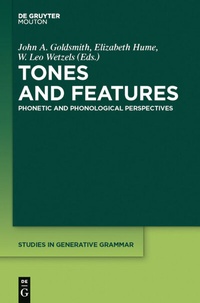
Tones and Features
Phonetic and Phonological Perspectives
1st Edition
Published on 28. October 2011
XII, 369 pages
978-3-11-024622-3 (ISBN)
Description

This volume includes papers by leading figures in phonetics and phonology on two topics central to phonological theory: tones and phonological features. Papers address a wide range of topics bearing on tones and features including their formal representation and phonetic foundation.
Reviews / Votes
"The book provides useful insights into phonetic and phonological perspectives of language research, including the basics of data collection, methods of recording, and selecting equipment. [...] The collection is a valuable tool of individual resources for anyone interested in an in-depth study of various phonetic and phonological theories, along with their assumptions and interpretation. The exhaustive treatment of the underlying forms of features with special reference to certain African languages, both in terms of tones and features, makes the book an important contribution to the field of phonology."Seetha Jayaraman in: Linguist List 23.2378More details
Series
Language
English
Place of publication
Berlin/Boston
Germany
Publishing group
de Gruyter Mouton
Target group
Professional and scholarly
US School Grade: College Graduate Student
Illustrations
Num. figs.
Num. figs.
File size
24,43 MB
ISBN-13
978-3-11-024622-3 (9783110246223)
Schweitzer Classification
Other editions
Additional editions
John A. Goldsmith | Elizabeth Hume | Leo Wetzels
Tones and Features
Phonetic and Phonological Perspectives
Book
10/2011
1st Edition
De Gruyter Mouton
€189.95
Shipment within 7-9 days
Persons
John A. Goldsmith, University of Chicago, USA; Elisabeth Hume, Ohio State University, Columbus, USA; Leo Wetzels, Vrije Universiteit Amsterdam, The Netherlands and Centre National de la Recherche Scientifique, Paris, France.
Content
1 - Preface [Seite 7]
2 - 1. The representation and nature of tone [Seite 13]
2.1 - Do we need tone features? [Seite 15]
2.2 - Rhythm, quantity and tone in the Kinyarwanda verb [Seite 37]
2.3 - Do tones have features? [Seite 62]
2.4 - Features impinging on tone [Seite 93]
2.5 - Downstep and linguistic scaling in Dagara-Wulé [Seite 120]
3 - 2. The representation and nature of phonological features [Seite 147]
3.1 - Crossing the quantal boundaries of features: Subglottal resonances and Swabian diphthongs [Seite 149]
3.2 - Voice assimilation in French obstruents: Categorical or gradient? [Seite 161]
3.3 - An acoustic study of the Korean fricatives /s, s'/: implications for the features [spread glottis] and [tense] [Seite 188]
3.4 - Autosegmental spreading in Optimality Theory [Seite 207]
3.5 - Evaluating the effectiveness of Unified Feature Theory and three other feature systems [Seite 235]
3.6 - Language-independent bases of distinctive features [Seite 276]
3.7 - Representation of complex segments in Bulgarian [Seite 304]
3.8 - Proposals for a representation of sounds based on their main acoustico-perceptual properties [Seite 318]
3.9 - The representation of vowel features and vowel neutralization in Brazilian Portuguese (southern dialects) [Seite 343]
4 - Index [Seite 373]
2 - 1. The representation and nature of tone [Seite 13]
2.1 - Do we need tone features? [Seite 15]
2.2 - Rhythm, quantity and tone in the Kinyarwanda verb [Seite 37]
2.3 - Do tones have features? [Seite 62]
2.4 - Features impinging on tone [Seite 93]
2.5 - Downstep and linguistic scaling in Dagara-Wulé [Seite 120]
3 - 2. The representation and nature of phonological features [Seite 147]
3.1 - Crossing the quantal boundaries of features: Subglottal resonances and Swabian diphthongs [Seite 149]
3.2 - Voice assimilation in French obstruents: Categorical or gradient? [Seite 161]
3.3 - An acoustic study of the Korean fricatives /s, s'/: implications for the features [spread glottis] and [tense] [Seite 188]
3.4 - Autosegmental spreading in Optimality Theory [Seite 207]
3.5 - Evaluating the effectiveness of Unified Feature Theory and three other feature systems [Seite 235]
3.6 - Language-independent bases of distinctive features [Seite 276]
3.7 - Representation of complex segments in Bulgarian [Seite 304]
3.8 - Proposals for a representation of sounds based on their main acoustico-perceptual properties [Seite 318]
3.9 - The representation of vowel features and vowel neutralization in Brazilian Portuguese (southern dialects) [Seite 343]
4 - Index [Seite 373]
