

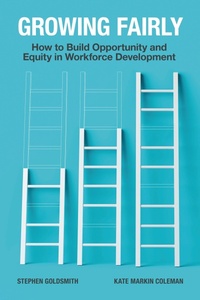
Growing Fairly
How to Build Opportunity and Equity in Workforce Development
1st Edition
Published on 22. February 2022
280 pages
978-0-8157-4163-3 (ISBN)
Description

Tested, practical ideas to meet current and future skilling needs of both workers and employers
The labor market in the United States faces seemingly contradictory challenges: Many employers have trouble finding qualified applicants for current and future jobs, while millions of Americans are out of work or are underemployed-their paths to living-wage jobs blocked by systemic barriers or lack of adequate skills.
Growing Fairly offers workforce development reforms that meet the needs of both workers and employers. Based on the experiences of hundreds of leaders and workers, the authors set out ten principles for designing a more effective and equitable system that helps workers obtain the skills necessary for economic mobility.
The principles outlined in the book argue for a more comprehensive view of the skilling needs of current and prospective workers. They spell out the attributes of effective programs and make the case for skill-based hiring, widely distributed performance data, and collaboration. The book emphasizes the importance of local action to overcome the structural barriers that challenge even the most determined would-be learners. Growing Fairly shows cross sector leaders how to work across organizational boundaries to change the trajectory of individuals struggling to make a living wage.
This is not a book of untested theories. Instead, it is written by practitioners for practitioners. Much of it is told through the voices of those who run programs and people who have taken advantage of them. While the issues the book addresses are profound, its take on the subject is optimistic.
Between them, the authors have spent decades searching out and supporting effective practices. Even more critically, they have learned how to knit competing agencies and organizations into cohesive systems with coordinated missions. Their practical ideas will benefit a wide range of readers, from practitioners in the field to students and scholars of the American labor system.
The labor market in the United States faces seemingly contradictory challenges: Many employers have trouble finding qualified applicants for current and future jobs, while millions of Americans are out of work or are underemployed-their paths to living-wage jobs blocked by systemic barriers or lack of adequate skills.
Growing Fairly offers workforce development reforms that meet the needs of both workers and employers. Based on the experiences of hundreds of leaders and workers, the authors set out ten principles for designing a more effective and equitable system that helps workers obtain the skills necessary for economic mobility.
The principles outlined in the book argue for a more comprehensive view of the skilling needs of current and prospective workers. They spell out the attributes of effective programs and make the case for skill-based hiring, widely distributed performance data, and collaboration. The book emphasizes the importance of local action to overcome the structural barriers that challenge even the most determined would-be learners. Growing Fairly shows cross sector leaders how to work across organizational boundaries to change the trajectory of individuals struggling to make a living wage.
This is not a book of untested theories. Instead, it is written by practitioners for practitioners. Much of it is told through the voices of those who run programs and people who have taken advantage of them. While the issues the book addresses are profound, its take on the subject is optimistic.
Between them, the authors have spent decades searching out and supporting effective practices. Even more critically, they have learned how to knit competing agencies and organizations into cohesive systems with coordinated missions. Their practical ideas will benefit a wide range of readers, from practitioners in the field to students and scholars of the American labor system.
More details
Series
Edition
1. Auflage
Language
English
Place of publication
United States
Publishing group
Bloomsbury Publishing Plc
Target group
Professional and scholarly
Illustrations
4 tables
ISBN-13
978-0-8157-4163-3 (9780815741633)
Copyright in bibliographic data and cover images is held by Nielsen Book Services Limited or by the publishers or by their respective licensors: all rights reserved.
Schweitzer Classification
Other editions
Additional editions
Stephen Goldsmith | Kate Markin Coleman
Growing Fairly
How to Build Opportunity and Equity in Workforce Development
Book
02/2022
Brookings Institution
€41.60
Shipment within 10-20 days
Persons
Stephen Goldsmith is the Derek Bok Professor of the Practice of Urban Affairs at Harvard's Kennedy School of Government where he directs Data-Smart City Solutions. He previously served as mayor of Indianapolis, deputy mayor of New York City and Chair of the Corporation for National and Community Service.
Kate Markin Coleman is a principal of IAS advising, LLC and former executive vice president, chief strategy and advancement officer of YMCA of the USA. She previously served as executive vice president of the YMCA of Metro Chicago and held leadership positions in fintech and financial services.n Goldsmith is the Derek Bok Professor of the Practice of Urban Affairs at Harvard's Kennedy School of Government where he directs Data-Smart City Solutions. He previously served as mayor of Indianapolis, deputy mayor of New York City and Chair of the Corporation for National and Community Service.
Kate Markin Coleman is a principal of IAS advising, LLC and former executive vice president, chief strategy and advancement officer of YMCA of the USA. She previously served as executive vice president of the YMCA of Metro Chicago and held leadership positions in fintech and financial services.
Kate Markin Coleman is a principal of IAS advising, LLC and former executive vice president, chief strategy and advancement officer of YMCA of the USA. She previously served as executive vice president of the YMCA of Metro Chicago and held leadership positions in fintech and financial services.n Goldsmith is the Derek Bok Professor of the Practice of Urban Affairs at Harvard's Kennedy School of Government where he directs Data-Smart City Solutions. He previously served as mayor of Indianapolis, deputy mayor of New York City and Chair of the Corporation for National and Community Service.
Kate Markin Coleman is a principal of IAS advising, LLC and former executive vice president, chief strategy and advancement officer of YMCA of the USA. She previously served as executive vice president of the YMCA of Metro Chicago and held leadership positions in fintech and financial services.
Content
Contents:
Foreword: Mayor Keisha Lance Bottoms and Dr. Michael Lomax
Acknowledgments
1. Introduction
2. Start with People, Offer Meaningful Choices
3. Listen, Respond, Get Personal
4. Support Learners, Remove Barriers
5. Contextualize Learning
6. Bridge to Employment
7. Use Skills as Currency
8. Commit to Transparency
9. Make Places Work
10. Organize for Collaboration
11. The Houston Story: Putting It All Together
Notes
Index
Foreword: Mayor Keisha Lance Bottoms and Dr. Michael Lomax
Acknowledgments
1. Introduction
2. Start with People, Offer Meaningful Choices
3. Listen, Respond, Get Personal
4. Support Learners, Remove Barriers
5. Contextualize Learning
6. Bridge to Employment
7. Use Skills as Currency
8. Commit to Transparency
9. Make Places Work
10. Organize for Collaboration
11. The Houston Story: Putting It All Together
Notes
Index
