

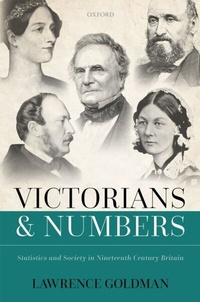
Victorians and Numbers
Statistics and Society in Nineteenth Century Britain
1st Edition
Published on 3. February 2022
240 pages
978-0-19-266340-5 (ISBN)
Description

A defining feature of nineteenth-century Britain was its fascination with statistics. The processes that made Victorian society, including the growth of population, the development of industry and commerce, and the increasing competence of the state, generated profuse numerical data. This is a study of how such data influenced every aspect of Victorian culture and thought, from the methods of natural science and the struggle against disease, to the development of social administration and the arguments and conflicts between social classes. Numbers were collected in the 1830s by newly-created statistical societies in response to this 'data revolution'. They became a regular aspect of governmental procedure thereafter, and inspired new ways of interrogating both the natural and social worlds. William Farr used them to study cholera; Florence Nightingale deployed them in campaigns for sanitary improvement; Charles Babbage was inspired to design and build his famous calculating engines to process them. The mid-Victorians employed statistics consistently to make the case for liberal reform. In later decades, however, the emergence of the academic discipline of mathematical statistics - statistics as we use them today - became associated with eugenics and a contrary social philosophy. Where earlier statisticians emphasised the unity of mankind, some later practitioners, following Francis Galton, studied variation and difference within and between groups. In chapters on learned societies, government departments, international statistical collaborations, and different Victorian statisticians, Victorians and Numbers traces the impact of numbers on the era and the intriguing relationship of Victorian statistics with 'Big Data' in our own age.
More details
Other editions
Additional editions
Book
02/2022
Oxford University Press
€69.00
Shipment within 15-20 days
Person
Lawrence Goldman was born in London and educated at Cambridge and Yale. Following a Junior Research Fellowship at Trinity College, Cambridge, he taught British and American History for three decades in Oxford, where he was a fellow of St. Peter's College, and Editor of the Oxford Dictionary of National Biography 2004-2014. Latterly he was Director of the Institute of Historical Research, University of London. His publications include books on Victorian social science and the history of workers' education, and a biography of the historian and political thinker R. H. Tawney. He is now Emeritus Fellow of St. Peter's College, Oxford.
Content
- Introduction: Victorians and Numbers
- Prologue: Statistics at the Zenith: The International Statistical Congress, London 1860
- Part I: Political Arithmetic and Statistics 1660-1840
- 1: Before the Victorians
- Part II: The Origins of the Statistical Movement 1825-1835
- 2: Cambridge and London: The Cambridge Network and the Statistical Society of London
- 3: Manchester: The Manchester Statistical Society: Industry, Sectarianism and Reform
- 4: Clerkenwell: The London Statistical Society and Artisan Statisticians, 1825-30
- Part III: Intellectual Influences
- 5: Charles Babbage and Ada Lovelace: Statistics and Computing
- 6: Richard Jones and William Whewell: Statistics, Induction, and Political Economy
- 7: Adolphe Quetelet: Social Physics, Determinism, and 'The Average Man'
- 8: Alexander von Humboldt: Humboldtian Science, Natural Theology, and the Unity of Nature
- 9: The Opposition to Numbers: Disraeli, Dickens, Ruskin, and Carlyle
- Part IV: Statistics at Mid-Century
- 10: Mapping and Defining British Statistics
- 11: Buckle's Fatal History: Making Statistics Popular
- 12: Statistics and Medicine
- Part V: Liberal Decline and Reinvention
- 13: The International Statistical Congress 1851-78: Conservative Nationalism versus Liberal Internationalism
- 14: The End of the Statistical Movement: Francis Galton, Variation and Eugenics
- 15: Social Statistics in the 1880s: The Industrial Remuneration Conference, London 1885
- 16: Conclusion: From Statistics to Big Data 1822-2022
