

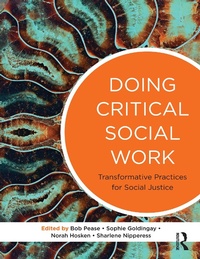
Doing Critical Social Work
Transformative Practices for Social Justice
1st Edition
Published on 25. July 2020
384 pages
978-1-000-24926-2 (ISBN)
Description

Critical social work encourages emancipatory personal and social change. This text focuses on the challenge of incorporating critical theory into the practice of social workers and provides case studies and insights from a range of fields to illustrate how to work with tensions and challenges.
Beginning with an outline of the theoretical basis of critical social work and its different perspectives, the authors go on to introduce key features of working in this tradition including critical reflection. Part II explores critical practices in confronting privilege and promoting social justice in social work, examining such issues as human rights, gender, poverty and class. Part III considers the development of critical practices within the organisational context of social work including the fields of mental health, child and family services, within Centrelink and prison settings. Part IV is focused on doing anti- discriminatory and anti-oppressive practice in social work with particular populations including asylum seekers, Aboriginal and Torres Strait Islander peoples, domestic violence survivors, older people and lesbian, gay and transgender groups. Finally, Part V outlines collectivist and transformative practices in social work and beyond, looking at environmental issues, social activism, the disability movement and globalisation.
'A highly valuable addition to social work education and practice literature in Australia and beyond its shores.' Ruth Phillips, Associate Professor, Faculty of Education and Social Work, University of Sydney
Beginning with an outline of the theoretical basis of critical social work and its different perspectives, the authors go on to introduce key features of working in this tradition including critical reflection. Part II explores critical practices in confronting privilege and promoting social justice in social work, examining such issues as human rights, gender, poverty and class. Part III considers the development of critical practices within the organisational context of social work including the fields of mental health, child and family services, within Centrelink and prison settings. Part IV is focused on doing anti- discriminatory and anti-oppressive practice in social work with particular populations including asylum seekers, Aboriginal and Torres Strait Islander peoples, domestic violence survivors, older people and lesbian, gay and transgender groups. Finally, Part V outlines collectivist and transformative practices in social work and beyond, looking at environmental issues, social activism, the disability movement and globalisation.
'A highly valuable addition to social work education and practice literature in Australia and beyond its shores.' Ruth Phillips, Associate Professor, Faculty of Education and Social Work, University of Sydney
More details
Edition
1. Auflage
Language
English
Place of publication
London
United Kingdom
Publishing group
Taylor & Francis Ltd
Target group
College/higher education
ISBN-13
978-1-000-24926-2 (9781000249262)
Copyright in bibliographic data and cover images is held by Nielsen Book Services Limited or by the publishers or by their respective licensors: all rights reserved.
Schweitzer Classification
Other editions
Additional editions
Book
03/2021
1st Edition
Routledge
€191.88
Shipment within 15-20 days
Book
06/2016
1st Edition
Allen & Unwin
€57.00
Shipment within 3-4 weeks
Person
BOB PEASE is Professor of Social Work at the University of Tasmania. SOPHIE GOLDINGAY is a senior lecturer in the School of Health and Social Development at Deakin University. NORAH HOSKEN is a senior lecturer in the School of Health and Social Development at Deakin University. SHARLENE NIPPERESS is a lecturer in Social Work at RMIT University.
Content
Contents
Foreword Donna Baines
List of contributors
Acknowledgments of contributors
Part I Addressing the Tensions in Critical Social Work
1 Doing critical social work in the neoliberal context: Working on the contradictions Bob Pease and Sharlene Nipperess
2 Critical reflection and critical social work Christine Morley
3 Towards critical social work supervision Carolyn Noble
4 Making sense of different theoretically informed approaches in doing critical social work Norah Hosken and Sophie Goldingay
Part II Critical Practices in Confronting Privilege and Promoting Social Justice
5 Towards a critical human rights-based approach to social work practice Sharlene Nipperess
6 Interrogating privilege and complicity in the oppression of others Bob Pease
7 Social work, class and the structural violence of poverty Norah Hosken
Part III Developing Critical Practices within the Organisational Context of Social Work
8 Beyond the dominant approach to mental health practice Noel Renouf
9 Embedding critical social work in child protection practice Robyn Miller
10 Critical social work in Centrelink: an oxymoron or an opportunity? Peter Humphries
11 Building relationships and effecting change: critical social work practice in prison settingsSophie Goldingay
12 Professional practice standards and critical practices: addressing the tensions in social work field education settings Norah Hosken, Lesley Ervin and Jody Laughton
Part IV Doing Anti-discriminatory and Anti-oppressive Practice in Social Work
13 Anti-oppressive practice with people seeking asylum in Australia: reflections from the field Sharlene Nipperess and Sherrine Clark
14 Challenges for Indigenous and non-Indigenous practitioners in the neoliberal context Stephanie Gilbert
15 Feminism under siege: critical reflections on the impact of neoliberalism and managerialism on feminist practice Ann Carrington
16 Developing anti-ageist practice in social work Tina Kosteciki
17 Working for equality and difference: (de)constructing heteronormativity Jude Irwin
Part V Towards Collectivist and Transformative Practices in Social Work
18 Environmental social work as critical, decolonising practice Mel Gray and John Coates
19 Taking it to the streets: critical social work's relationship with activism Jessica Morrison
20 Social work, disability and social change: a critical participatory approach Russell Shuttleworth
21 The structural, the post-structural and the commons: new practices for creating change in a complex world Jose Ramos
22 Education for critical social work: being true to a worthy project Selma Macfarlane
Foreword Donna Baines
List of contributors
Acknowledgments of contributors
Part I Addressing the Tensions in Critical Social Work
1 Doing critical social work in the neoliberal context: Working on the contradictions Bob Pease and Sharlene Nipperess
2 Critical reflection and critical social work Christine Morley
3 Towards critical social work supervision Carolyn Noble
4 Making sense of different theoretically informed approaches in doing critical social work Norah Hosken and Sophie Goldingay
Part II Critical Practices in Confronting Privilege and Promoting Social Justice
5 Towards a critical human rights-based approach to social work practice Sharlene Nipperess
6 Interrogating privilege and complicity in the oppression of others Bob Pease
7 Social work, class and the structural violence of poverty Norah Hosken
Part III Developing Critical Practices within the Organisational Context of Social Work
8 Beyond the dominant approach to mental health practice Noel Renouf
9 Embedding critical social work in child protection practice Robyn Miller
10 Critical social work in Centrelink: an oxymoron or an opportunity? Peter Humphries
11 Building relationships and effecting change: critical social work practice in prison settingsSophie Goldingay
12 Professional practice standards and critical practices: addressing the tensions in social work field education settings Norah Hosken, Lesley Ervin and Jody Laughton
Part IV Doing Anti-discriminatory and Anti-oppressive Practice in Social Work
13 Anti-oppressive practice with people seeking asylum in Australia: reflections from the field Sharlene Nipperess and Sherrine Clark
14 Challenges for Indigenous and non-Indigenous practitioners in the neoliberal context Stephanie Gilbert
15 Feminism under siege: critical reflections on the impact of neoliberalism and managerialism on feminist practice Ann Carrington
16 Developing anti-ageist practice in social work Tina Kosteciki
17 Working for equality and difference: (de)constructing heteronormativity Jude Irwin
Part V Towards Collectivist and Transformative Practices in Social Work
18 Environmental social work as critical, decolonising practice Mel Gray and John Coates
19 Taking it to the streets: critical social work's relationship with activism Jessica Morrison
20 Social work, disability and social change: a critical participatory approach Russell Shuttleworth
21 The structural, the post-structural and the commons: new practices for creating change in a complex world Jose Ramos
22 Education for critical social work: being true to a worthy project Selma Macfarlane
