

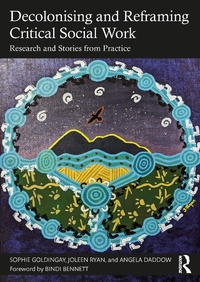
Decolonising and Reframing Critical Social Work
Research and Stories from Practice
1st Edition
Published on 21. October 2024
122 pages
978-1-040-15178-5 (ISBN)
Description

This book problematises and then reshapes critical social work to bring a range of perspectives to what constitutes truly effective and ethical social work practice, moving beyond binary oppositions (where two states or concepts are defined as opposite to each other) to create new words and concepts to be inclusive of a range of identities, practice contexts, and groups or communities of service users.
Currently, critical social work, derived from sociological critical theories proliferated in the 1960s, enjoys dominance as the theory that encompasses the ethical principles of social work in Australia. While on the surface critical social work appears to align with the Australian Association of Social Workers' (AASW) ethical principles of social justice, professional integrity, and respect for persons, practitioners, and students alike find enacting it can be problematic in complex practice situations.
Reporting original research of cases from the field, the book focuses on the impact of intersectionality and shows new ways to address the nuance of othering and modern-day colonialism.
It will be of interest to researchers, practitioners, and students who are keen to engage with the latest in the field of critical social work and consider implications of this for the development of their own identity.
Currently, critical social work, derived from sociological critical theories proliferated in the 1960s, enjoys dominance as the theory that encompasses the ethical principles of social work in Australia. While on the surface critical social work appears to align with the Australian Association of Social Workers' (AASW) ethical principles of social justice, professional integrity, and respect for persons, practitioners, and students alike find enacting it can be problematic in complex practice situations.
Reporting original research of cases from the field, the book focuses on the impact of intersectionality and shows new ways to address the nuance of othering and modern-day colonialism.
It will be of interest to researchers, practitioners, and students who are keen to engage with the latest in the field of critical social work and consider implications of this for the development of their own identity.
Reviews / Votes
For social work students, practitioners and scholars, this book presents fresh insights and alternative discourses of practice. Drawing on Indigenous knowledge and perspectives, the authors trace how the colonial foundations of social work have a living legacy, decentring dominant binary categorisations of professional knowledge in the process. They use multiple standpoints and frameworks to story and re-story ways of saying (knowing) and doing social work and being a social worker. Combining an ethos of reciprocity, cultural responsiveness, spirituality, creative scholarship and contemporary practice examples, this original work is expansive in its scope, intent and potential to positively transform the field.Dr Juliana RyanLecturer, Teacher Education and Ethics
La Trobe University
Early in my academic writing I issued an invitation for Indigenous and non-Indigenous peoples to walk together as equals and reject the process of colonisation and challenge the social norms that enable it to continue. Credit to the authors who have made a decisive move to engage with decolonisation in this book.
Each author demonstrated cultural respect by introducing themselves, their identity, heritage, and background to writing this book. The authors encourage readers to do the work to learn from existing scholarship and knowledge holders, noting the need to familiarise themselves with the work of First Nation's Scholars, such as Wanganeen's (2010) work on loss, grief, and trauma.
Significantly the authors make it clear that there is a duty of care for all social workers to tread carefully and respectfully in their practice so they can move beyond socially embedded thinking to consider multiple perspectives before expecting collaboration with First Nations or unfamiliar communities and organisations.
Lorraine Muller (PhD x2) is an Adjunct Senior Research Fellow in the College Medicine and Dentistry at James Cook University, Australia. She is Indigenous Australian and her areas of expertise are Indigenous Australian knowledges and practices, and non-Indigenous mainstream Australian culture having extensively studies the values and principles that construct both Indigenous and non-Indigenous Australian cultural identities.
More details
Edition
1. Auflage
Language
English
Place of publication
London
United Kingdom
Publishing group
Taylor & Francis Ltd
Target group
College/higher education
Professional and scholarly
Illustrations
6 Line drawings, black and white; 1 Halftones, black and white; 7 Illustrations, black and white
ISBN-13
978-1-040-15178-5 (9781040151785)
Copyright in bibliographic data and cover images is held by Nielsen Book Services Limited or by the publishers or by their respective licensors: all rights reserved.
Schweitzer Classification
Other editions
Additional editions

Book
11/2024
Taylor & Francis
Unfortunately, price unknown
Available (delivery time upon request)
Sophie Goldingay | Joleen Ryan | Angela Daddow
Decolonising and Reframing Critical Social Work
Research and Stories from Practice
Book
10/2024
1st Edition
Routledge
€54.50
Shipment within 10-20 days
Sophie Goldingay | Joleen Ryan | Angela Daddow
Decolonising and Reframing Critical Social Work
Research and Stories from Practice
Book
10/2024
1st Edition
Routledge
€204.40
Shipment within 10-20 days
Persons
Sophie Goldingay (PhD) is Associate Professor and Course Director of the Bachelor of Social Work at Deakin University, Geelong, Australia.
Joleen Ryan (BSW) is an academic currently teaching social work at the National Indigenous Knowledges, Education, Research, Innovation Institute at Deakin University.
Angela Daddow (EdD) is a senior sessional academic at Deakin University and Senior Fellow of the Higher Education Academy.
Joleen Ryan (BSW) is an academic currently teaching social work at the National Indigenous Knowledges, Education, Research, Innovation Institute at Deakin University.
Angela Daddow (EdD) is a senior sessional academic at Deakin University and Senior Fellow of the Higher Education Academy.
Content
Section One - Revisiting Critical Social Work. 1.From 'radical' to 'dominant' in Australian academia: The context and history of current acceptance of theories in social work. 2.Benefits and consequences of the dominance of modernist critical social work approaches. Section Two - Rethinking Critical Social Work Practice. 3.Positioning Indigenous perspectives alongside critical social work. 4.Intersectionality: A multifaceted approach with critical social work. Section Three - Reframing Critical Social Work Practice. 5.Stories of practice. 6.Multiple perspectives and polychotomies. Section Four - Decolonising and Restorying Practice. 7.Decolonising and restorying practice: A reframed approach to critical social work.
