

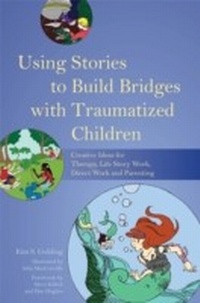
Using Stories to Build Bridges with Traumatized Children
Creative Ideas for Therapy, Life Story Work, Direct Work and Parenting
Published on 21. July 2014
176 pages
978-0-85700-961-6 (ISBN)
Description

Using Stories to Build Bridges with Traumatized Children is full of creative ideas for how you can use stories therapeutically with children in counselling, life story work or direct work.
Psychologist Kim S. Golding shows how you can use stories to build connections with children aged 4-16 and support their recovery from trauma and stress. She illustrates the techniques with 21 stories adapted from her own clinical work with children and families, and explains how you can expand or adapt them to make them more relevant for a particular child. Advice and stories are arranged into sections dealing with common psychological issues, including looking back and moving on, lack of trust and need for attention. Golding also gives invaluable tips for planning stories and life story work, and for storymaking with children. She also describes how stories can be used therapeutically with parents of traumatized children and as a tool for self-reflection by counsellors.
Imaginative and practical, this book will be enormously useful for counsellors, psychologists, therapists and social workers working with traumatized children, and will also be helpful for parents and carers involved in therapeutic parenting.
Psychologist Kim S. Golding shows how you can use stories to build connections with children aged 4-16 and support their recovery from trauma and stress. She illustrates the techniques with 21 stories adapted from her own clinical work with children and families, and explains how you can expand or adapt them to make them more relevant for a particular child. Advice and stories are arranged into sections dealing with common psychological issues, including looking back and moving on, lack of trust and need for attention. Golding also gives invaluable tips for planning stories and life story work, and for storymaking with children. She also describes how stories can be used therapeutically with parents of traumatized children and as a tool for self-reflection by counsellors.
Imaginative and practical, this book will be enormously useful for counsellors, psychologists, therapists and social workers working with traumatized children, and will also be helpful for parents and carers involved in therapeutic parenting.
Reviews / Votes
The stories in this book, created from both the realities of children's lives and a liberating imagination, show how storymaking and storytelling can help children understand themselves better and see themselves differently. It illustrates, as stories clearly can, the almost magical power of storytelling to transform and heal. Kim tells us her process of developing stories and then shows us the stories allowing us to see how powerful they are. When I first read them I thought of many children I've worked with and felt closer to them, that I understood them better and, in turn, become more curious about their experience. Kim shows us what we can do when we start thinking about the children we work with using imagination and creativity. -- Dr Steve Killick, Clinical Psychologist, Cardiff University, and Storyteller This book provides a cogent model for understanding the applications of stories to therapy and counselling as well as articulate advice about developing therapeutic, solution-based, and personalized stories to enhance trauma recovery. It is a book that I will return to on a regular basis and a "must-have" volume for counsellors, social workers, psychologists, creative arts therapists and trauma specialists. -- Cathy Malchiodi, PhD, LPCC, LPAT, ATR-BC, REAT, Trauma-Informed Practices and Expressive Arts Therapy Institute and President, Art Therapy Without Borders Kim Golding is truly both an excellent psychologist, teacher, and writer while at the same time being a wonderful story creator. This is a work to read deeply and to keep nearby as we use stories to help children, their families, and ourselves to make sense of our life long journeys. -- From the foreword by Dan Hughes, psychologist and founder of Dyadic Developmental Psychotherapy, author of Attachment-Focused Family Therapy Workbook Practitioners will easily identify themes in Golding's stories that will have resonance for many of the children and families they work with. This book may also inspire some to "have a go" at writing their own therapeutic stories, and the structure suggested and underlying principles are equally relevant to compiling life story books for children. -- Joy Rees, adoption adviser for a London borough, independent social work consultant and trainer, author of Life Story Books for Adopted ChildrenMore details
Edition
Digital original
Language
English
Place of publication
London
United Kingdom
Target group
College/higher education
Professional and scholarly
Edition type
Digital original
ISBN-13
978-0-85700-961-6 (9780857009616)
Copyright in bibliographic data and cover images is held by Nielsen Book Services Limited or by the publishers or by their respective licensors: all rights reserved.
Schweitzer Classification
Other editions
Additional editions
Kim S. Golding
Using Stories to Build Bridges with Traumatized Children
Creative Ideas for Therapy, Life Story Work, Direct Work and Parenting
Book
07/2014
Jessica Kingsley Publishers
€29.00
Shipment within 15-20 days
Persons
Kim S. Golding CBE, BSc, MSc, D. Clin. Psy. AFBPsS is a clinical psychologist who works in Worcestershire, England where she was influential in the founding of the Integrated Service for Looked After Children - a multi-agency, holistic service providing support for foster, adoptive and residential parents, schools and the range of professionals supporting children growing up in care or in adoptive families. Kim was trained and mentored by Dan Hughes in the use of Dyadic Developmental Psychotherapy (DDP). She is on the board of the Dyadic Developmental Psychotherapy Institute supporting the use of DDP in Europe, USA and Canada. She accredits and trains professionals in the approach in the UK and has been invited to speak about this work internationally.
Content
Foreword. Steve Killick, Clinical Psychologist and Storyteller. Introduction. 1. The Power of Stories for Facilitating Healing for Children and their Families. 2. 'Once upon a time...' Creating Your Own Stories. Section One: Looking Back and Moving On, Life in Stories. 3. Story One: The Caterpillar Who Did not Want to Become a Butterfly. 4. Story Two: Kirsty, the Cuckoo in the Nest. 5. Story Three: The Puppy Who needed healing. Section Two: Coping in Fear and Without Trust. 6. Story Four: Conner the Superhero. 7. Story Five: Millie and Her Mother. 8. Story Six: In the Eye of the Storm. Section Three: I Will Do It By Myself. 9. Story Seven: Born to Care. 10. Story Eight: The Boy with all the Knowledge of the World in His Head. 11. Story Nine: The Mermaid's Song. Section Four: Keep Noticing Me. 12. Story Ten: Melinda and the Golden Balloon. 13. Story Eleven: The Clockmakers and the Cuckoo Clock. 14. Story Twelve: The Space Boy. Section Five: Learning About Relationships. 15. Story Thirteen: Survival of the Fittest. 16. Story Fourteen: A Mummy Finds out how to Look After her Baby. 17. Story Fifteen: Sally Sunshine and the Big Bag of Worries. Section Six: Stories for Parents. 18. Story Sixteen: A Daughter's Tale. 19. Story Seventeen: William and Edward. 20. Story Eighteen: Longing and Belonging. Section Seven: Stories for the Practitioners. 21. Story Nineteen: The Finest Forest in all the Land. 22. Story Twenty: Never You Mind. 23. Story Twenty One: Bridge over Troubled Water. Appendix 1. Planning a Solution Story. Appendix 2. Planning a Therapeutic Story. Appendix 3. Planning a Trauma Story. Appendix 4. Planning a Narrative to Explore Life Story. Appendix 5. Planning an Insight Story. References.
