

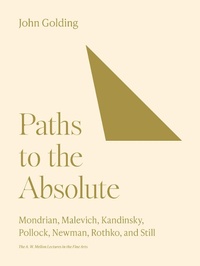
Paths to the Absolute
Mondrian, Malevich, Kandinsky, Pollock, Newman, Rothko, and Still
1st Edition
Published on 12. October 2023
240 pages
978-0-691-25294-0 (ISBN)
Description

A groundbreaking account of the meaning of abstract painting
From Mondrian's bold geometric forms to Kandinsky's use of symbols to Pollock's "dripped paintings," the richly diverse movement of abstract painting challenges anyone trying to make sense of either individual works or the phenomenon as a whole. Applying his insights as an art historian and a painter, John Golding offers a unique approach to understanding the evolution of abstractionism by looking at the personal artistic development of seven of its greatest practitioners. He re-creates the journey undertaken by each painter in his move from representational art to the abstract-a journey that in most cases began with cubism but led variously to symbolism, futurism, surrealism, theosophy, anthropology, Jungian analysis, and beyond. For each artist, spiritual quest and artistic experimentation became inseparable. And despite their different techniques and philosophies, these artists shared one goal: to break a path to a new, ultimate pictorial truth.
The book first explores the works and concerns of three pioneering European abstract painters-Mondrian, Malevich, Kandinsky-and then those of their American successors-Pollock, Newman, Rothko, and Still. Golding shows how each painter sought to see the world and communicate his vision in the purest or most expressive form possible. For example, Mondrian found his way into abstraction through a spiritual response to the landscape of his native Holland, Malevich through his apprehension of the human body, Kandinsky through a blend of religious mysticism and symbolism. Line and color became the focus for many of their creative endeavors. In the 1940s and 50s, the Americans raised the level of pictorial innovation, beginning most notably with Pollock and his Jung-inspired concept of action.
Golding makes a powerful case that at its best and most profound, abstract painting is heavily imbued with meaning and content. Through a blend of biography, art analysis, and cultural history, Paths to the Absolute offers remarkable insights into how a sense of purpose is achieved in painting, and how abstractionism engaged with the intellectual currents of its time.
Please note: All images in this ebook are presented in black and white and have been reduced in size.
From Mondrian's bold geometric forms to Kandinsky's use of symbols to Pollock's "dripped paintings," the richly diverse movement of abstract painting challenges anyone trying to make sense of either individual works or the phenomenon as a whole. Applying his insights as an art historian and a painter, John Golding offers a unique approach to understanding the evolution of abstractionism by looking at the personal artistic development of seven of its greatest practitioners. He re-creates the journey undertaken by each painter in his move from representational art to the abstract-a journey that in most cases began with cubism but led variously to symbolism, futurism, surrealism, theosophy, anthropology, Jungian analysis, and beyond. For each artist, spiritual quest and artistic experimentation became inseparable. And despite their different techniques and philosophies, these artists shared one goal: to break a path to a new, ultimate pictorial truth.
The book first explores the works and concerns of three pioneering European abstract painters-Mondrian, Malevich, Kandinsky-and then those of their American successors-Pollock, Newman, Rothko, and Still. Golding shows how each painter sought to see the world and communicate his vision in the purest or most expressive form possible. For example, Mondrian found his way into abstraction through a spiritual response to the landscape of his native Holland, Malevich through his apprehension of the human body, Kandinsky through a blend of religious mysticism and symbolism. Line and color became the focus for many of their creative endeavors. In the 1940s and 50s, the Americans raised the level of pictorial innovation, beginning most notably with Pollock and his Jung-inspired concept of action.
Golding makes a powerful case that at its best and most profound, abstract painting is heavily imbued with meaning and content. Through a blend of biography, art analysis, and cultural history, Paths to the Absolute offers remarkable insights into how a sense of purpose is achieved in painting, and how abstractionism engaged with the intellectual currents of its time.
Please note: All images in this ebook are presented in black and white and have been reduced in size.
More details
Other editions
Additional editions
Book
10/2000
Princeton University Press
€84.18
Shipment within 10-20 days
Person
John Golding (1929-2012)wasa distinguished art historian, art critic, curator, and painter. He was a lecturer and reader in the history of art at the Courtauld Institute; a senior tutor at the Royal College of Art, London; and Slade Professor of Fine Arts at the University of Cambridge. His history of cubism published in 1959 remains a standard work on the subject. His other books include Braque: The Late Works, Picasso: Sculptor/Painter, and Visions of the Modern.
Content
- Cover
- Half-title
- Title
- Copyright
- Dedication
- Contents
- Preface
- 1. Mondrian and the architecture of the future
- 2. Malevich and the ascent into ether
- 3. Kandinsky and the sound of colour
- 4. Pollock and the search for a symbol
- 5. Newman, Rothko, Still and the reductive image
- 6. Newman, Rothko, Still and the abstract sublime
- Notes on the text
- List of illustrations and sources
- Index
