

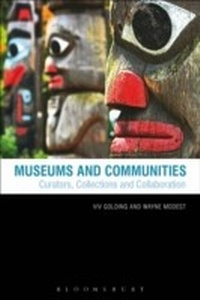
Museums and Communities
Curators, Collections and Collaboration
1st Edition
Published on 1. August 2013
256 pages
978-0-85785-133-8 (ISBN)
Description

This edited volume critically engages with contemporary scholarship on museums and their engagement with the communities they purport to serve and represent. Foregrounding new curatorial strategies, it addresses a significant gap in the available literature, exploring some of the complex issues arising from recent approaches to collaboration between museums and their communities.
The book unpacks taken-for-granted notions such as scholarship, community, participation and collaboration, which can gloss over the complexity of identities and lead to tokenistic claims of inclusion by museums. Over sixteen chapters, well-respected authors from the US, Australia and Europe offer a timely critique to address what happens when museums put community-minded principles into practice, challenging readers to move beyond shallow notions of political correctness that ignore vital difference in this contested field.
Contributors address a wide range of key issues, asking pertinent questions such as how museums negotiate the complexities of integrating collaboration when the target community is a living, fluid, changeable mass of people with their own agendas and agency. When is engagement real as opposed to symbolic, who benefits from and who drives initiatives? What particular challenges and benefits do artist collaborations bring? Recognising the multiple perspectives of community participants is one thing, but how can museums incorporate this successfully into exhibition practice?
Students of museum and cultural studies, practitioners and everyone who cares about museums around the world will find this volume essential reading.
The book unpacks taken-for-granted notions such as scholarship, community, participation and collaboration, which can gloss over the complexity of identities and lead to tokenistic claims of inclusion by museums. Over sixteen chapters, well-respected authors from the US, Australia and Europe offer a timely critique to address what happens when museums put community-minded principles into practice, challenging readers to move beyond shallow notions of political correctness that ignore vital difference in this contested field.
Contributors address a wide range of key issues, asking pertinent questions such as how museums negotiate the complexities of integrating collaboration when the target community is a living, fluid, changeable mass of people with their own agendas and agency. When is engagement real as opposed to symbolic, who benefits from and who drives initiatives? What particular challenges and benefits do artist collaborations bring? Recognising the multiple perspectives of community participants is one thing, but how can museums incorporate this successfully into exhibition practice?
Students of museum and cultural studies, practitioners and everyone who cares about museums around the world will find this volume essential reading.
More details
Edition
1. Auflage
Language
English
Place of publication
London
United Kingdom
Publishing group
Bloomsbury Publishing PLC
Target group
College/higher education
Professional and scholarly
ISBN-13
978-0-85785-133-8 (9780857851338)
Copyright in bibliographic data and cover images is held by Nielsen Book Services Limited or by the publishers or by their respective licensors: all rights reserved.
Schweitzer Classification
Other editions
Additional editions
Book
03/2013
Bloomsbury Academic
€88.09
Article exhausted; check different version
Book
03/2013
Bloomsbury Academic
€36.00
Shipment within 3-4 weeks
Persons
Viv Golding is Director of Research Students and Senior Lecturer in the School of Museum Studies, University of Leicester. Her most recent publication is Learning at the Museum Frontiers: Identity Race and Power and she is currently working on two Arts and Humanities Research Council-funded projects 'Behind the Looking Glass: 'Other' Cultures Within Translating Cultures' and 'Mapping Faith and Place in Leicester', and a Daiwa project 'Museum Literacy'.
Wayne Modest is currently Head of the Curatorial Department at the Tropenmuseum in Amsterdam. Previously he has been Keeper of Anthropology at the Horniman Museum and Director of the Museums of History and Ethnography at the Institute of Jamaica. Recent publications include 'Slavery and the (Symbolic) Politics of Memory in Jamaica: Rethinking the Bicentenary' in Laurajane Smith et al. (ed) Representing Enslavement and Abolition in Museums: Ambiguous Engagements.
Wayne Modest is currently Head of the Curatorial Department at the Tropenmuseum in Amsterdam. Previously he has been Keeper of Anthropology at the Horniman Museum and Director of the Museums of History and Ethnography at the Institute of Jamaica. Recent publications include 'Slavery and the (Symbolic) Politics of Memory in Jamaica: Rethinking the Bicentenary' in Laurajane Smith et al. (ed) Representing Enslavement and Abolition in Museums: Ambiguous Engagements.
Content
List of Illustrations
List of Contributors
Acknowledgements
Introduction - Viv Golding, University of Leicester, UK
Part One: Community Matters?
Collaborative Museums: Curators, Communities, Collections - Viv Golding, University of Leicester, UK
The City, Race, and the Creation of a Common History at the Virginia Historical Society - Eric Gable, University of Mary Washington, USA
Negotiating the Power of Art: Tyree Guyton and Detroit Communities - Bradley L. Taylor, University of Michigan, USA
Learning to Share Knowledge: Collaborative Projects In Taiwan - Marzia Varutti, University of Leicester, UK
Community Engagement, Curatorial Practice and Museum Ethos in Alberta Canada - Bryony Onciul, Newcastle University, UK
Co-Curating with Teenagers at the Horniman Museum - Wayne Modest, Tropenmuseum, the Netherlands
Part Two: Sharing Authority?
Museums, Migrant Communities and Intercultural Dialogue in Italy - Serena Iervolino, University of Leicester, UK
Community Consultation and the Redevelopment of Manchester Museum's Ancient Egypt Galleries - Karen Exell, University College London, Qatar, Doha
'Shared Authority': Collaboration, Curatorial Voice and Exhibition Design in Canberra Australia - Mary Hutchison, Humanities Research Centre, Australian National University, Australia
One Voice to Many Voices?: Displaying Polyvocality in an Art Gallery - Rhiannon Mason, Chris Whitehead, and Helen Graham, Newcastle University, UK
A Question of Trust: Addressing Historical Injustices with Romani-people - Åshild Andrea Brekke, Arts Council, Norway
Part Three: Audiences and Social Justice? Audience Experiences?
Creolising the Museum: Humour, Art and Young Audiences - Viv Golding, University of Leicester, UK
Museums and Civic Engagement: Children Making a Difference - Elizabeth Wood, Indiana University-Purdue University, USA
Community Consultation in the Museum: The 2007 Bicentenary of Britain's Abolition of the Slave Trade - Kalliopi Fouseki, University College London, UK and Laurajane Smith. Australian National University, Australia
Interpreting the Shared Past Within the World Heritage Site of Göreme, Cappadocia Turkey - Elizabeth Carnegie, University of Sheffield, UK and Hazel Tucker, University of Otago, New Zealand
Testimony, Memory and Art at the Jewish Holocaust Museum Melbourne Australia - Andrea Witcomb, Deakin University, Australia
Afterword - A View from the Bridge in Conversation with Susan Pearce - Kirstin James, University of Leicester, UK, Petrina Foti, University of Leicester, UK and the Editors
Index
List of Contributors
Acknowledgements
Introduction - Viv Golding, University of Leicester, UK
Part One: Community Matters?
Collaborative Museums: Curators, Communities, Collections - Viv Golding, University of Leicester, UK
The City, Race, and the Creation of a Common History at the Virginia Historical Society - Eric Gable, University of Mary Washington, USA
Negotiating the Power of Art: Tyree Guyton and Detroit Communities - Bradley L. Taylor, University of Michigan, USA
Learning to Share Knowledge: Collaborative Projects In Taiwan - Marzia Varutti, University of Leicester, UK
Community Engagement, Curatorial Practice and Museum Ethos in Alberta Canada - Bryony Onciul, Newcastle University, UK
Co-Curating with Teenagers at the Horniman Museum - Wayne Modest, Tropenmuseum, the Netherlands
Part Two: Sharing Authority?
Museums, Migrant Communities and Intercultural Dialogue in Italy - Serena Iervolino, University of Leicester, UK
Community Consultation and the Redevelopment of Manchester Museum's Ancient Egypt Galleries - Karen Exell, University College London, Qatar, Doha
'Shared Authority': Collaboration, Curatorial Voice and Exhibition Design in Canberra Australia - Mary Hutchison, Humanities Research Centre, Australian National University, Australia
One Voice to Many Voices?: Displaying Polyvocality in an Art Gallery - Rhiannon Mason, Chris Whitehead, and Helen Graham, Newcastle University, UK
A Question of Trust: Addressing Historical Injustices with Romani-people - Åshild Andrea Brekke, Arts Council, Norway
Part Three: Audiences and Social Justice? Audience Experiences?
Creolising the Museum: Humour, Art and Young Audiences - Viv Golding, University of Leicester, UK
Museums and Civic Engagement: Children Making a Difference - Elizabeth Wood, Indiana University-Purdue University, USA
Community Consultation in the Museum: The 2007 Bicentenary of Britain's Abolition of the Slave Trade - Kalliopi Fouseki, University College London, UK and Laurajane Smith. Australian National University, Australia
Interpreting the Shared Past Within the World Heritage Site of Göreme, Cappadocia Turkey - Elizabeth Carnegie, University of Sheffield, UK and Hazel Tucker, University of Otago, New Zealand
Testimony, Memory and Art at the Jewish Holocaust Museum Melbourne Australia - Andrea Witcomb, Deakin University, Australia
Afterword - A View from the Bridge in Conversation with Susan Pearce - Kirstin James, University of Leicester, UK, Petrina Foti, University of Leicester, UK and the Editors
Index
