

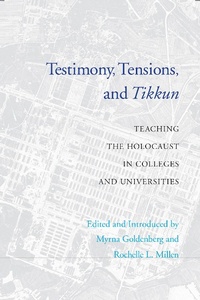
Testimony, Tensions, and Tikkun
Description

The Holocaust was a cataclysmic upheaval in politics, culture, society, ethics, and theology. The very fact of its occurrence has been forcing scholars for more than sixty years to assess its impact on their disciplines. Educators whose work is represented in this volume ask their students to grapple with one of the grand horrors of the twentieth century and to accept the responsibility of building a more just, peaceful world (tikkun olam).
More details
Other editions
Additional editions
Persons
Myrna Goldenberg is professor emerita, Montgomery College, Maryland, founding director of the Paul Peck Humanities Institute at Montgomery, and adjunct professor at the University of Maryland and Johns Hopkins University. Rochelle L. Millen is professor of religion at Wittenberg University, Springfield, Ohio. Other contributors include Beth Hawkins Benedix, Timothy A. Bennett, David R. Blumenthal, Stephen Feinstein, Donald Felipe, Leonard Grob, Marilyn J. Harran, Henry F. Knight, Paul A. Levine, Juergen Manemann, Rachel Rapperport Munn, Tam Parker, David Patterson, Didier Pollefeyt, Amy Shapiro, Stephen D. Smith, Laurinda Stryker, and Mary Todd.
Content
Foreword / Hubert G. Locke
Acknowledgments
Introduction / Myrna Goldenberg and Rochelle L. Millen
Part One: Course Content
1. Use of the Arts in the Classroom: An Unexpected Alternative / Stephen Feinstein
2. History, Memory, and City: Case Study-Berlin / Rachel Rapperport Munn
3. Looking for Words: Teaching the Holocaust in Writing-Intensive Courses / Beth Hawkins
4. Teaching Business Ethics and the Holocaust / Donald Felipe
5. Teaching the Holocaust: The Ethics of "Witness" History / Tam Parker
6. From the Archive to the Classroom: Reflections on Teaching the History of the Holocaust in Different Countries / Paul A. Levine
7. Teaching as Testimony: Pedagogical Peculiarities of Teaching the Holocaust / David Patterson
8. Histories: Betrayed and Unfulfilled / Timothy A. Bennett and Rochelle L. Millen
9. Cross-Disciplinary Notes: Four Questions for Teaching the Shoah / David R. Blumenthal
10. Developing Criteria for Religious and Ethical Teaching of the Holocaust / Didier Pollefeyt
Part Two: The Process and Nature of Student Learning
11. Students' Affective Responses to Studying the Holocaust: Pedagogical Issues and an Interview Process / Amy Shapiro
12. Keeping the Faith: Exploring the Holocaust with Christian Students / Mary Todd
13. Teaching Theology after Auschwitz: A Political-Theological Perspective / Juergen Manemann
Part Three: Progress and Process: Higher Education, Museums, and Memorials
14. The Tensions of Teaching: Truth and Consequences / Laurinda Stryker
15. An Unlikely Setting: Holocaust Education in Orange County / Marilyn J. Harran
16. The Importance of Teaching the Holocaust in Community College: Democratizing the Study of the Holocaust / Myrna Goldenberg
17. Teaching about the Holocaust in the Setting of Museums and Memorials / Stephen D. Smith
18. Dialogue at the Threshold: The Pastora Goldner Symposium and the Work of Tikkun Olam / Leonard Grob and Henry F. Knight
About the Editors and Contributors
Index
