

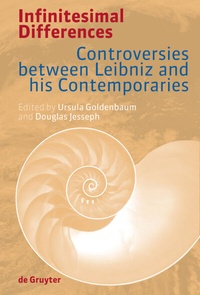
Infinitesimal Differences
Description

The essays offer a unified and comprehensive view of 17th century mathematical and metaphysical disputes over status of infinitesimals, particularly the question whether they were real or mere fictions. Leibniz's development of the calculus and his understanding of its metaphysical foundation are taken as both a point of departure and a frame of reference for the 17th century discussions of infinitesimals, that involved Hobbes, Wallis, Newton, Bernoulli, Hermann, and Nieuwentijt. Although the calculus was undoubtedly successful in mathematical practice, it remained controversial because its procedures seemed to lack an adequate metaphysical or methodological justification. The topic is also of philosophical interest, because Leibniz freely employed the language of infinitesimal quantities in the foundations of his dynamics and theory of forces. Thus, philosophical disputes over the Leibnizian science of bodies naturally involve questions about the nature of infinitesimals. The volume also includes newly discovered Leibnizian marginalia in the mathematical writings of Hobbes.
Reviews / Votes
"As a philosopher, Leibniz thought deeply about the nature of the infinite and the infinitesimal. [...] Infinitesimal Differences makes compulsory reading for anyone interested in how Leibniz defined and manipulated infinitesimals as geometrical, algebraic, and physical magnitudes, and how Leibniz's ideas on infinitesimals were received-and often misunderstood-by his contemporaries, including acolytes of his, such as Johann Bernoulli."Niccolò Guicciardini in: NTM Zeitschrift für Geschichte der Wissenschaften, Technik und Medizin, Band 18/ 2010More details
Other editions
Additional editions
Persons
Content
- Frontmatter
- Table of Contents
- Introduction
- Leery Bedfellows: Newton and Leibniz on the Status of Infinitesimals
- Infinity, Infinitesimals, and the Reform of Cavalieri: John Wallis and his Critics
- Indivisibilia Vera - How Leibniz Came to Love Mathematics
- Indivisibles and Infinitesimals in Early Mathematical Texts of Leibniz
- Archimedes, Infinitesimals and the Law of Continuity: On Leibniz's Fictionalism
- An Enticing (Im)Possibility: Infinitesimals, Differentials, and the Leibnizian Calculus
- Productive Ambiguity in Leibniz's Representation of Infinitesimals
- Generality and Infinitely Small Quantities in Leibniz's Mathematics - The Case of his Arithmetical Quadrature of Conic Sections and Related Curves
- Leibniz's Calculation with Compendia
- Nieuwentijt, Leibniz, and Jacob Hermann on Infinitesimals
- Truth in Fiction: Origins and Consequences of Leibniz's Doctrine of Infinitesimal Magnitudes
- Rule of Continuity and Infinitesimals in Leibniz's Physics
- Leibniz on Infinitesimals and the Reality of Force
- Dead Force, Infinitesimals, and the Mathematicization of Nature
- Backmatter
