

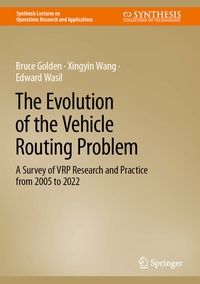
The Evolution of the Vehicle Routing Problem
A Survey of VRP Research and Practice from 2005 to 2022
Published on 1. January 2023
VII, 65 pages
978-3-031-18716-2 (ISBN)
Description

This book presents state-of-the-art research and practice in optimization routing, specifically the vehicle routing problem (VRP). Since its introduction in the late 1950s, the VRP has been a very significant area of research and practice in operations research. Vehicles are used to make deliveries and for pick-ups every day and everywhere. Companies such as Amazon, UPS, FedEx, and DHL use route optimization to reduce mileage, fuel use, number of trucks on the road, and carbon dioxide emissions. The authors compile and analyze 135 survey and review articles on vehicle routing topics published between 2005 and 2022 in an effort to make key observations about publication and trend history, summarize the overall contributions in the field, and identify trends in VRP research and practice. The authors have compiled published research on models, algorithms, and applications for specific areas, including: alternative and multiple objectives; arc routing and general routing; drones, last-mile delivery, and urban distribution; dynamic and stochastic routing; green routing; inventory routing; loading constraints; location-routing; multiple depots; pickup and delivery and dial-a-ride problems; rich and multi-attribute routing; routing over time; shipping; two-echelon, collaborative, and inter-terminal problems; specific variants, benchmark datasets, and software; and exact algorithms and heuristics. In addition, the book discusses how vehicle routing problems are among the most widely studied problems in combinatorial optimization due to the mathematical complexity and practical significance.
More details
Series
Language
English
Place of publication
Cham
Switzerland
Publishing group
Springer International Publishing
Target group
Professional and scholarly
Product notice
Reflowable
Illustrations
VII, 65 p. 2 illus., 1 illus. in color.
File size
0,58 MB
ISBN-13
978-3-031-18716-2 (9783031187162)
DOI
10.1007/978-3-031-18716-2
Schweitzer Classification
Other editions
Additional editions
Bruce Golden | Xingyin Wang | Edward Wasil
The Evolution of the Vehicle Routing Problem
A Survey of VRP Research and Practice from 2005 to 2022
Book
01/2023
Springer
€29.95
Shipment within 15-20 days
Persons
Bruce Golden, Ph.D., is the France-Merrick Chair in Management Science in the Robert H. Smith School of Business at the University of Maryland. His research interests include vehicle routing, logistics, combinatorial optimization, and networks. Over the past 47 years, Professor Golden has made numerous and substantial contributions to the field of vehicle routing and logistics. In recognition of this, he was selected as the second Verolog Fellow and he received the 2019 Robert Herman Lifetime Achievement Award in Transportation Science. In parallel with his academic contributions to the field of vehicle routing, he founded a company with several colleagues in 1980 in order to implement the latest advances in vehicle routing and business logistics. By the late 1980s, this company (RouteSmart Technologies, Inc.) specialized in the design and licensing of vehicle routing software. Bruce and his partners successfully grew the company and sold it in late 1998. The surviving company continues to thrive. Today, RouteSmart is the dominant routing solution in the Postal/Parcel, Utilities, Public Works, and Newspaper markets in the U.S., where routes can range from a couple of hundred to thousands of stops.
Xingyin Wang, PhD. is a Lead Data Scientist at Workforce Optimizer, a company that specializes in software solutions to workforce scheduling problems. His research interests are in labor demand forecasting and AI methods for scheduling. He obtained his Ph.D. in Applied Mathematics from the University of Maryland, College Park in 2016 and B.Sc. (Honors) in Quantitative Finance from the National University of Singapore in 2011. His Ph.D. thesis focused on vehicle routing problems that minimize the makespan. Prior to joining industry, Dr. Wang had been working at the Singapore University of Technology and Design where he applied both exact and heuristic approaches to solve problems in vehicle routing and aviation. He has published over 10 research articles in scientific journals and co-authored three book chapters. In 2014, his team was among the finalists of the VeRoLog (Vehicle Routing and Logistics) Challenge. In 2017, his paper "The Vehicle Routing Problem with Drones: Several Worst-case Results" received an Honorable Mention in the Optimization Letters Best Paper Award Competition.
Edward Wasil, Ph.D., holds the UPS Professorship in the Kogod School of Business at American University. He conducts research in the areas of network optimization and applications of decision-aiding methods. He has published more than 100 technical articles in a wide variety of academic outlets including Operations Research , Production and Operations Management, Manufacturing & Service Operations Management , and the INFORMS Journal on Computing . Dr. Wasil received the INFORMS Computing Society Prize for research excellence in the interface between operations research and computer science (awarded with four co-authors) in 2005. From 1992 to 2013, he was the Feature Article Editor of the INFORMS Journal on Computing .
Xingyin Wang, PhD. is a Lead Data Scientist at Workforce Optimizer, a company that specializes in software solutions to workforce scheduling problems. His research interests are in labor demand forecasting and AI methods for scheduling. He obtained his Ph.D. in Applied Mathematics from the University of Maryland, College Park in 2016 and B.Sc. (Honors) in Quantitative Finance from the National University of Singapore in 2011. His Ph.D. thesis focused on vehicle routing problems that minimize the makespan. Prior to joining industry, Dr. Wang had been working at the Singapore University of Technology and Design where he applied both exact and heuristic approaches to solve problems in vehicle routing and aviation. He has published over 10 research articles in scientific journals and co-authored three book chapters. In 2014, his team was among the finalists of the VeRoLog (Vehicle Routing and Logistics) Challenge. In 2017, his paper "The Vehicle Routing Problem with Drones: Several Worst-case Results" received an Honorable Mention in the Optimization Letters Best Paper Award Competition.
Edward Wasil, Ph.D., holds the UPS Professorship in the Kogod School of Business at American University. He conducts research in the areas of network optimization and applications of decision-aiding methods. He has published more than 100 technical articles in a wide variety of academic outlets including Operations Research , Production and Operations Management, Manufacturing & Service Operations Management , and the INFORMS Journal on Computing . Dr. Wasil received the INFORMS Computing Society Prize for research excellence in the interface between operations research and computer science (awarded with four co-authors) in 2005. From 1992 to 2013, he was the Feature Article Editor of the INFORMS Journal on Computing .
Content
Introduction.- Overall Contributions of Survey Articles.- Observations and Trends.- Conclusions.- References.
