

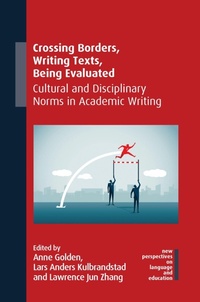
Crossing Borders, Writing Texts, Being Evaluated
Cultural and Disciplinary Norms in Academic Writing
Published on 14. December 2021
184 pages
978-1-78892-858-8 (ISBN)
Description

This book provides critical perspectives on issues relating to writing norms and assessment, as well as writing proficiency development, and suggests that scholars need to both carefully examine testing regimes and develop research-informed perspectives on tests and testing practices. In this way schools, institutions of adult education and universities can better prepare learners with differing cultural experiences to meet the challenges. The book brings together empirical studies from diverse geographical contexts to address the crossing of literacy borders, with a focus on academic genres and practices. Most of the studies examine writing in countries where the norms and expectations are different, but some focus on writing in a new discourse community set in a new discipline. The chapters shed light on commonalities and differences between these two situations with respect to the expectations and evaluations facing the writers. They also consider the extent to which the norms that the writers bring with them from their educational backgrounds and own cultures are compromised in order to succeed in the new educational settings.
Reviews / Votes
This thought-provoking book is truly crossing borders in its themes, locations, and researcher profiles. It shows convincingly the range and span of the linguistic and social issues that writers from diverse backgrounds face when entering new contexts and facing new circumstances and genres. A must-read for all those teaching and evaluating writing. * Anne Pitkaenen-Huhta, University of Jyvaeskylae, Finland * The authors know firsthand what it means to cross borders and struggle to master the writing conventions of a new language and community to become fully participating members of that community. Their research elucidates the multifaceted challenges that people in this situation face, and offers valuable insights into how these challenges can be addressed and overcome. * Scott Jarvis, University of Utah, USA * Every chapter concludes with recommendations for heightened awareness and modifications to pedagogical practice, so the book will be a valuable resource for anyone engaged in teaching or assessing academic writing, and particularly those involved in designing writing assessments. * Peter Beech, University of Nottingham Ningbo, China, IATEFL Voices, Issue 289 * ...this concise but informative volume adds to our understanding of the various challenges L2 learners face in academic writing and the actions required to help them succeed academically [...] The volume successfully showed the challenges faced by FL/L2 students in crossing the borders of academic Western literacy conventions [...] this book is highly recommended to writing instructors, postgraduate supervisors, researchers, raters and administrators interested in developing the academic writing of learners of additional languages. * Orlando Chaves Varon and Maria Eugenia Guapacha Chamorro, Universidad del Valle, Colombia, System 112, 2023 *More details
Series
Language
English
Place of publication
Bristol
United Kingdom
Target group
College/higher education
Product notice
Reflowable
ISBN-13
978-1-78892-858-8 (9781788928588)
Copyright in bibliographic data and cover images is held by Nielsen Book Services Limited or by the publishers or by their respective licensors: all rights reserved.
Schweitzer Classification
Other editions
Additional editions
Anne Golden | Lars Anders Kulbrandstad | Lawrence Jun Zhang
Crossing Borders, Writing Texts, Being Evaluated
Cultural and Disciplinary Norms in Academic Writing
Book
12/2021
Multilingual Matters
€47.90
Shipment within 3-4 weeks
Persons
Anne Golden is an Emeritus Professor of Second Language Acquisition at MultiLing, the University of Oslo, Norway.
Lars Anders Kulbrandstad is an Emeritus Professor of Norwegian at Inland Norway University of Applied Sciences and a Senior Professor of Swedish as a Second Language at Karlstad University, Sweden.
Lawrence Jun Zhang is Professor of Applied Linguistics at the Faculty of Education and Social Work, University of Auckland, New Zealand.
Lars Anders Kulbrandstad is an Emeritus Professor of Norwegian at Inland Norway University of Applied Sciences and a Senior Professor of Swedish as a Second Language at Karlstad University, Sweden.
Lawrence Jun Zhang is Professor of Applied Linguistics at the Faculty of Education and Social Work, University of Auckland, New Zealand.
Content
Acknowledgements
Contributors
Preface
Chapter 1. Anne Golden and Lars Anders Kulbrandstad: Crossing Borders
Chapter 2. Anne Golden and Lars Anders Kulbrandstad: When Errors Are Corrected
Chapter 3. Rosmawati: Writing Academically in English as a Second Language: The Case of Syntactic Constructions
Chapter 4. Zhihui Fang and Guofang Li: Writing in School Science for EAL Students: Linguistic Challenges and Pedagogical Response
Chapter 5. Morena Botelho de Magalhaes: Supporting EAL Writing Development in the Early Stages of the Doctorate: Candidates from the East Writing in the West
Chapter 6. Kirsi Leskinen: Agency in L2 Academic Literacies: Immigrant Students' Lived Experiences in Focus
Chapter 7. Jihua Dong: Constructing Persuasion: A Cross-cultural Comparison of Chinese and English Student Writings
Chapter 8. Lawrence Jun Zhang: Crossing Literacy Borders through Writing: Transformational Apprenticeship and Repositioning of EAL Learners
Index
Contributors
Preface
Chapter 1. Anne Golden and Lars Anders Kulbrandstad: Crossing Borders
Chapter 2. Anne Golden and Lars Anders Kulbrandstad: When Errors Are Corrected
Chapter 3. Rosmawati: Writing Academically in English as a Second Language: The Case of Syntactic Constructions
Chapter 4. Zhihui Fang and Guofang Li: Writing in School Science for EAL Students: Linguistic Challenges and Pedagogical Response
Chapter 5. Morena Botelho de Magalhaes: Supporting EAL Writing Development in the Early Stages of the Doctorate: Candidates from the East Writing in the West
Chapter 6. Kirsi Leskinen: Agency in L2 Academic Literacies: Immigrant Students' Lived Experiences in Focus
Chapter 7. Jihua Dong: Constructing Persuasion: A Cross-cultural Comparison of Chinese and English Student Writings
Chapter 8. Lawrence Jun Zhang: Crossing Literacy Borders through Writing: Transformational Apprenticeship and Repositioning of EAL Learners
Index
