

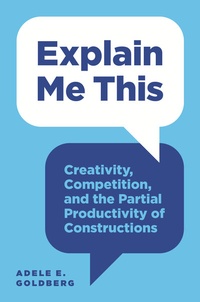
Explain Me This
Creativity, Competition, and the Partial Productivity of Constructions
1st Edition
Published on 14. January 2019
216 pages
978-0-691-18395-4 (ISBN)
Description

Why our use of language is highly creative yet also constrained
We use words and phrases creatively to express ourselves in ever-changing contexts, readily extending language constructions in new ways. Yet native speakers also implicitly know when a creative and easily interpretable formulation-such as "Explain me this" or "She considered to go"-doesn't sound quite right. In this incisive book, Adele Goldberg explores how these creative but constrained language skills emerge from a combination of general cognitive mechanisms and experience.
Shedding critical light on an enduring linguistic paradox, Goldberg demonstrates how words and abstract constructions are generalized and constrained in the same ways. When learning language, we record partially abstracted tokens of language within the high-dimensional conceptual space that is used when we speak or listen. Our implicit knowledge of language includes dimensions related to form, function, and social context. At the same time, abstract memory traces of linguistic usage-events cluster together on a subset of dimensions, with overlapping aspects strengthened via repetition. In this way, dynamic categories that correspond to words and abstract constructions emerge from partially overlapping memory traces, and as a result, distinct words and constructions compete with one another each time we select them to express our intended messages.
While much of the research on this puzzle has favored semantic or functional explanations over statistical ones, Goldberg's approach stresses that both the functional and statistical aspects of constructions emerge from the same learning mechanisms.
We use words and phrases creatively to express ourselves in ever-changing contexts, readily extending language constructions in new ways. Yet native speakers also implicitly know when a creative and easily interpretable formulation-such as "Explain me this" or "She considered to go"-doesn't sound quite right. In this incisive book, Adele Goldberg explores how these creative but constrained language skills emerge from a combination of general cognitive mechanisms and experience.
Shedding critical light on an enduring linguistic paradox, Goldberg demonstrates how words and abstract constructions are generalized and constrained in the same ways. When learning language, we record partially abstracted tokens of language within the high-dimensional conceptual space that is used when we speak or listen. Our implicit knowledge of language includes dimensions related to form, function, and social context. At the same time, abstract memory traces of linguistic usage-events cluster together on a subset of dimensions, with overlapping aspects strengthened via repetition. In this way, dynamic categories that correspond to words and abstract constructions emerge from partially overlapping memory traces, and as a result, distinct words and constructions compete with one another each time we select them to express our intended messages.
While much of the research on this puzzle has favored semantic or functional explanations over statistical ones, Goldberg's approach stresses that both the functional and statistical aspects of constructions emerge from the same learning mechanisms.
All prices
More details
Other editions
Additional editions

Adele E. Goldberg
Explain Me This
Creativity, Competition, and the Partial Productivity of Constructions
Book
02/2019
Princeton University Press
€116.50
Shipment within 10-20 days
Adele E. Goldberg
Explain Me This
Creativity, Competition, and the Partial Productivity of Constructions
Book
02/2019
Princeton University Press
€33.50
Shipment within 10-20 days
Person
Adele E. Goldberg is professor of psychology at Princeton University. She is the author of Constructions at Work: The Nature of Generalization in Language and Constructions: A Construction Grammar Approach to Argument Structure.
Content
- Cover
- Title
- Copyright
- Contents
- Preface
- Acknowledgments
- 1 Introduction
- 1.1 The Puzzle
- 1.2 The Roadmap
- 1.3 The CENCE ME Principles
- 1.4 Speakers Are Efficient and Expressive and also Conform
- 2 Word Meanings
- 2.1 Meanings Are Rich, Structured, and Partially Abstracted
- 2.2 Vast Implicit Memory
- 2.3 Clusters of Conventional, Related Senses
- 2.4 Creativity
- 2.5 Competition Constrains Word Meanings
- 2.6 Learning and Fluency Reduce Overgeneralizations
- 2.7 Summary
- 3 Constructions as Invitations to Form Categories
- 3.1 Meaning (Semantics)
- 3.1.1 Evidence
- 3.1.2 The Construct-i-con
- 3.1.3 Compatibility
- 3.2 Form (Syntax)
- 3.3 Sound Patterns (Phonology)
- 3.4 Discourse Context (Information Structure)
- 3.5 Social Context
- 3.6 Variation across Dialects
- 3.7 Variation across Languages
- 3.7.1 One-Participant Events
- 3.7.2 Two-Participant Events
- 3.7.3 Three-Participant Events
- 3.7.4 Serial Verb Languages
- 3.8 Constructions Are Combined (Recursively)
- 3.9 Summary
- 4 Creativity: Coverage Is Key
- 4.1 Knowledge and Memory
- 4.2 Memory for Language
- 4.3 Verbs in ASCs
- 4.4 Why Noun Phrases Are Open Slots in ASCs
- 4.5 Simple Entrenchment
- 4.6 Creativity and Productivity
- 4.7 Coverage: Clustering of Partially Abstract Exemplars
- 4.7.1 Evidence
- 4.7.2 Token Frequencies
- 4.8 Modeling Coverage
- 4.9 Summary
- 5 Competition: Statistical Preemption
- 5.1 Constraining Morphology and Meaning
- 5.2 Statistical Preemption
- 5.3 Evidence
- 5.4 Recasts
- 5.5 Explain Me This
- 5.6 Calculating the Probabilities
- 5.7 A Secondary Factor: Confidence
- 5.8 Mechanism: Error-Driven Learning
- 5.9 What Coverage Adds to Statistical Preemption
- 5.10 Summary
- 6 Age and Accessibility Effects
- 6.1 Younger Children Are More Conservative
- 6.2 Younger Children Are More Likely to Simplify in Production
- 6.3 Scaffolding Encourages "Early Abstraction"
- 6.4 Why Adult Learners of English Are Prone to Continuing Errors
- 6.4.1 Highly Entrenched L1 Warps Representational Space
- 6.4.2 Reduced Tendency to Predict Grammatical Forms
- 6.5 Summary
- 7 The Roads Not Taken
- 7.1 Is Compatibility between Verb and Construction Enough?
- 7.2 Are Invisible Features or Underlying Structure Explanatory?
- 7.3 Conservatism via Entrenchment?
- 7.4 Are "Tolerance" and "Sufficiency" Numbers Explanatory?
- 7.5 Are Frequencies without Function Effective?
- 7.6 Are Storage and Productivity Inversely Related?
- 7.7 Preempted Forms Need Not Be Created
- 7.8 Witnessing Enough Data
- 7.9 Summary
- 8 Where We Are and What Lies Ahead
- References
- Index

