

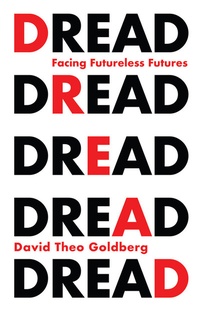
Dread
Description

A pervasive sense has taken hold that any and all of us are under suspicion and surveillance, walking on a tightrope, a step away from erasure of rights or security. Nothing new for many long-targeted populations, it is now surfacing as a broad social sensibility, ramped up by environmental crisis and pandemic wreckage. We have come to live in proliferating dread, even of dread itself.
In this brilliant analysis of the nature, origins, and implications of this gnawing feeling, David Theo Goldberg exposes tracking-capitalism as the operating system at the root of dread. In contrast to surveillance, which requires labor-intensive analysis of people's actions and communications, tracking strips back to the fundamental mapping of our movements, networks, and all traces of our digitally mediated lives. A simultaneous tearing of the social fabric - festering culture wars, the erosion of truth, even "civil war" itself - frays the seams of the sociality and solidarity needed to thwart this transformation of people into harvestable, expendable data.
This searing commentary offers a critical apparatus for interrogating the politics of our time, arguing that we need not just a politics of refusal and resistance, but a creative politics to counter the social life of dread.
More details
Other editions
Additional editions
Person
Content
1. A World of Dread
2. Sensing Dread
3. Dread's Operating System
4. Tracking-Capitalism: The Political Economy of Dread
5. Viral Dread
6. Ecoforming Dread
7. Civil War
8. De-Dreading
References
Preface and Acknowledgments
As 2016 unfolded, a recognition gathered pace that the world was less settled than it had seemed. Syria had torn itself apart in a seemingly endless civil war, and fleeing refugees were overloading Lebanon and flowing into Europe. ISIS had maximized its power and territorial spread as the year opened, expanding beyond Iraq, controlling much of Northern Syria, and mobilizing in other Middle Eastern and North African countries while recruiting more broadly in Europe. A series of coordinated attacks in Paris in November 2015 had killed 130. Six months later, a supporter gunned down nearly fifty people in an Orlando nightclub catering to a largely gay clientele. Rather than liberating Afghanistan and Iraq, the sustained "securing" had extended the devastation and unsettlement. The June 2016 outcome of the Brexit referendum and Trump's support, locally and globally, propelling him to election in November confounded the complacent. Sexual harassment and racist violence were openly proliferating. The planet surpassed the carbon threshold, global temperatures soared, the ice cap was melting at a record pace, storm systems became more devastating, and species were being wiped out.
By early 2017, many were waking each morning to wonder what disaster faced them, what sinister arrangements, what enclosures and exclusions, would be enacted by authoritarian leaders worldwide with smiling approval from their thrilled supporters. I couldn't quite put my finger on the uncanny upset pouring from most everyone with whom I interacted, in person and virtually. That summer, the sensibility manifested more clearly for me. Dread had gripped life.
Over the ensuing year, the feeling grew. Others readily concurred. But it was also becoming apparent that the rising authoritarianism across a growing number of societies was symptomatic, as it invariably is, of a deeper set of structural forces, while exacerbating them. This book is an attempt to make sense as much of the range and proliferation of underlying prompts as of the sensibility itself. A great deal has, of course, been written about the impacts on our lives of the technological revolution, of climate change, and of racial conflagration. Over the past year, the COVID-19 pandemic quickly became the pressing subject of our time, perhaps understandably eclipsing most everything else. The experience produced not just an explosion of scientific literature but also a slew of writing on the experience, the racial and class differentiations, and compelling critical contributions on the turn to the empirical, detection, the immunological, and the right to breathe.
The pandemic, however, also prompted predictable critical accounts by notable public philosophers intent on fitting breaking events into their preconceived theories. Slavoj Zizek (2020), for one, focused, perhaps predictably, on the contorted political panics to which the pandemic inevitably gave rise, the improbably renewed prompting of socialism's possibility as the driving viral fallout. Bernard-Henri Lévy (2020) dismissed everyone else's stupidity in accepting thoughtlessly the curtailments of their freedoms. Mostly more nuanced, Giorgio Agamben (2020a, 2020b) stressed how readily governments - he was especially concerned with the Italian state response in the early days - elevated a "techno-medical despotism," looking to the disciplinary technologies of delimiting liberties, the devaluation of human sociality underpinning these moves, and the fascistic reduction to "bare life."
A tendency among some analysts to forgo a more subtle, relational, and intersectional account of social positioning prompted an occasional declaration that all members of a racial group, for example, would be subjected to the same deathly experience in an emergency room no matter what their class standing and professional networks. Dread takes hold of the unexpecting. The pandemic nevertheless neither materialized nor has operated in a social vacuum. It is implicated in and has magnified a compound of social factors, at once enabling or advancing novel modes of control while fracturing social forces in less containable fashion. This calls for a more interactively nuanced analysis of the social field than any reductively self-replicating and selfreinforcing account warrants (cf. Hartman 2020; and Cottom 2019 for a more subtle reading of the social field of health).
Dread, as I conceive it, has emerged as the driving social sensibility in our times. There has been a quiet uptick in the term's popular usage, perhaps unsurprisingly. Yet there has been little theoretical analysis since Kierkegaard's novel focus on the concept, Heidegger on "angst," Sartre on "anguish," and, more passingly, Freud's later analyses of anxiety. Neel Ahuja (2016) speaks of "dread life" less as an analytic than as a shorthand for fear at the interface of race and species, architectures of power and security.
Dread, I will argue by contrast, is driven now by the socially specific interaction of currently impactful conditions. As the expressive manifestation of complex social fields, then, dread is a general index of contemporary specificities. The book is intended less as a comprehensive account than as a means of prompting a critical vocabulary and analytics for understanding what dread is, why it manifests as it does now, what its modes of articulation and expression are, what its implications are for the politics of our time. My starting point is the American context because dread has manifested so clearly in its shadow. The account, nevertheless, is intended to apply more generally, if variously, across wider contexts, as many examples drawn on will suggest.
The argument opens with two introductory chapters conceptualizing dread. Two chapters follow on the operative logics underlying contemporary dread, including digital automation and the driving technologies of contemporary capitalism, notably consumptive, political, and cultural tracking. A chapter each is then devoted to the looming devastations of the interlacing viral disasters of disease and climate change, as dread's materializations. I close with two concluding chapters, one reflecting on civil war as contesting conceptions of how to be in the world; the other on the politics in which dread manifests, contrasting between the material infrastructure of racism and infrastructures of care. Instead of a specific chapter devoted to race and its repressions, I thread racial articulation throughout as it is repeatedly, renewably, and interactively constitutive of the conditions of the social, and dread-making especially.
*
No work is authored alone. This book has benefited from layers of interactions and conversations with colleagues, friends, authors long engaged with and newly discovered. A number of people were kind - or concerned - enough to review a full draft of the manuscript. Ackbar Abbas provided me with characteristically insightful and probing feedback. Anjali Prabhu offered suggestive revisions too. Extensive conversations with Anirban Gupta-Nigam throughout the writing process drew my attention to ideas and literature I otherwise too self-satisfiedly would have skated past. Achille Mbembe in Johannesburg kept pushing me further, as did Lisa Leung in Hong Kong. Jenna Ng nudged my thinking along over these years on algorithmic logic and being. My lifelong friend filmmaker and incomparable surf movie director Michael Oblowitz made me uncomfortable with the taken-for-granted (in this case, regarding dread), as he always does. Gaby Schwab arranged a conversation on the coronavirus chapter with members of the University of California Humanities Research Institute (UCHRI) residential research group she was convening on "Artificial Humanity." The group prompted me to clarify and sharpen ideas key to that chapter's analysis. A passing question about dread's etymology from Sarah Farmer between our morning laps at the pool led to a little revision.
Early on in my thinking, the Los Angeles Review of Books published an outline version of my argument, causing me to extend my analysis. A shout-out to Brad Evans for opening that door and fueling me with invites throughout the book's elaboration. A public discussion on civil war with Brad, Adom Getachew, Libby Anker, and Achille Mbembe prompted some tweaks to Chapter 7. The driving dynamic ideas central to this book were the subject of keynote presentations to the Postcolonial Studies Association in Manchester, a conference at Radbout University in Nijmegen, and a CEMFOR conference at the University of Uppsala. The ensuing discussions all extended my thinking significantly. Cheers respectively to Helen Cousins and David Firth, to Anya Topolski and Josias Tembo, and to Mattias Gardell and his colleagues Daniel Strand and Mehek Muftee for the engagements. My colleagues in the Asia Theory Network devoted meetings in Taipei, Seoul, and Tokyo to various ideas germane to the book. I am grateful to all the members of the group for their rich generation of insights and ideas, and to Li Hung-Chiung for his tireless and self-effacing organizational energy. Extensive exchanges with Sarah Nuttall, Yogita Goyal, Alex Taek-Gwang Lee, and Woosung Kang especially opened my eyes to different ways of seeing points in the book.
The folks at Polity, as always, have been a pleasure to work with. Jonathan Skerrett gently steered me towards clarity and creativity. Karina Jákupsdóttir reminded me of tasks and deadlines with the lightest of...
