

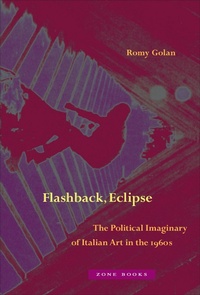
Flashback, Eclipse
Description

From a leading art historian, a provocative exploration of the intersection of art, politics, and history in 1960s Italy
Flashback, Eclipse is a groundbreaking study of 1960s Italian art and its troubled but also resourceful relation to the history and politics of the first part of the twentieth century and the aftermath of World War II. Most analyses have treated the 1960s in Italy as the decade of "presentism" par excellence, a political decade but one liberated from history. Romy Golan, however, makes the counterargument that 1960s Italian artists did not forget Italian and European history but rather reimagined it in oblique form. Her book identifies and explores this imaginary through two forms of nonlinear and decidedly nonpresentist forms of temporality-the flashback and the eclipse. In view of the photographic and filmic nature of these two concepts, the book's analysis is largely mediated by black-and-white images culled from art, design, and architecture magazines, photo books, film stills, and exhibition documentation.
The book begins in Turin with Michelangelo Pistoletto's Mirror Paintings; moves on to Campo urbano, a one-day event in the city of Como; and ends with the Vitalità del Negativo exhibition in Rome. What is being recalled and at other moments occluded are not only episodes of Italian nationalism and Fascism but also various liberatory moments of political and cultural resistance. The book's main protagonists are, in order of appearance, artists Michelangelo Pistoletto and Giosetta Fioroni, photographer Ugo Mulas, Ettore Sottsass (as critic rather than designer), graphic designer Bruno Munari, curators Luciano Caramel and Achille Bonito Oliva, architect Piero Sartogo, Carla Lonzi (as artist as much as critic), filmmakers Michelangelo Antonioni and Bernardo Bertolucci, and, in flashback among the departed, painter Felice Casorati, writer Massimo Bontempelli, art historian Aby Warburg, architect Giuseppe Terragni, and Renaissance friar-philosopher-mathematician Giordano Bruno (as patron saint of the sixty-eighters).
More details
Other editions
Additional editions
Person
Content
- Cover
- Contents
- Introduction
- Chapter One. Inside/Outside: Michelangelo Pistoletto's Mirror Paintings
- Steel Plates: An Occasion for Reflections
- Reading for the Plot in Early 1960s Turin
- Ettore Sottsass's Vertiginous Flashbacks
- Looking Askance at (International) Pop
- The Many Wars of Pistoletto's Alpino
- Eclipse of the Object at the 1964 Milan Triennale
- Magic Realism Redux: Pistoletto and Felice Casorati
- Closing the Temporal Gap
- Chapter Two. Campo Urbano: A Late Summer Festival
- Como: The City as Frame
- Ugo Mulas: One Camera, One Day
- Bruno Munari's Photo Book: Episodes from an Unwritten History of Participation
- Giordano Bruno, Patron Saint of the Sixty-Eighters
- Aby Warburg in Rome
- Eclipsing Giuseppe Terragni's Casa del Fascio
- After 1968
- Chapter Three. Vitalità del Negativo: The Exhibition as Palimpsest
- In the Winter of 1970: The Strange World of Vitalità
- In Black and White
- Beautiful Season: From Lo spazio dell'immagine to Amore mio
- Entrapped in the City of Eternal Return
- The Long Life of Symbols: Vitalità's Deposed X
- Bernardo Bertolucci's Il conformista and the Exhibition as Cinematic Remake
- Before the Years of Lead: Achille Bonito Oliva's "Traitor" Strategy
- A Final Eclipse
- Acknowledgments
- Notes
- Index
- Color Plates
