

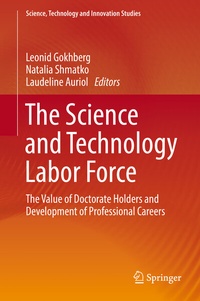
The Science and Technology Labor Force
Description

More details
Other editions
Additional editions
Persons
Leonid Gokhberg, Prof. Dr., is First Vice-Rector of the Higher School of Economics (HSE) - one of the most prominent research universities in Russia. He is also Director of HSE Institute for Statistical Studies and Economics of Knowledge (ISSEK). He authored over 350 publications in Russian and international peer-reviewed journals on S&T and innovation. Professor Gokhberg has coordinated dozens of international projects, inter alia on S&T and innovation policies, nanotechnology and roadmaps, funded by Russian governmental agencies, as well as by the intergovernmental organizations. Professor Gokhberg has served as a consultant of OECD, Eurostat, UNESCO, and other international and national agencies. He is also member of OECD and Eurostat expert groups and task forces on indicators for S&T, nanotechnology, information society and education. Professor Gokhberg is editor-in-chief of the Russian scientific journal "Foresight". He holds PhD and Dr. ofSc. degrees in Economics. In 2012 the President of Russia awarded Professor Gokhberg the title 'Honored Master of Sciences'.
Natalia Shmatko is a head of Department for human capital studies at ISSEK HSE, PhD. She authored over 100 publications in Russian and international peer-reviewed journals. Her main area of research activity is sociological and statistical studies of human resources, social differentiation studies, analysis and forecast of education system, competencies and skills assessment, job opportunity for highly qualified personnel. With extensive experience and expertise in the field of social institutions and social differentiation studies, Natalia has participated and has headed many projects, both national and international, which have deal with the social topology, professional and social identity, formation of the Russian businessmen, as well as the labor market and mobility of researchers and engineers.
Laudeline Auriol
is an analystat the OECD Directorate for Science, Technology and Industry where she is responsible for the measurement of human resources for science and technology and project manager of the international (OECD/UNESCO) survey on careers of doctorate holders (CDH). She has more than twenty years of experience in the field of science and technology indicators, is responsible for the biannual publication of the Main Science and Technology Indicators (MSTI) and has been participating actively in two successive revisions of the Frascati Manual - the international standards for the surveys on research and development. She is the author of articles in specialized or academic journals. She has also been a Member of the Scientific and Prospective Committee at the French Observatory for Science and Techniques for 2 successive mandates. She holds a Master Degree in statistics and demographics.
