

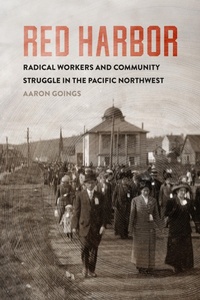
Red Harbor
Description

Brings to life Grays Harbor's fiery legacy of class conflict
In the early decades of the twentieth century, Grays Harbor was the Lumber Capital of the World. While thousands of lumber and maritime workers fought for higher wages and decent conditions, employers unified to protect their interests, often through violent and corrupt means. They spied on unionists, expelled them from their own towns, vilified them in the press, and physically assaulted labor activists. But with deep roots in their communities, radical workers continued to meet in their halls and immigrant neighborhoods?and to influence the wider labor movement well into the 1930s.
In Red Harbor, Aaron Goings resurrects the forgotten history of lumber workers in a bastion of labor radicalism, examining the conflict as workers faced down an alliance of employers, police, and violent anti-radicals, including the Ku Klux Klan. But he goes beyond these clashes to illuminate the vital roles of families, immigrants, and working-class women in the labor movement, revealing how people fought not only for labor rights but also for the good of their communities. The Industrial Workers of the World (or Wobblies) in particular adopted views and tactics from socialist Finnish immigrants while authoring programs responsive to local needs and supported by the people?radical and otherwise.
Vivid and revealing, Red Harbor shines a light on lumber workers and the pursuit of justice in the Pacific Northwest.
More details
Other editions
Additional editions
Person
Aaron Goings is professor of history at South Puget Sound Community College. His books include The Port of Missing Men: Billy Gohl, Labor, and Brutal Times in the Pacific Northwest, winner of the 2021 Sally and Ken Owens Book Award.
