

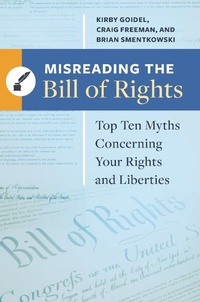
Misreading the Bill of Rights
Top Ten Myths Concerning Your Rights and Liberties
1st Edition
Published on 30. March 2015
272 pages
978-1-4408-3234-5 (ISBN)
Description

The Bill of Rights-the first 10 amendments to the U.S. Constitution-are widely misunderstood by many Americans. This book explores the widely held myths about the Bill of Rights, how these myths originated, why they have persisted, and the implications for contemporary politics and policy.
Interestingly, most Americans today-even professional political commentators-misinterpret or misunderstand what the Bill of Rights' intended meaning and purposes were. Culturally ingrained myths about the Bill of Rights have helped to define what it means to be an "American" but also limited the range of political debate and justified unfair and unequal treatment of minorities. This book addresses the top ten myths regarding the Bill of Rights from the standpoint of public understanding (and misunderstanding) from a non-partisan, objective point of view, provoking independent thought and enabling readers to reach their own educated conclusions and opinions.
Written by two experts in the fields of political science, public policy, media law, and civil liberties, the work explores the key role of modern news and entertainment media in contributing to public misunderstanding of individual rights and liberties. The authors also apply and interpret data from public opinion surveys to further examine public beliefs about the Bill of Rights and closely connect the analysis of misperceptions to existing political beliefs.
Interestingly, most Americans today-even professional political commentators-misinterpret or misunderstand what the Bill of Rights' intended meaning and purposes were. Culturally ingrained myths about the Bill of Rights have helped to define what it means to be an "American" but also limited the range of political debate and justified unfair and unequal treatment of minorities. This book addresses the top ten myths regarding the Bill of Rights from the standpoint of public understanding (and misunderstanding) from a non-partisan, objective point of view, provoking independent thought and enabling readers to reach their own educated conclusions and opinions.
Written by two experts in the fields of political science, public policy, media law, and civil liberties, the work explores the key role of modern news and entertainment media in contributing to public misunderstanding of individual rights and liberties. The authors also apply and interpret data from public opinion surveys to further examine public beliefs about the Bill of Rights and closely connect the analysis of misperceptions to existing political beliefs.
More details
Edition
1. Auflage
Language
English
Place of publication
United States
Publishing group
Bloomsbury Publishing Plc
Target group
Interest Age: From 7 to 17 years
ISBN-13
978-1-4408-3234-5 (9781440832345)
Copyright in bibliographic data and cover images is held by Nielsen Book Services Limited or by the publishers or by their respective licensors: all rights reserved.
Schweitzer Classification
Other editions
Additional editions
Kirby Goidel | Craig Freeman | Brian Smentkowski
Misreading the Bill of Rights
Top Ten Myths Concerning Your Rights and Liberties
Book
03/2015
Praeger Publishers Inc
€68.80
Shipment within 10-20 days
Persons
Kirby Goidel is professor in the Department of Communication and the Public Policy Research Institute at Texas A&M University.
Craig Freeman is professor of media law and entrepreneurial journalism at Oklahoma State University's School of Media and Strategic Communications.
Brian Smentkowski is associate director of faculty and academic development and a member of the Department of Government and Justice Studies at Appalachian State University.
Craig Freeman is professor of media law and entrepreneurial journalism at Oklahoma State University's School of Media and Strategic Communications.
Brian Smentkowski is associate director of faculty and academic development and a member of the Department of Government and Justice Studies at Appalachian State University.
