

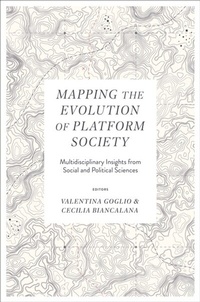
Mapping the Evolution of Platform Society
Multidisciplinary Insights from Social and Political Sciences
1st Edition
Published on 18. March 2025
200 pages
978-1-83608-028-2 (ISBN)
Description

Our society is becoming inextricably intertwined with digital platforms. Mapping the Evolution of Platform Society brings together a team of multidisciplinary scholars to investigate the intricate web of challenges and opportunities posed by the digital landscape.
The chapters provide novel research on the impact of platforms on education, media, politics and social disadvantage. Delivering a necessary update to seminal work with new empirical evidence and evolving key challenges - such as the role of TikTok - the authors do not merely identify risks of the 'platformization' of society, they offer a vital exploration of potential solutions and best practices. Opening with an introduction by the editors, it then covers five sections exploring education and lifelong learning, discrimination and marginalized communities, media and news dissemination, the digital transformation of government, and the environmental challenges of the platform society. Encompassing case studies and analyses from countries and regions often overlooked in existing literature, this collection offers a global perspective on the evolution of the opportunities and inherent challenges posed by the platform society.
Emerging from genuine interdisciplinarity, deriving from rigorous research across education, social work, journalism, government, and environmental studies, this is rich reading for scholars from across the political and social sciences interested in the risks and opportunities of this evolving societal trend.
The chapters provide novel research on the impact of platforms on education, media, politics and social disadvantage. Delivering a necessary update to seminal work with new empirical evidence and evolving key challenges - such as the role of TikTok - the authors do not merely identify risks of the 'platformization' of society, they offer a vital exploration of potential solutions and best practices. Opening with an introduction by the editors, it then covers five sections exploring education and lifelong learning, discrimination and marginalized communities, media and news dissemination, the digital transformation of government, and the environmental challenges of the platform society. Encompassing case studies and analyses from countries and regions often overlooked in existing literature, this collection offers a global perspective on the evolution of the opportunities and inherent challenges posed by the platform society.
Emerging from genuine interdisciplinarity, deriving from rigorous research across education, social work, journalism, government, and environmental studies, this is rich reading for scholars from across the political and social sciences interested in the risks and opportunities of this evolving societal trend.
More details
Language
English
Place of publication
Bingley
United Kingdom
Target group
College/higher education
Professional and scholarly
ISBN-13
978-1-83608-028-2 (9781836080282)
Copyright in bibliographic data and cover images is held by Nielsen Book Services Limited or by the publishers or by their respective licensors: all rights reserved.
Schweitzer Classification
Other editions
Additional editions
Valentina Goglio | Cecilia Biancalana
Mapping the Evolution of Platform Society
Multidisciplinary Insights from Social and Political Sciences
Book
03/2025
Emerald Publishing Limited
€93.50
Shipment within 3-4 weeks
Persons
Valentina Goglio is Associate Professor of Economic Sociology at the Department of Cultures, Politics and Society of the University of Turin, Italy. Her research interests are at the intersection between education and the labour market, with a particular focus on the implications of the digital transformation for education and work.
Cecilia Biancalana is Assistant Professor in the Department of Culture, Politics and Society at the University of Turin, Italy. Her research focuses on political ecology, party change, populism, and the relationship between the internet and politics.
Cecilia Biancalana is Assistant Professor in the Department of Culture, Politics and Society at the University of Turin, Italy. Her research focuses on political ecology, party change, populism, and the relationship between the internet and politics.
Content
Chapter 1. Introduction: Mapping the evolution of the platform society; Cecilia Biancalana and Valentina Goglio
Section 1. Education
Chapter 2. Collective intelligence online experiments: A learning method and its pedagogical applications through online collaborative work platforms; Pablo Bautista-Alcaine, Tatiana Iniguez-Berrozpe, and Javier Fernandez-Albas
Chapter 3. A better-skilled workforce for the digital transformation: What role for platform education; Valentina Goglio
Section 2. Discrimination
Chapter 4. The use of digital devices and digital platforms in social work: Challenges and risks; Giovanni Cellini and Carlotta Mozzone
Chapter 5. "Made in Italy": Online hate speech targeting gender-normative defiance at the Sanremo music festival; Camilla Borgna and Antonio Martella
Section 3. Media
Chapter 6. Can I have some news? Local journalism gaps and the role of platforms; Pedro Jeronimo and Luisa Torre
Chapter 7. TikTokization of the news: News media content production strategies in Portugal; Antonio Martella and Pedro Jeronimo
Section 4. Institutions
Chapter 8. Digital and financial literacy and the development of e-government platforms; Anna Lo Prete
Chapter 9. Ruling the digital environment at last?; Enea Fiore, Daniela R. Piccio, and Antonella Seddone
Section 5. Environment
Chapter 10. Environmental challenges in the platform society: Insights from mobilizations against data centers; Cecilia Biancalana
Section 1. Education
Chapter 2. Collective intelligence online experiments: A learning method and its pedagogical applications through online collaborative work platforms; Pablo Bautista-Alcaine, Tatiana Iniguez-Berrozpe, and Javier Fernandez-Albas
Chapter 3. A better-skilled workforce for the digital transformation: What role for platform education; Valentina Goglio
Section 2. Discrimination
Chapter 4. The use of digital devices and digital platforms in social work: Challenges and risks; Giovanni Cellini and Carlotta Mozzone
Chapter 5. "Made in Italy": Online hate speech targeting gender-normative defiance at the Sanremo music festival; Camilla Borgna and Antonio Martella
Section 3. Media
Chapter 6. Can I have some news? Local journalism gaps and the role of platforms; Pedro Jeronimo and Luisa Torre
Chapter 7. TikTokization of the news: News media content production strategies in Portugal; Antonio Martella and Pedro Jeronimo
Section 4. Institutions
Chapter 8. Digital and financial literacy and the development of e-government platforms; Anna Lo Prete
Chapter 9. Ruling the digital environment at last?; Enea Fiore, Daniela R. Piccio, and Antonella Seddone
Section 5. Environment
Chapter 10. Environmental challenges in the platform society: Insights from mobilizations against data centers; Cecilia Biancalana
