

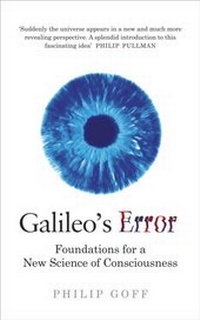
Galileo's Error
Foundations for a New Science of Consciousness
1st Edition
Published on 7. November 2019
256 pages
978-1-4735-6335-3 (ISBN)
Description

'Suddenly the universe appears in a new and much more revealing perspective. A splendid introduction to this fascinating idea' Philip Pullman
From a leading philosopher of mind comes this lucid, provocative argument that offers a radically new picture of human consciousness-panpsychism.
Understanding how brains produce consciousness is one of the great scientific challenges of our age. Some philosophers argue that consciousness is something "extra," beyond the physical workings of the brain. Others think that if we persist in our standard scientific methods, our questions about consciousness will eventually be answered. Some even suggest that the mystery is so deep that it will never be solved. Decades have been spent in trying to explain consciousness from within our current scientific paradigm, but little progress has been made.
Now, Philip Goff offers an exciting alternative that could pave the way forward. Rooted in an analysis of the philosophical underpinnings of modern science and based on the early 20th century work of Arthur Eddington and Bertrand Russell, Goff makes the case for panpsychism, a theory which posits that consciousness is not confined to biological entities but is a fundamental feature of all physical matter-from subatomic particles to the human brain. In Galileo's Error, he has taken the first step on a new path toward the final theory of human consciousness.
From a leading philosopher of mind comes this lucid, provocative argument that offers a radically new picture of human consciousness-panpsychism.
Understanding how brains produce consciousness is one of the great scientific challenges of our age. Some philosophers argue that consciousness is something "extra," beyond the physical workings of the brain. Others think that if we persist in our standard scientific methods, our questions about consciousness will eventually be answered. Some even suggest that the mystery is so deep that it will never be solved. Decades have been spent in trying to explain consciousness from within our current scientific paradigm, but little progress has been made.
Now, Philip Goff offers an exciting alternative that could pave the way forward. Rooted in an analysis of the philosophical underpinnings of modern science and based on the early 20th century work of Arthur Eddington and Bertrand Russell, Goff makes the case for panpsychism, a theory which posits that consciousness is not confined to biological entities but is a fundamental feature of all physical matter-from subatomic particles to the human brain. In Galileo's Error, he has taken the first step on a new path toward the final theory of human consciousness.
Reviews / Votes
This is one of the clearest accounts I've ever read about the mystery of consciousness, and the way in which one theory about it, panpsychism, does a great deal to explain how it occurs and what it is. Why shouldn't consciousness be a normal property of matter, like mass or electrical charge? This idea has the glorious simplicity of our first realisation that the earth goes around the sun, and not vice versa. Suddenly the universe appears in a new and much more revealing perspective. Philip Goff's book is altogether a splendid introduction to this fascinating idea. In Galileo's Error, Philip Goff argues for a new approach to the scientific study of consciousness. He offers an accessible and compelling analysis of why our felt experience continues to elude scientific explanation and why the theories that describe consciousness as a fundamental feature of matter have been neglected-and why they now deserve serious consideration. This is a must-read for anyone interested in the future of consciousness studies. -- Annaka Harris, best-selling author of Conscious: A Brief Guide to the Fundamental Mystery of the Mind Goff's ideas are radical, but his arguments are rigorous and the book is a pleasure to read. I recommend it to anyone who wants to come to grips with mystery of consciousness. -- David Chalmers, New York University In this provocative, brave and clearly written book, Goff makes a compelling case for an initially absurd thesis. -- Lee Smolin, Perimeter Institute for Theoretical Physics Galileo's Error is wonderful introduction to this ancient set of beliefs and how panpsychism can give rise to a naturalized form of spirituality that can overcome the alienation we all feel in today's globalized world that is beginning to fracture Galileo's Error is a tour de force. Goff defends his distinctive view of consciousness with verve, wit and authority, and for good measure adds an even-handed account of alternative views and a graphic introduction to the surrounding science. It is hard to imagine a better introduction to current debates about consciousness Philip Goff has written an extraordinarily accessible and entertaining book introducing and defending an increasingly popular, if on the face of it outlandish, claim: that consciousness is everywhere. Matter doesn't somehow magically become conscious depending on how it's arranged; rather the consciousness is there from the start. There's no better introduction to this fascinating subject Goff's elegant book offers a thought provoking, inspiring picture of the nature of mind. His spirited defense of panpsychism moves well beyond the usual academic discussions, mulling over our place in the larger universe Galileo's Error is an exciting and provocative book, which argues for the revolutionary view that all matter is conscious. Goff writes with clarity and passion, and whether you agree or disagree with his conclusions, you will find his book enjoyable, engaging, and deeply thought-provoking One of Goff's many achievements in this book is that he makes the fundamental problem of consciousness vivid and comprehensible to non-experts ... it is packed with rich discussions in clear, charming, easily readable prose ... an admirable work * The TLS *More details
Language
English
Place of publication
London
United Kingdom
Publishing group
Ebury Publishing
Target group
College/higher education
Professional and scholarly
File size
1,42 MB
ISBN-13
978-1-4735-6335-3 (9781473563353)
Copyright in bibliographic data and cover images is held by Nielsen Book Services Limited or by the publishers or by their respective licensors: all rights reserved.
Schweitzer Classification
Other editions
Additional editions
Book
11/2019
Rider & Co
€24.00
Available immediately
Person
Philip Goff is a philosopher of mind who teaches at Durham University. He has more than 40 academic publications and is the author of Consciousness and Fundamental Reality. Goff has published numerous articles in newspapers and magazines, such as The Guardian and the Times Literary Supplement, and has guest edited an edition of Philosophy Now magazine. He lives in Durham, England.
www.philipgoffphilosophy.com
www.conscienceandconsciousness.com
Twitter: @Philip_Goff
www.philipgoffphilosophy.com
www.conscienceandconsciousness.com
Twitter: @Philip_Goff
