

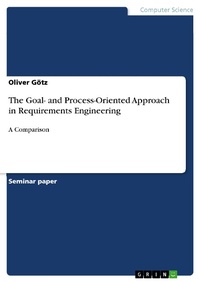
The Goal- and Process-Oriented Approach in Requirements Engineering
A Comparison
1st Edition
Published on 8. March 2017
22 pages
978-3-668-41250-7 (ISBN)
Description

Seminar paper from the year 2016 in the subject Computer Science - Software, grade: 1,0, University of Cologne (Seminar für Wirtschaftsinformatik und integrierte Informationssysteme), course: Bachelorseminar Requirements Engineering, language: English, abstract: The goal of this work was to provide a holistic overview of current frameworks for requirements elicitation. They can be catogrized as goal- or process-oriented ones. For achieving this goal, I conducted a structured literature review and summarized the results within in tables. Hence, this work can serve as reference manual for quickly getting an overview of possbile requirements elicitation approaches.
There exist a couple of approaches for the elicitation of requirements for software projects. Usually, it is difficult to identify the most relevant ones in order to have a coherent software development process. In general, it is distinguished between functional and non-functional requirements. Functional ones describe what a system has to do, what a system has to perform. Non-functional ones put constraints on the software, meaning they are quality attributes such as availability and security.
More details
Other editions
Additional editions
Book
03/2017
1st Edition
GRIN Verlag
€17.95
Shipment within 7-9 days
