

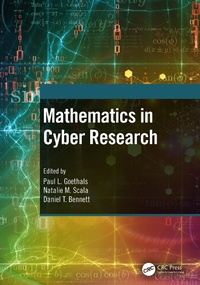
Mathematics in Cyber Research
1st Edition
Published on 6. February 2022
524 pages
978-1-000-54269-1 (ISBN)
Description

In the last decade, both scholars and practitioners have sought novel ways to address the problem of cybersecurity. Innovative outcomes have included applications such as blockchain as well as creative methods for cyber forensics, software development, and intrusion prevention. Accompanying these technological advancements, discussion on cyber matters at national and international levels has focused primarily on the topics of law, policy, and strategy. The objective of these efforts is typically to promote security by establishing agreements among stakeholders on regulatory activities. Varying levels of investment in cyberspace, however, comes with varying levels of risk; in some ways, this can translate directly to the degree of emphasis for pushing substantial change.
At the very foundation or root of cyberspace systems and processes are tenets and rules governed by principles in mathematics. Topics such as encrypting or decrypting file transmissions, modeling networks, performing data analysis, quantifying uncertainty, measuring risk, and weighing decisions or adversarial courses of action represent a very small subset of activities highlighted by mathematics. To facilitate education and a greater awareness of the role of mathematics in cyber systems and processes, a description of research in this area is needed.
Mathematics in Cyber Research aims to familiarize educators and young researchers with the breadth of mathematics in cyber-related research. Each chapter introduces a mathematical sub-field, describes relevant work in this field associated with the cyber domain, provides methods and tools, as well as details cyber research examples or case studies.
Features
One of the only books to bring together such a diverse and comprehensive range of topics within mathematics and apply them to cyber research.
Suitable for college undergraduate students or educators that are either interested in learning about cyber-related mathematics or intend to perform research within the cyber domain. The book may also appeal to practitioners within the commercial or government industry sectors.
Most national and international venues for collaboration and discussion on cyber matters have focused primarily on the topics of law, policy, strategy, and technology. This book is among the first to address the underpinning mathematics.
At the very foundation or root of cyberspace systems and processes are tenets and rules governed by principles in mathematics. Topics such as encrypting or decrypting file transmissions, modeling networks, performing data analysis, quantifying uncertainty, measuring risk, and weighing decisions or adversarial courses of action represent a very small subset of activities highlighted by mathematics. To facilitate education and a greater awareness of the role of mathematics in cyber systems and processes, a description of research in this area is needed.
Mathematics in Cyber Research aims to familiarize educators and young researchers with the breadth of mathematics in cyber-related research. Each chapter introduces a mathematical sub-field, describes relevant work in this field associated with the cyber domain, provides methods and tools, as well as details cyber research examples or case studies.
Features
One of the only books to bring together such a diverse and comprehensive range of topics within mathematics and apply them to cyber research.
Suitable for college undergraduate students or educators that are either interested in learning about cyber-related mathematics or intend to perform research within the cyber domain. The book may also appeal to practitioners within the commercial or government industry sectors.
Most national and international venues for collaboration and discussion on cyber matters have focused primarily on the topics of law, policy, strategy, and technology. This book is among the first to address the underpinning mathematics.
Reviews / Votes
"This volume edited by Goethals (United States Military Academy), Scala (Towson Univ.), and Bennett (National Renewable Energy Laboratory) is one of the best showcases of foundational algorithms and new research directions applied to computing this reviewer has seen. The range of topics could provide a basis for implementation in many areas. Although it would be impossible to cover all mathematical contributions to computer science in one book, the breadth of content here inspires awe. Fields include combinatorics, cryptography, data analytics, game theory, and quantum theory, and cybersecurity is emphasized in several chapters. Contributing authors position their material in the context of interconnectivity, the Internet of Things, and quantum computing. Readers will need significant background in linear algebra, calculus, and statistics. Naturally, foundational knowledge in computer science (networking, AI, and the theory of computation) will be helpful. A list of references accompanies each chapter, facilitating preliminary research toward more-advanced studies. Overall, the book is an excellent resource for students interested in applied math or advanced algorithms and for experienced scientists, educators, or practitioners who must investigate mathematical topics in a computing domain. Practically all areas covered are worthy of attention from graduate and postgraduate researchers. In addition, many sections include practical applications in computing and system development.Summing Up: Highly recommended. Lower- and upper-division undergraduates. Graduate students, faculty, and professionals."
- J. Brzezinski, McHenry County College, CHOICE Review
More details
Edition
1. Auflage
Language
English
Place of publication
London
United Kingdom
Publishing group
Taylor & Francis Ltd
Target group
College/higher education
Illustrations
35 Tables, black and white; 115 Line drawings, black and white; 115 Illustrations, black and white
ISBN-13
978-1-000-54269-1 (9781000542691)
Copyright in bibliographic data and cover images is held by Nielsen Book Services Limited or by the publishers or by their respective licensors: all rights reserved.
Schweitzer Classification
Other editions
Additional editions
Paul L. Goethals | Natalie M. Scala | Daniel T. Bennett
Mathematics in Cyber Research
Book
02/2022
1st Edition
Chapman & Hall/CRC
€250.90
Shipment within 15-20 days
Persons
Dr. Paul L. Goethals is an Academy Professor and the Director of Research for the Department of Mathematical Sciences at the United States Military Academy. He earned an M.S. degree in Mathematics from Florida State University in 2002 and a Ph.D. in Industrial Engineering from Clemson University in 2011. Dr. Goethals has served 29 years of active duty service within the United States Army, most recently as a Research Scientist at the Army Cyber Institute and as a member of the Commander's Action Group within the United States Cyber Command. He currently serves on the editorial board for the Cyber Defense Review and has served as the Editor-in-Chief of the International Journal of Experimental Design and Process Optimization since 2012.
Dr. Natalie M. Scala is an Associate Professor and Director of the graduate programs in Supply Chain Management in the College of Business and Economics at Towson University. She earned Ph.D. and M.S. degrees in Industrial Engineering from the University of Pittsburgh. Her primary research is in decision analysis, with foci on military applications and cybersecurity. Specific projects include army unit readiness, risk in voting systems, cybersecurity metrics and best practices, naval seabasing, nuclear power plants, and workforce planning. Dr. Scala frequently consults to government clients and has extensive professional experience, to include positions with Innovative Decisions, Inc., the United States Department of Defense, and the RAND Corporation. Her first book, a co-edited volume titled Handbook of Military and Defense Operations Research, was released by CRC Press in early 2020.
Dr. Daniel T. Bennett is the Senior Research and Operations Advisor for Energy Security and Resilience at the National Renewable Energy Laboratory (NREL). He has a Ph.D. and M.S. in Electrical Engineering from the University of Colorado at Boulder. Dan came to NREL from the Army Cyber Institute at the U.S. Military Academy where he led research for the Army's cyber think tank. While at West Point, he was also an Associate Professor in the Department of Electrical Engineering and Computer Science where he was the Academy's recognized expert in analog, digital and wireless communications systems and networks. He also recently served a yearlong tour as Technical Director Advisor to the 2-star commander of U.S. Cyber Command's Cyber National Mission Force at Ft. Meade, MD. Previous experiences include 15 months as Director of the Joint Network Operations & Security Center for Combined Joint Task Force-101 in Bagram, Afghanistan. Currently he is a technical lead on the Department of Energy's '5G Catalogue'.
Dr. Natalie M. Scala is an Associate Professor and Director of the graduate programs in Supply Chain Management in the College of Business and Economics at Towson University. She earned Ph.D. and M.S. degrees in Industrial Engineering from the University of Pittsburgh. Her primary research is in decision analysis, with foci on military applications and cybersecurity. Specific projects include army unit readiness, risk in voting systems, cybersecurity metrics and best practices, naval seabasing, nuclear power plants, and workforce planning. Dr. Scala frequently consults to government clients and has extensive professional experience, to include positions with Innovative Decisions, Inc., the United States Department of Defense, and the RAND Corporation. Her first book, a co-edited volume titled Handbook of Military and Defense Operations Research, was released by CRC Press in early 2020.
Dr. Daniel T. Bennett is the Senior Research and Operations Advisor for Energy Security and Resilience at the National Renewable Energy Laboratory (NREL). He has a Ph.D. and M.S. in Electrical Engineering from the University of Colorado at Boulder. Dan came to NREL from the Army Cyber Institute at the U.S. Military Academy where he led research for the Army's cyber think tank. While at West Point, he was also an Associate Professor in the Department of Electrical Engineering and Computer Science where he was the Academy's recognized expert in analog, digital and wireless communications systems and networks. He also recently served a yearlong tour as Technical Director Advisor to the 2-star commander of U.S. Cyber Command's Cyber National Mission Force at Ft. Meade, MD. Previous experiences include 15 months as Director of the Joint Network Operations & Security Center for Combined Joint Task Force-101 in Bagram, Afghanistan. Currently he is a technical lead on the Department of Energy's '5G Catalogue'.
Content
1. Combinatorics. 2. Cryptography. 3. Algebraic Geometry. 4. Topology. 5. Differential Equations. 6. Network Science. 7. Operations Research. 8. Data Analysis. 9. Statistics. 10. Probability Theory. 11. Game Theory. 12. Number Theory. 13. Quantum Theory. 14. Group Theory. 15. Ring Theory.
