

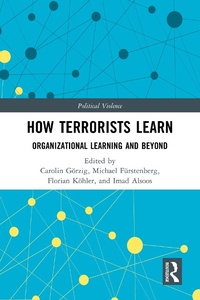
How Terrorists Learn
Organizational Learning and Beyond
1st Edition
Published on 1. September 2023
216 pages
978-1-000-93650-6 (ISBN)
Description

This volume helps us understand the transformations of terrorist organisations, and the conflicts they are involved in, by broadening the perspective on what is considered terrorist learning.
Using a variety of methodological approaches and empirical data, the volume offers a look at the clandestine inner lives of groups from different continents and ideological backgrounds in order to explore from whom they learn and how, and what the outcomes are. Their internal and external interactions are examined within their socio-political contexts to illuminate how they adapt to challenges or fail to do so. Unpacking the question of 'how do terrorists learn' helps us to grasp not only changes of violent means of action but also of operational and strategic approaches and, ultimately, even transformations of the ends pursued. The chapters demonstrate that terrorist learning is not principally different from that of other human organisations. The contributors draw on conceptual frameworks of organizational learning, but also broaden the scope beyond the organizational framework to acknowledge the variety of forms of informal and decentralized learning characteristic of much contemporary terrorism.
This book will be of much interest to students of terrorism studies, violent extremism, organisational studies and International Relations.
Using a variety of methodological approaches and empirical data, the volume offers a look at the clandestine inner lives of groups from different continents and ideological backgrounds in order to explore from whom they learn and how, and what the outcomes are. Their internal and external interactions are examined within their socio-political contexts to illuminate how they adapt to challenges or fail to do so. Unpacking the question of 'how do terrorists learn' helps us to grasp not only changes of violent means of action but also of operational and strategic approaches and, ultimately, even transformations of the ends pursued. The chapters demonstrate that terrorist learning is not principally different from that of other human organisations. The contributors draw on conceptual frameworks of organizational learning, but also broaden the scope beyond the organizational framework to acknowledge the variety of forms of informal and decentralized learning characteristic of much contemporary terrorism.
This book will be of much interest to students of terrorism studies, violent extremism, organisational studies and International Relations.
Reviews / Votes
'This volume offers an exceptional collection of well-written and important studies on how terrorist networks acquire and interpret information, store and share knowledge, and actively seek new ways to adapt and innovate. These learning attributes distinguish the relatively few effective terrorists from the many who fail.'-- James J.F. Forest, UMass Lowell and Editor-in-Chief, Perspectives on Terrorism
'This book makes an important contribution to the steadily growing literature on terrorism learning. The authors build a comprehensive model that explains how violent non-state actors learn, which they apply to a range of terrorist and insurgent case studies. Not content to limit themselves to explaining how terrorists improve their violent repertoires, the authors explore how some groups learn to question-and change-their goals and strategies, including moving away from political violence. How Terrorists Learn will appeal to anyone interested in terrorism studies and homeland security, insurgency and counterinsurgency, organizational adaptation and learning, and security studies.'
-- Michael Kenney, University of Pittsburgh, USA
More details
Series
Edition
1. Auflage
Language
English
Place of publication
London
United Kingdom
Publishing group
Taylor & Francis Ltd
Target group
College/higher education
Professional and scholarly
Illustrations
10 Tables, black and white; 11 Line drawings, black and white; 11 Illustrations, black and white
ISBN-13
978-1-000-93650-6 (9781000936506)
Copyright in bibliographic data and cover images is held by Nielsen Book Services Limited or by the publishers or by their respective licensors: all rights reserved.
Schweitzer Classification
Other editions
Additional editions
Carolin Goerzig | Michael Fuerstenberg | Florian Koehler
How Terrorists Learn
Organizational Learning and Beyond
Book
12/2024
1st Edition
Routledge
€63.10
Shipment within 10-20 days
Carolin Goerzig | Michael Fuerstenberg | Florian Koehler
How Terrorists Learn
Organizational Learning and Beyond
Book
09/2023
1st Edition
Routledge
€206.20
Shipment within 10-20 days
Persons
Carolin Goerzig is a Research Group Leader at the Max Planck Institute for Social Anthropology, Halle, Germany.
Michael Fuerstenberg is Senior Research Fellow at the Max Planck Institute for Social Anthropology, Halle, Germany.
Florian Koehler is Senior Research Fellow at the Max Planck Institute for Social Anthropology, Halle, Germany.
Imad Alsoos is Senior Research Fellow at the Max Planck Institute for Social Anthropology, Halle, Germany.
Michael Fuerstenberg is Senior Research Fellow at the Max Planck Institute for Social Anthropology, Halle, Germany.
Florian Koehler is Senior Research Fellow at the Max Planck Institute for Social Anthropology, Halle, Germany.
Imad Alsoos is Senior Research Fellow at the Max Planck Institute for Social Anthropology, Halle, Germany.
Content
1. Introduction: Tackling the Complexity of Terrorist Learning Part I: Learning of Organizations 2. Double-loop Learning in Terrorist Organizations: Facilitators and Impediments 3. Downgrading or Upsizing Strategies: How Rebels Learn about the Right Repertoire of Violence 4. Social-Media Jihad as a Learned Strategy: How Daesh Learned but Failed to Exploit Western Vulnerabilities 5. Learning Patterns and Failures: An Analysis of ISIS Operations between 2013 and 2019 Part II: Learning beyond Organizations 6. Adaptation of Propaganda and Communication: The Online Magazines of al-Qaeda and the Islamic State Compared 7. Terrorist Tactical Diffusion Among Lone Actors: Explaining the Spread of Vehicle Ramming Attacks 8. Learning through the Migration of Knowledge: Exploring the Transition of Operatives between Violence Organisations 9. Decentralized Collective Learning: Militant Accelerationism as a Community of Practice 10. Conclusion: What Have We Learned about Terrorist Learning?
