

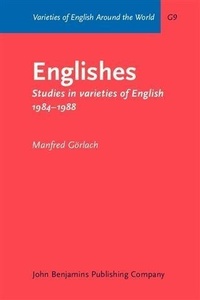
Englishes
Studies in varieties of English 1984-1988
1st Edition
Published on 19. April 1991
211 pages
978-90-272-7756-5 (ISBN)
Description

Problems of how to describe and explain the forms and functions of English outside Britain and the United States (and of varieties within the two countries) have become central for English linguistics over the past twenty years. The present collection combines 8 of Gorlach's major articles in the field written between 1984 and 1988. They range from methodological and state-of-the-art accounts to treatments of "colonial lag", from lexicographical problems, and translations into pidgins and creoles to papers focussing on individual regions.
More details
Other editions
Additional editions
Book
04/1991
John Benjamins Publishing Co
€84.80
Shipment within 10-15 days
Person
Content
- ENGLISHES STUDIES IN VARIETIES OF ENGLISH 1984-1988
- Editorial page
- Title page
- Copyright page
- Table of contents
- ABBREVIATIONS
- PREFACE
- ENGLISHES
- ENGLISH AS A WORLD LANGUAGE -THE STATE OF THE ART
- 1. General reflections1
- 2. Individual aspects of EWL as related to traditional disciplines
- 2.2. The sociolinguistics of EWL
- 2.2.2. Dialects and other regional varieties
- 2.2.3. Sociolects
- 2.2.4. Multilingualism
- 2.2.5. Political questions
- 2.3. Historical aspects of EWL
- 2.4. The acquisition of English and standards of education
- 2.5. Creative/xpressive aspects of EWL
- 2.6. Individual levels of language
- 2.6.1. Pronunciation and intelligibility
- 2.6.2. Syntax
- 2.6.3. The lexicon and lexicography
- 2.6.4. Styles
- 3. Conclusion
- 4. EWL as a discipline of academic teaching
- LEXICOGRAPHICAL PROBLEMS OF NEW ENGLISHES AND ENGLISH-RELATED PIDGIN AND CREOLE LANGUAGES1
- 1. The history
- 2. Methodology
- 2.0. The scope of this investigation
- 2.1. Dictionaries analysed
- 2.2. Exclusive (complementary) vs. inclusive dictionaries
- 2.3. Categories of items and types of information included in glossaries
- 2.4. The inclusive dictionary
- 2.5. Pidgin and creole dictionaries
- 3. Individual linguistic levels
- 3.1. Orthography
- 3.2. Pronunciation
- 3.3. Parts of speech and grammatical information
- 3.4. Phrases and idi
- 3.5. Meaning
- 3.6. Synonyms and heteronyms
- 3.7. Restrictive labels
- 3.8. Etymologies
- 3.8.1. Pidgin and creole languages
- 4. Desiderata
- Postscript
- SCOTLAND AND JAMAICA - BIDIALECTAL OR BILINGUAL?1
- 1. Introduction
- 1.1. Preliminary: Why compare the Scottish and Jamaican speech communities
- 1.2. The sociolinguistics of dialects and creoles
- 1.3. Comparable cases of endangered linguistic identity
- 2. Historical background: historicity
- 2.1. The social history of Scots and Jamaican contrasted
- 2.2. Numbers of speakers
- 3. Criteria drawn from language structure
- 3.1.Abstand
- 3.2. Dictionaries and translations
- 3.3. Languages in contact: code-switching and code-mixing
- 4. Selected aspects of the sociolinguistics of Scots and Jamaican
- 4.1. The role of the schools
- 4.2. The church
- 4.3. Literary texts
- 4.4. The language of radio and television
- 5. Language planning
- 5.1. Introduction
- 5.2. Code selection
- 5.3. Homogenization
- 5.4. Expansion (ausbau)
- 5.5. Acceptance and implementation
- 6. Conclusion
- COLONIALLAG? THE ALLEGED CONSERVATIVE CHARACTER OF AMERICAN ENGLISH AND OTHER 'COLONIAL' VARIETIES1
- 1. Introductory
- 2. Phonetic and phonological features
- 3. The lexicon
- 4. Syntax
- 5. Conclusion
- Postscript
- THE IDENTITY OF CANADIAN ENGLISH1
- 1. Introduction
- 2. Survey of existing research
- 3. Settlement history
- 4. The nature of CanE on individual linguistic levels
- 4.1. Homogeneity or variability?
- 4.2. Spelling
- 4.3. Pronunciati
- 4.4. Morphology and syntax
- 4.5. The lexicon
- 4.6. Other language-related factors contributing to Canadian identity
- 5. Comparable cases of national varieties
- 6. Prospects
- Postscript
- ENGUSH INAFRICA- AFRICAN ENGLISH?1
- 0. Introduction
- 1. West Africa
- 1.1. Sierra Leone
- 1.2. Liberia
- 1.3. Nigeria
- 1.4. Pidgin vs. broken English
- 1.5. Style
- 1.6. Correctness and education
- 1.7. Literature
- 2. Southern and Eastern África
- 2.1. South Africa
- 2.2. East Africa
- 3. Politics and the future of English
- Postscript
- AUSTRALIAN ENGLISH: STANDARDS, STIGMATA, STEREOTYPES AND STATISTICS1
- 1. Introduction
- 1.1. Botany Bay and the consequences
- 1.2. Historical sociolinguistics
- 1.3. Homogeneity vs. regional divergence in AusE
- 1 4. Social stratification
- 1.5. Conservatism vs. innovation in AusE
- 1.6. The Aborigines and Pidgin English
- 1.7. The American connection
- 2. AusE and its distinctiveness on individual levels
- 2.1. Preliminary
- 2.2. Spelling
- 2.3. Pronunciation
- 2.3.1. Stereotypes and evaluations
- 2.3.2. General chara cteristics of AusE
- 2.3.3. Regional and social differences in pronunciation
- 2.4. Syntax and usage
- 2.5. Lexis
- 2.5.1. Preliminary
- 2.5.2. 'Survivals' in AusE from BrE dialects
- 2.5.3. Regional variation in the lexis of AusE
- 2.5.4. Slang and colloquialisms
- 2.5.5. Borrowings from Aboriginal languages
- 2.5.6. Words of American provenance and the internationalization of English
- 2.5.7. Lexical innovation: change of meaning
- 2.5.8. Compounds and derivations
- 3. AusE and World English, and what remains to be done
- Postscript
- MAX AND MORITZ IN BLACK AND WHITE: PROBLEMS OF 'CREOLIZING' A GERMAN CHILDREN'S BOOK1
- 0. Prolegomena
- 1. Traduttore, traditore, or: the limits of translation
- 2. Spelling
- 3. Sounds: rhyme
- 4. Morphology and syntax
- 5. Lexical problems and solutions
- 6. Style and context
- 7. Conclusion
- REFERENCES
- INDEXOF NAMES
- INDEX OF TOPICS
