

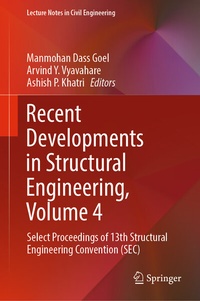
Recent Developments in Structural Engineering, Volume 4
Description

The book presents the select proceedings of 13th Structural Engineering Convention. It covers the latest research in multidisciplinary areas within structural engineering. Various topics covered include structural dynamics, structural mechanics, finite element methods, structural vibration control, advanced cementitious and composite materials, bridge engineering, soil-structure interaction, blast, impact, fire, material and many more. The book will be a useful reference material for structural engineering researchers and practicing engineers.
More details
Other editions
Additional editions
Persons
Dr. Manmohan Dass Goel completed his Bachelor of Engineering from Yeshwantrao Chavan College of Engineering, Nagpur. He was awarded three gold medals by Nagpur University for academic excellence. He completed M.Tech. in offshore engineering from Indian Institute of Technology (IIT) Bombay, Mumbai in year 2003. His Ph.D. is from Department of Civil Engineering, Indian Institute of Technology (IIT) Delhi and University of Federal Armed Forces, Munich, Germany, under German Academic Exchange Service (DAAD) Sandwich Fellowship in year 2013. He was awarded Surendranath Mukherjee Memorial Medal for best research paper by Institution of Engineers (India) in year 2009. He has been selected Young Ambassador by German Academic Exchange Services (DAAD) for consecutively for two years. His doctoral thesis has been awarded as the best thesis by the Indian National Academy of Engineering under "Innovative Student Project Award 2013" at doctoral level in Civil Engineering discipline. He has been awarded "CSIR Young Scientist Awards-2014" in Engineering Sciences by CSIR. He is recipient of "Young Engineer Award" from Institution of Engineers (India) in 2014. He has been nominated as "DAAD Research Ambassador" by German Academic Exchange Services (DAAD). He is also recipient of "Young Associate", Maharashtra Academy of Sciences, Maharashtra in year 2015. His paper has been awarded IGS-HEICO Biennial Award- 2017 by Indian Geotechnical Society (IGS), India as a best paper on "Rock Mechanics" published in Indian Geotechnical Journal through Indian Geotechnical Society (IGS). He has been interviewed by Rajya Sabha TV under popular science program "Eureka" in recognition of contribution to the R&D in Engineering Sciences. He has been Senate Member of ACSIR (Academy of Scientific & Innovative Research) CSIR, Delhi. Currently, he is serving as Associate Professor, Department of Applied Mechanics, Visvesvaraya National Institute of Technology (VNIT), Nagpur. Prior to this, he served CSIR-AMPRI Bhopal and CSIR-National Environmental Engineering Research Institute (NEERI) Nagpur, India as Scientist. He has more than 150 international and national journal/conference publications to his credit. His areas of research interest include blast analysis, blast resistant structures, lightweight materials, composite structures, low, medium, and high strain rate material characterization and computational mechanics. He is looking forward to contributing to the broader areas of structural protection systems used against blast and impact loading.
Dr. Arvind Vyavahare is a highly qualified and accomplished individual with a background in Structural Engineering. He graduated from the Government Engineering College, Aurangabad (Maharashtra) and went on to pursue a Master's degree in structural engineering, followed by a Ph.D. at Visvesvaraya National Institute of Technology in Nagpur. Dr. Vyavahare's received a UGC research fellowship and contributed to the Structural Dynamics Laboratory at CSIR Structural Engineering Research Center in Chennai. His was involved in setting up the Advanced Seismic Testing & Research (ASTaR) Laboratory. In 2006, Dr. Vyavahare joined the Applied Mechanics Department at Visvesvaraya National Institute of Technology in Nagpur. Since then, he has actively engaged in teaching undergraduate and postgraduate programs in civil and structural engineering. Dr. Vyavahare's research interests encompass several crucial areas within structural engineering, including design structures, advanced finite element analysis, structural health monitoring, and the rehabilitation of structures. His expertise is reflected in his guidance of more than thirty postgraduate research scholars in various aspects of structural engineering, and two Ph.D. scholars. Moreover, Dr. Vyavahare has contributed significantly to the academic and research community through the publication of research papers in reputable international journals. His publications underscore his commitment to advancing the understanding of structural engineering principles and practices. In summary, Dr. Arvind Vyavahare is a distinguished professional in the field of civil and structural engineering, with a rich academic background, extensive research experience, and a notable commitment to both teaching and advancing the frontiers of structural engineering through innovative research.
Dr. A. P. Khatri is Assistant Professor in the Department of Applied Mechanics at Visvesvaraya National Institute of Technology (VNIT), Nagpur, India. With a profound academic background, he obtained his B.E. in civil engineering in 2001, followed by an M. Tech. in structural engineering in 2003, and a Ph.D. in structural engineering in 2017. He has 5 years of industrial experience (2003-2008) in designing residential buildings and office buildings for government organizations and private industry. He has 15 years of research and teaching experience. His areas of interest include steel structures, RC structures, composite structures, buckling analysis, non-linear analysis, and structural fire behavior. He has 18 numbers of research publications in reputed journals and conferences. He is a life member of various institutions of engineers, civil engineers, and structural engineers. Dr. A. P. Khatri is dedicated to work as a driving influence in the fields of academics and research.
Content
- Intro
- Preface
- Acknowledgements
- Contents
- About the Editors
- A Study on Energy Dissipation Capacity of Multi Coil MR Damper for Seismic Mitigation
- 1 Introduction
- 2 Experimental Work
- 2.1 MRF 132-DG
- 2.2 Developed Multicoil MRD
- 3 Experimental Investigation
- 4 Results and Discussion
- 5 Conclusion
- References
- Performance Evaluation of Graphene Incorporated Cementitious Systems
- 1 Introduction
- 2 Materials and Methods
- 2.1 Materials
- 2.2 Methods
- 3 Results and Discussions
- 3.1 Dispersion of Graphene
- 3.2 Compressive Strength
- 3.3 FESEM Analysis
- 4 Conclusion
- References
- Dynamic Characteristics and Seismic Response Analysis of Rectangular Tanks
- 1 Introduction
- 2 Modeling of Rectangular Tank
- 2.1 Lumped Mass Modeling of Tank
- 2.2 3D Finite Element Modeling of Tank
- 3 Ground Motion Selection
- 4 Details of Tank Geometry and Material
- 5 Numerical Study
- 5.1 Modal Analysis
- 5.2 Response of Fixed-Base Tanks to Bi-Directional Earthquake Excitation
- 6 Conclusions
- References
- Enhanced Involuntary Characteristics and Corrosion Resistance for Reclaimed Materials
- 1 Introduction
- 2 Methodology
- 2.1 Experimental Approach
- 3 Result and Discussions
- 3.1 Compressive Strength
- 3.2 Flexural Strength
- 3.3 Splitting Tensile Strength
- 3.4 Molarity
- 4 Conclusions
- References
- Analysis of Sustainability and Cost-Effectiveness of Ultra-high Performance Concrete
- 1 Introduction
- 2 Research Significance
- 3 Methodology
- 3.1 Material Properties
- 3.2 Mixture Proportion
- 4 Sustainability Analysis
- 4.1 Cost Analysis
- 4.2 Total CO2 Emissions
- 4.3 Emboded Energy
- 5 Results and Discussions
- 5.1 Cost Analysis
- 5.2 CO2 Emissions and Embodied Energy
- 6 Conclusion
- References
- Nonlinear Bending of Composite Singly Curved Stiffened Shells Under Temperature Stresses
- 1 Introduction
- 2 Numerical Simulation
- 3 Numerical Problems
- 4 Results and Discussion
- 5 Conclusions
- References
- Numerical Investigation on the Ballistic Response of Alumina/Dyneema Composite Structure
- 1 Introduction
- 2 Numerical Modeling
- 3 Results and Discussions
- 3.1 Target Perforation Process
- 3.2 Defeat Mechanism of the Projectile
- 3.3 Energy Dissipation
- 3.4 Ballistic Resistance
- 4 Conclusions
- References
- Reliability-Based Optimal Design of SMA and Yield Damper for Seismic Vibration Control of Connected Building: A Predictive Model Using Machine Learning
- 1 Introduction
- 2 Numerical Modeling
- 2.1 Stochastic Model of Earthquake
- 2.2 Stochastic Model of Building
- 2.3 Sensitivity Study and Sample Generation
- 2.4 Optimization Objective
- 2.5 Machine Learning (ML) Regression Method
- 3 Result and Discussion
- 4 Conclusion
- References
- Effect of Mixing Approaches on Carbonation of Concrete
- 1 Introduction
- 2 Experimental Program
- 2.1 Raw Material
- 2.2 Mixing Techniques
- 2.3 Mix Proportions
- 2.4 Carbonation
- 2.5 Testing Procedure
- 3 Results and Discussion
- 3.1 Compressive Strength
- 3.2 Carbonation Depth
- 4 Conclusion
- References
- A Numerical Study of Impact Pile Driving in Different Soil Conditions
- 1 Introduction
- 1.1 Parameters for Evaluating Ground Vibrations
- 2 Numerical Modelling
- 2.1 Material Property
- 2.2 Validation
- 2.3 Numerical Modelling with Trench
- 2.4 Modelling of 1st Case Study and 2nd Case Study
- 3 Results and Discussion
- 3.1 Results of Validated Model with Trench
- 3.2 Results of Case Study-1
- 3.3 Results of 2nd Case Study
- 4 Conclusion
- References
- A Comparative Study to Evaluate the Performance of Various Deep Learning Models for Damage Identification in a Cantilever Beam
- 1 Introduction
- 2 Mathematical Formulations
- 2.1 Finite Element Formulation for Beam
- 2.2 Frequency Response Function (FRF)
- 3 Numerical Modelling and Dataset Generation of a Cantilever Beam
- 3.1 Modelling of a Cantilever Beam
- 3.2 Generation of the FRF Dataset
- 4 Deep Learning Algorithms
- 5 Results and Discussions
- 5.1 Training Results
- 5.2 Validation Results
- 5.3 Testing Results
- 6 Conclusion
- References
- Parametric Study of RC Jacketing on Seismic Vulnerability of Non-ductile RC Frame Building
- 1 Introduction
- 2 General Description of Case Study Frame
- 2.1 Details of Case Study Frame
- 2.2 Finite Element Modelling of Bare Frame
- 2.3 Design of RC Jacketing
- 3 Results and Discussions
- 3.1 Non-linear Static Analysis (Pushover Analysis)
- 3.2 Non-linear Time History Analysis
- 4 Conclusion
- References
- An Experimental Study on Optimal Placement of AE Sensor for Localisation of AE Source in Steel Truss Bridge
- 1 Introduction
- 2 Experimental Setup
- 3 Methodology
- 4 Results and Discussion
- 5 Conclusion
- 6 Future Scope
- References
- Structural Integrity Assessment of Reinforced Concrete (RC) Building Due to Fire Hazard
- 1 Introduction
- 2 Modelling and Analysis
- 2.1 Linear Static Analysis Using SAP2000
- 2.2 Using SAFIR
- 3 Results and Discussions
- 4 Conclusion
- References
- Comparative Analysis of RCC Multi-storey Building by Different Lateral Load Resisting Systems
- 1 Introduction
- 1.1 Description of Building
- 2 Methodology
- 2.1 Case 1
- 2.2 Case 2
- 2.3 Case 3
- 2.4 Case 4
- 3 Result and Discussion
- 3.1 Storey Displacement
- 3.2 Storey Drift
- 3.3 Base Shear
- 3.4 Time Period
- 4 Conclusion
- References
- Comprehensive Design of an Educational High-Rise Steel Building at Anurag University: A Case Study
- 1 Introduction
- 2 Soil Investigation
- 3 Site Survey and Architectural Planning
- 4 Structural Design
- 5 Estimation and Costing
- 6 Conclusions
- References
- Flexural Behavour of GFRP-Concrete Composite Slabs
- 1 Introduction
- 2 Experimental Procedures
- 2.1 Materials
- 2.2 GFRP-GGBS Based Concrete Composite Slab
- 2.3 Experimental Set-Up
- 3 Result and Discussion
- 3.1 Failure Pattern of the Composite Slabs
- 3.2 Load-deflection Behaviour of the Composite Slabs
- 4 Conclusion
- References
- An Overview of Masonry Material Properties for Historical Buildings
- 1 Introduction
- 2 Buildings Materials Used for Historical Masonry
- 2.1 Stones
- 2.2 Mortars
- 2.3 Bricks
- 2.4 Aggregates
- 3 Conclusion
- References
- Numerical Analysis of Resilient Beam-Column Connection with Replaceable Integrated Type Fuse Link
- 1 Introduction
- 2 Proposed Fuse Geometry
- 2.1 Optimization of Parameters
- 3 Analysis by Finite Element Method
- 3.1 Comparison of Models with and Without Fuse Subjected to Cyclic Load
- 4 Results and Discussions
- 4.1 Failure Pattern
- 4.2 Hysteretic Behaviour
- 4.3 Analysis of Bilinear Curve and Comparison
- 4.4 Cumulative Energy Dissipation Behavior
- 5 Conclusions
- References
- Behavior of Exterior Beam Column Joint with Rectangular Spiral Reinforcement
- 1 Introduction
- 1.1 Beam-Column Joint
- 1.2 Materials and Methodology
- 2 Results and Discussions
- 2.1 Crack Patterns
- 2.2 Joint Shear Stress
- 3 Conclusion
- References
- Response of Steel Moment Resisting Frames Under Pushover Analysis
- 1 Introduction
- 2 Effect of Different Types of Bracing Patterns
- 2.1 Comparison of Pushover Analysis of Seven Concentric and Three Eccentric 3D (G+7) Steel Frames
- 3 Effect of Different Types of Bracings Patterns by FEMA 356 Lateral Loading and Uniform Lateral Loading
- 3.1 FEMA 356 Lateral Loading
- 3.2 Uniform Lateral Loading
- 3.3 Comparison of Pushover Analysis of Two Lateral Load Patterns on Four Different 3D (G + 7) Braced Steel Frames
- 4 Uniform Lateral Load
- 5 Results and Conclusion
- References
- Investigations on Live-Line Strengthening of Transmission Line Towers by Using GFRP Angle Sections
- 1 Introduction
- 2 Present Study
- 3 Numerical Investigations on Strengthening of Steel Angle with GFRP Angle Section
- 4 Summary
- References
- Code Provisions to Contain Pounding Effects in RC Buildings Under Earthquake Excitation
- 1 Introduction
- 2 Numerical Study
- 2.1 Building Characteristics
- 2.2 Inelastic Behaviour Using Nonlinear Static Analysis
- 3 Conclusions
- References
- Simulating Fresh Concrete Behavior Through Discrete Element Approach
- 1 Introduction
- 2 Discrete Element Methodology
- 3 Parametric Study
- 3.1 Setting up Stiffness
- 3.2 Damping Coefficients
- 3.3 Failure Point
- 3.4 Yield Stress
- 3.5 Bond Strengths
- 4 Conclusion
- References
- On Softening Behaviour of Force-Based Shear-Flexible Concrete Frame Element
- 1 Introduction
- 2 Force-Based Shear-Flexible Element Formulation
- 2.1 Sectional Model
- 3 Regularisation Techniques Based on Scaling of Integration Weight
- 3.1 Method 1
- 3.2 Method 2
- 4 Numerical Study
- 5 Conclusions
- References
- Synthesis and Application of Zeolitic Imidazolate Framework (ZIF-8) in Cement Composites
- 1 Introduction
- 2 Materials and Methodology
- 3 Results and Discussion
- 3.1 Mechanical Properties
- 3.2 XRD Analysis
- 3.3 Microstructure Studies
- 4 Conclusion
- References
- Impact Factor for High-Speed Railway Bridge Structures
- 1 Introduction
- 2 Impact Factor by Various Codes
- 3 Analytical Formulation
- 3.1 Single (Point) Mass
- 3.2 Single (Finite Size) Mass
- 3.3 Multiple (Point) Mass
- 3.4 Multiple (Finite Size) Mass
- 4 Finite Element Modeling
- 5 Result and Discussion
- 5.1 Point Mass Versus Finite Size Mass
- 5.2 FEM Versus Analytical
- 5.3 Effect of Span Length
- 5.4 Effect of Axle Spacing
- 5.5 Effect of Number of Wheels
- 5.6 Proposed IF for HSR Bridge
- 6 Conclusion
- References
- Enhancing Performance of Geopolymer Concrete Via Control of Liquid-to-Binder Ratio and Curing Temperature
- 1 Introduction
- 2 Materials and Test Setup
- 2.1 Properties of Materials
- 2.2 Mixing, Casting and Curing of Fresh Concrete
- 3 Results and Discussions
- 3.1 Effect of Liquid to Binder Ratio
- 3.2 Effect of Curing Temperature
- 4 Conclusions
- References
- Modelling the Shear Behaviour of Wall-Type Short Reinforced Concrete Columns
- 1 Introduction
- 2 Review of Literature
- 3 Analytical Investigation
- 3.1 Piecewise Linear Model
- 3.2 Generalised Truss Analogy
- 4 Experimental Investigation
- 5 Results and Discussions
- 6 Summary and Conclusions
- References
- Effects of Spent Wash Water on the Properties of Concrete
- 1 Introduction
- 2 Experimental Analysis of Materials
- 2.1 Experimental Analysis of Water Samples
- 2.2 Experimental Analysis of Cement Sample
- 2.3 Testing for Concrete Specimen
- 3 Test Results
- 3.1 Experimental Analysis of Fresh Concrete
- 3.2 Experimental Analysis of Hardened Concrete
- 4 Conclusion
- References
- Adaptive Kriging Metamodel with Error Stability-Based Stopping Criterion for Reliability Analysis of Underground Tunnel
- 1 Introduction
- 2 Kriging Metamodel-Based Structural Reliability Analysis
- 3 Proposed Adaptive Kriging with Error Stability-Based Stopping Criteria (AK-ESSC)
- 4 Analytical Formulation Based Reliability Analysis of Circular Unlined Tunnel
- 5 Conclusion
- References
- Assessment of the Failure Mechanisms of URM Infilled RC Hill Buildings
- 1 Introduction
- 2 Description of Representative Buildings
- 3 Seismic Response of URM Infilled RC Building on Hill
- 4 Damage Pattern and Failure Mechanism
- 5 Conclusion
- References
- Design of Highway Sign Supporting Structures with Various Structural Systems
- 1 Introduction
- 2 Literature Review
- 3 Objective of Study
- 4 Methodology
- 4.1 Loadings
- 5 Design of Steel Structure and Foundation
- 5.1 Welded Connections
- 6 Conclusions
- References
- Dynamics of Freestanding Rigid Blocks: Interpretation of Free Vibration Characteristics
- 1 Introduction
- 2 Scope and Significance
- 3 System Idealization and Equation of Motion
- 4 Free Vibration Properties
- 5 Overturning Conditions: Derivation from Free Vibration
- 6 Summary and Conclusion
- References
- Free Vibration Analysis of Functionally Graded Shell Panels in a Hygrothermal Environment
- 1 Introduction
- 2 Mathematical Formulation
- 3 Validation and Numerical Simulation Results
- 3.1 Effect of Hygrothermal Environment on Eigen Frequency
- 3.2 Effect of R/W Ratio and Boundary Conditions on FG Shell Panel Behavior in Hygrothermal Environments
- 3.3 Effect of Material Distribution
- 3.4 Impact of Material Composition in Hygrothermal Environment
- 4 Conclusion
- References
- Loss of Bifurcation in Thin Unsymmetric Composite Ribbons
- 1 Introduction
- 2 Semi-Analytical Framework
- 2.1 Rayleigh-Ritz Polynomial Approximations
- 2.2 Computation of the Total Potential Energy
- 2.3 Minimization of the Total Potential Energy
- 3 Numerical Simulation
- 3.1 Steps Involved in FE Analysis
- 4 Results
- 5 Conclusion
- References
- Local Buckling of Cold-Formed Steel Members Under Pure Compression
- 1 Introduction
- 2 Numerical Modelling
- 2.1 Finite Element Type and Material
- 2.2 Load and Boundary Condition
- 2.3 Imperfection and Residual Stresses
- 2.4 Validating Developed FE Model
- 3 Parametric Study Results
- 4 Results and Discussion
- 5 Conclusion
- References
- Exploring the Efficacy of Drop-Weight Impact Test on Structural Components: A Comparative Investigation
- 1 Introduction
- 2 Experimental Setup for Drop-Weight Impact Test
- 2.1 Impactor Geometry and Contact Area
- 2.2 Initial Inclination of Drop-Weight
- 2.3 Support Arrangement
- 3 Response Measuring Devices
- 4 Response and Modes of Failure Due to Impact
- 5 Conclusion
- References
- Concrete Resistivity Measurements for Chloride-Induced Accelerated Corrosion Monitoring of Reinforced Concrete Slabs
- 1 Introduction
- 2 Experimental Procedure
- 2.1 Materials and Specimen Preparation
- 2.2 Accelerated Corrosion Set-Up and Corrosion Monitoring
- 3 Results and Discussions
- 3.1 Effect of Probe Configuration on ER
- 3.2 Comparative Study of Half-Cell Potential and ER Measurements
- 4 Conclusions
- References
- Dynamic Analysis of Open Web Steel Frame
- 1 Introduction
- 1.1 Limitations on Slenderness for I Section
- 2 Finite Element Modelling-Analytical Study
- 2.1 Hinge Properties and Primary Coefficients
- 2.2 Verification of Nonlinear Static Analysis
- 3 Results and Discussion
- References
- Effect of Loading Height on the GFRP I-Beam Using Finite Element Analysis
- 1 Introduction
- 2 Numerical Study
- 2.1 General
- 2.2 Geometric and Material Properties
- 2.3 Loading and Boundary Conditions
- 2.4 Element Type, Mesh and Numerical Validation
- 3 Results and Discussion
- 4 Conclusions
- References
- Ramie- Fiber Reinforced Cementitious Composite
- 1 Introduction
- 2 Ramie Fiber and Its Mechanical Attributes
- 3 Ramie Fiber Reinforced Cementitious Composite (RFRCC)
- 4 Results and Discussions
- 5 Summary
- References
- Damage Evaluation in a Concrete Gravity Dam Using Smoothed Particle Hydrodynamics
- 1 Introduction
- 2 SPH Governing Equations
- 3 Fracture Model and Pseudo-Spring Algorithm
- 4 Dam Configuration
- 5 Results for Estimation of Damage
- 5.1 Damage Under Sinusoidal Loading
- 5.2 Damage Under Earthquake Loading
- 6 Conclusion
- References
- Effect of Waterproofing Membrane on Debonding of Asphalt Layer on Bridge Deck-A Simulation Study
- 1 Introduction
- 2 Methodology
- 2.1 FE Modelling
- 2.2 FE Analysis
- 3 Results and Discussions
- 4 Conclusions
- References
- Early Setting and Hardening of Concrete Containing Flyash Using Non-destructive Techniques
- 1 Introduction
- 2 Materials, Methodology and Tests Conducted
- 2.1 Materials Used
- 2.2 Sample Preparation
- 2.3 Tests Conducted
- 3 Results
- 3.1 Compressive Strength
- 3.2 SEM Results
- 3.3 Ultrasonic Guided Wave Results
- 3.4 Acoustic Emission Results
- 4 Conclusions
- References
- Analytical Study of Interior Beam-Column Joint Under Cyclic Loading
- 1 Introduction
- 2 Methodology and Modeling
- 2.1 Interior Beam-Column Joint Detail
- 2.2 Geometry Details of Beam-Column Joint
- 2.3 Material Properties
- 2.4 Modeling
- 3 Results and Discussion
- 3.1 Loads-Displacement Curves
- 3.2 Degradation of Stiffness
- 3.3 Energy Dissipation Capacity
- 4 Conclusion
- References
- Evaluation of Ductility Ratio of Recycled Aggregate Concrete Beams Under Torsion
- 1 Introduction
- 2 Significance of Work
- 3 Experimental Works
- 4 Test Setup and Instrumentation
- 5 Test Results and Discussion
- 5.1 Compressive and Spilt Tensile Strength of RAC
- 5.2 Methodology to Determining the Torsional Ductility
- 6 Conclusions
- References
- A Review on Supplementary Damping Systems in Tall Buildings
- 1 Introduction
- 2 Passive Systems
- 2.1 Fluid Viscous Damper
- 2.2 Tuned Mass Damper
- 2.3 Tuned Liquid Damper
- 2.4 Tuned Liquid Column Damper
- 2.5 Air Tuned Damper
- 2.6 Humming Bird Damper
- 2.7 Viscoelastic Damper
- 3 Active Systems
- 3.1 Active Mass Damper
- 3.2 Active Tendon System
- 3.3 Active Bracing System
- 4 Semi-active Systems
- 4.1 Semi-active Tuned Mass Damper
- 4.2 Semi-active Controllable Fluid Damper
- 4.3 Semi-active Impact Damper
- 4.4 Semi-active Stiffness Damper
- 4.5 Piezoelectric Damper
- 5 Hybrid Systems
- 5.1 Hybrid Mass Damper
- 6 Case Studies
- 6.1 Beijing Yintai Centre
- 6.2 Taipei 101
- 7 Futuristic Devices
- 7.1 Fluid-Structure Coupling
- 7.2 Eddy Current Damping
- 8 Conclusion
- References
- Nonlinear First Ply Failure Study on Clamped Composite Cylindrical Shells Under Sinusoidal Load
- 1 Introduction
- 2 Mathematical Formulation
- 3 Numerical Examples
- 4 Results and Discussions
- 5 Concluding Remarks
- References
- Analysis of Various Types of Slabs and Their Comparison with the Conventional Slab
- 1 Introduction
- 2 Materials
- 3 Methodology
- 4 Numerical Investigation
- 5 Analytical Modelling
- 6 Result and Discussion
- 7 Discussion
- 8 Conclusion
- References
- Real-Time Concrete Surface Crack Detection Using Computer Vision Model-YOLO_v8
- 1 Introduction
- 1.1 Concrete Crack Detection
- 1.2 YOLO_v8
- 2 Methodology
- 2.1 Dataset Collection
- 2.2 Training of the Model
- 2.3 Annotation of Live Video Feed
- 3 Result
- 3.1 Labels Versus Predictions
- 4 Conclusion
- References
- Engineered Cementitious Composite Performance with Natural River Sand of Varying Particle Sizes
- 1 Introduction
- 2 Experimental Study
- 2.1 Materials
- 2.2 ECC Mix Design
- 2.3 Sample Preparation and Curing
- 2.4 Test Methods
- 3 Results and Discussion
- 3.1 Flowability
- 3.2 Compressive Strength
- 3.3 Flexural Strength
- 3.4 Ultrasonic Pulse Velocity
- 4 Conclusions
- References
- Seismic Assessment of Vertically Irregular RC Buildings Designed Using DDBD and FBD Approaches
- 1 Introduction
- 2 Direct-Displacement Based Assessment Procedure
- 3 RC Irregular Building Models
- 4 Selection of Ground-Motions
- 5 Results and Discussions
- 6 Conclusions
- References
- Effect of Addition of Nano Alumina on Torsional Strength of High Performance Concrete Beam
- 1 Introduction
- 2 Methods
- 2.1 Materials
- 2.2 Concrete Mixture
- 2.3 Concrete Mix Design-M70
- 2.4 Torsional Moment Analysis
- 2.5 Reinforcement
- 2.6 Experimental Setup
- 3 Results and Discussion
- 3.1 Failure Mode
- 4 Conclusions
- References
- Stainless Steel Reinforcement in Concrete Structures: A Review Based on Cost, Composition and Moment Curvature of RC Beam
- 1 Introduction
- 2 Chemical Composition and Cost
- 3 Mechanical Properties of Stainless-Steel Rebar.
- 4 Moment Curvature (M - f)
- 5 Conclusion
- References
- Stress Analysis of FGM Cylindrical Shell
- 1 Introduction
- 2 Mathematical Formulation
- 3 Semi-Analytical Method
- 4 Results and Discussion
- 4.1 Discussion of Results
- 5 Conclusion
- References
