

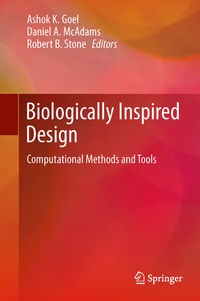
Biologically Inspired Design
Description

From simple cases such as hook and latch attachments found in Velcro to articulated-wing flying vehicles, biology often has been used to inspire many creative design ideas. The scientific challenge now is to transform the paradigm into a repeatable and scalable methodology. Biologically Inspired Design explores computational techniques and tools that can help integrate the method into design practice.
With an inspiring foreword from Janine Benyus, Biologically Inspired Design contains a dozen chapters written by some of the leading scholars in the transdisciplinary field of bioinspired design, such as Frank Fish, Julian Vincent and Jeannette Yen from biology, and Amaresk Chakrabarti, Satyandra Gupta and Li Shu from engineering. Based in part on discussions at two workshops sponsored by the United States National Science Foundation, this volume introduces and develops several methods and tools for bioinspired design including:
Information-processing theories,
Natural language techniques,
Knowledge-based tools, and
Functional approaches and Pedagogical techniques.
By exploring these fundamental theories, techniques and tools for supporting biologically inspired design, this volume provides a comprehensive resource for design practitioners wishing to explore the paradigm, an invaluable guide to design educators interested in teaching the method, and a preliminary reading for design researchers wanting to investigate bioinspired design.
More details
Other editions
Additional editions
Persons
Content
1.Introduction.- 2.The AskNature Database: Enabling Solutions in Biomimetic Design.- 3.A Natural Language Approach to Biomimetic design.- 4.A Thesaurus for Bioinspired Engineering Design.- 5.Function-Based Bioinspired Design.- 6.Information-Processing Accounts of Biologically Inspired Sustainable Design.- 7.Evolution of Undergraduate Biologically Inspired Design Course.- 8.Supporting Analogical Transfer in Biologically Inspired Design.- 9.Overcoming Cognitive Challenges in Bioinspired Design and Analogy.- 10.Bioinspiration in Robotics: A Design-Control-Manufacturing Perspective.- 11.Finding the gaps for BID.- 12.Evolution and Bio-inspired Design: Natural Limitations
