

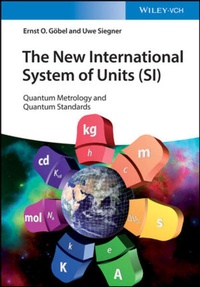
The New International System of Units (SI)
Description

The book is based on the book ?Quantum Metrology: Foundation of Units and Measurements? by the same authors.
From the contents:
-Measurement
-The SI (Système International d?Unités)
-Realization of the SI Second: Thermal Beam Cs Clock, Laser Cooling, and the Cs Fountain Clock
-Flux Quanta, Josephson Effect, and the SI Volt
-Quantum Hall Effect, the SI Ohm, and the SI Farad
-Single-Charge Transfer Devices and the SI Ampere
-The SI Kilogram, the Mole, and the Planck constant
-The SI Kelvin and the Boltzmann Constant
-Beyond the present SI: Optical Clocks and Quantum Radiometry
-Outlook
More details
Other editions
Additional editions
Persons
Ernst O. Göbel, PhD, was president of PTB from 1995 till 2011. His scientific background is in solid state and laser physics and laser spectroscopy. He was a member of the Comité International des Poids et Mesures, CIPM, from 1997 till 2013, and from 2004 till 2010, its president. He had been full professor at the University of Marburg and is member of several national and international academies. He has issued more than three hundred original scientific publications and is recipient of several scientific awards such as the Leibniz Prize of the German Research Foundation (DFG) and the Max Born Award jointly provided by the Institute of Physics (London) and the German Physical Society (DFG).
Uwe Siegner, PhD, is the head of the Electricity Division of PTB and a member of the Comité Consultatif d`Électricité et Magnétisme, CCEM, of the CIPM. He is an honorary professor at the Technical University of Braunschweig and a principal investigator of the Braunschweig International Graduate School of Metrology. His scientific background is in solid state physics and ultrafast laser optics and he has authored or co-authored about 100 original scientific publications in these fields.
Content
Preface
List of Abbreviations
INTRODUCTION
BASICS
Measurement
The SI (Système International d'Unités)
LASER COOLING, ATOMIC CLOCKS, AND THE SECOND
Techniques for Laser Cooling
The Cs-Fountain Clock
Optical Clocks
SUPERCONDUCTIVITY, JOSEPHSON EFFECT, AND FLUX QUANTA
Josephson Effect and Quantum Voltage Standards
Flux Quanta and Superconducting Quantum Interference Devices
QUANTUM HALL EFFECT
Basic Physics of Three- and Two Dimensional Semiconductors
Two-Dimensional Electron Systems in Real Semiconductors
The Hall Effect
Quantum Hall Resistance Standards
SINGLE-CHARGE TRANSFER DEVICES AND THE NEW AMPERE
Basic Physics of Single-Electron Transport
Quantized Current Sources
Consistency Tests: Quantum Metrology Triangle
PLANCK CONSTANT, THE NEW KILOGRAM, AND THE MOLE
The Avogadro Experiment
The Watt Balance Experiment
The Mole, Unit of Amount of Susbstance
BOLTZMANN CONSTANT AND THE NEW KELVIN
Primary Thermometers
Realization and Disseminiation of the New Kelvin
SINGLE-PHOTON METROLOGY AND QUANTUM RADIOMETRY
Single-Photon Sources
Single-Photon Detectors
Metrological Challenges
2
Some Basics
2.1 Measurement
Measurement is a physical process to determine the value or magnitude of a quantity. The quantity value can be calculated as follows:
(2.1)where {q} is the numerical value and [Q] the unit (see Section 2.2). The unit is thus simply a particular example of a quantity value. Equation (2.1) also applies for Q being a constant. If the numerical value of a constant is fixed, it defines the unit because their product must be equal to the quantity value, Q. This is the underlying concept of the present SI.
Repeated measurements of the same quantity, however, will generally result in slightly different results. In addition, systematic effects that impact the measurement result must be considered. Thus, any measurement result must be completed by an uncertainty statement. This measurement uncertainty quantifies the dispersion of quantity values being attributed to a measurand, based on the information used. Measurement uncertainty comprises, in general, many components. Some of the components may be evaluated by type A evaluation of measurement uncertainty from the statistical distribution of quantity values from a series of measurements and can be characterized by standard deviations. The other components, which may be evaluated by type B evaluation of measurement uncertainty, can also be characterized by standard deviations, evaluated from probability density functions based on experience or other information. For the evaluation of uncertainties in measurements, an international agreed guide has been published jointly by ISO and the Bureau International des Poids et Mesures (), the Guide to the Expression of Uncertainty in Measurement () [1-3]. Generally, precision measurements are those with smallest measurement uncertainty.
2.1.1 Limitations of Measurement Uncertainty
One might tend to believe that measurement uncertainty can be continuously decreased as more efforts are put in the respective experiment. However, this is not the case since there are fundamental as well as practical limitations for measurement precision. The fundamental limit is a consequence of the Heisenberg uncertainty principle of quantum mechanics, and the major practical limit is due to noise.
2.1.1.1 The Fundamental Quantum Limit
Note that throughout this book, we use the letter f to denote technical frequencies and the Greek letter ? to denote optical frequencies.
The Heisenberg uncertainty principle is a fundamental consequence of quantum mechanics stating that there is a minimum value for the physical quantity action, H:
(2.2)where h is the Planck constant. Action has the dimensions of energy multiplied by time and its unit is joule seconds. From the Heisenberg uncertainty principle, it follows that conjugated variables, such as position and momentum or time and energy, cannot be measured with ultimate precision at a time. For example, if ?x and ?p are the standard deviation for position, x, and momentum, p, respectively, the inequality relation holds (? = h/2p):
(2.3)Applied to measurement, the argument is as follows: during a measurement, information is exchanged between the measurement system and the system under consideration. Related to this is an energy exchange. For a given measurement time, t, or bandwidth of the measurement system, ?f = 1/t, the energy extracted from the system is limited according to Eq. (2.2) [4]:
(2.4)Let us now consider, for example, the relation between inductance, L, and, respectively, magnetic flux, F, and current, I (see Figure 2.1). The energy is given by E = (1/2)LI2 = (1/2)(F2/L), and consequently,
(2.5)Figure 2.1 Components and quantities considered (left) and the minimum current, Imin, and the minimum magnetic flux, Fmin, versus inductance, L, for an ideal coil.
Source: Kose and Melchert 1991 [4] . Reproduced with permission of John Wiley and Sons.
These relations are also depicted in Figure 2.1 . The gray area corresponds to the regime that is accessible by measurement. Note that this is a heuristic approach that does not consider a specific experiment. Nevertheless, it may provide useful conclusions on how to optimize an experiment. For instance, if an ideal coil (without losses) is applied to measure a small current, inductance should be large (e.g. L = 1 H, t = 1 s, and then Imin = 3.5 × 10⁻¹⁷ A). If instead the coil is applied to measure magnetic flux, L should be small (e.g. L = 10-10 H, t = 1 s, and then Fmin = 4 × 10-22 V s = 2 × 10⁻⁷ × F0, where F0 = h/2e is the flux quantum = 2.067 × 10⁻¹⁵ V s).
Similarly, for a capacitor with capacitance, C, the energy is given by
(2.6)and thus,
(2.7)Finally, for a resistor with resistance, R, the energy is given by
(2.8)and thus, for the minimum current and voltage, respectively, we obtain
(2.9)2.1.1.2 Noise
In this chapter, we briefly summarize some aspects of noise theory. For a more detailed treatment of this important and fundamental topic, the reader is referred to, for example, [5].
Noise limits the measurement precision in most practical cases. The noise power spectral density, P(T, f)/?f, can be approximated by (Planck formula)
(2.10)where f is the frequency, k the Boltzmann constant, and T the temperature. Two limiting cases can be considered as follows.
- (i) Thermal noise (Johnson noise) (kT » hf): (2.11)
According to this "Nyquist relation," the thermal noise power spectral density is independent of frequency (white noise) and increases linearly with temperature. Thermal noise was first studied by Johnson [6]. It reflects the thermal agitation of, for example, carriers (electrons) in a resistor.
- (ii) Quantum noise (hf » kT): (2.12)
The quantum noise power spectral density in this limit is determined by the zero point energy, hf, and is independent of temperature and increases linearly with frequency.
Thermal noise dominates at high temperatures and low frequencies (see Figure 2.2). The transition frequency, fc(T), where both contributions are equal depends on temperature and is given by
(2.13)This transition frequency amounts to 4.3 THz at T = 300 K and 60.6 GHz at the temperature of liquid He at T = 4.2 K.
The thermal noise in an electrical resistor at temperature T generates under open circuit or short circuit, respectively, a voltage or current with effective values:
(2.14) (2.15)To reduce thermal noise, the detector equipment should be cooled to low temperatures. Decreasing the temperature from room temperature (300 K) to liquid He temperature (4.2 K) reduces the thermal noise power by a factor of about 70. In addition, both thermal and quantum noise can be reduced by reducing the bandwidth, that is, by integrating over longer times, t. This, however, requires stable conditions during the measurement time, t. Unfortunately, however, other noises may be observed such as shot noise and at low frequencies the so-called 1/f noise.
- (iii) Shot noise: Shot noise originates from the discrete nature of the species carrying energy (e.g., electrons, photons). It was first discovered by Schottky [7] when studying the fluctuations of current in vacuum tubes. Shot noise is observed when the number of particles is small such that the statistical nature describing the occurrence of independent random events is described by the Poisson distribution. The Poisson distribution transforms into a normal (Gaussian) distribution as the number of particles increases. At low frequencies, shot noise is white; that is, the noise spectral density is independent of frequency and, in contrast to thermal noise, also independent of temperature. The shot noise spectral density of an electric current, Sel, at sufficiently low frequencies is given by (2.16)
where I is the average current. Similarly, for a monochromatic photon flux, we have the shot noise spectral density of photon flux, Sopt,
(2.17)where h? is the photon energy and P the average power.
- (iv) ...
