

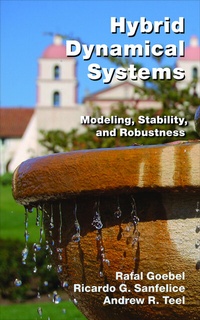
Hybrid Dynamical Systems
Modeling, Stability, and Robustness
1st Edition
Published on 18. March 2012
232 pages
978-1-4008-4263-6 (ISBN)
Description

Hybrid dynamical systems exhibit continuous and instantaneous changes, having features of continuous-time and discrete-time dynamical systems. Filled with a wealth of examples to illustrate concepts, this book presents a complete theory of robust asymptotic stability for hybrid dynamical systems that is applicable to the design of hybrid control algorithms--algorithms that feature logic, timers, or combinations of digital and analog components.
With the tools of modern mathematical analysis, Hybrid Dynamical Systems unifies and generalizes earlier developments in continuous-time and discrete-time nonlinear systems. It presents hybrid system versions of the necessary and sufficient Lyapunov conditions for asymptotic stability, invariance principles, and approximation techniques, and examines the robustness of asymptotic stability, motivated by the goal of designing robust hybrid control algorithms.
This self-contained and classroom-tested book requires standard background in mathematical analysis and differential equations or nonlinear systems. It will interest graduate students in engineering as well as students and researchers in control, computer science, and mathematics.
With the tools of modern mathematical analysis, Hybrid Dynamical Systems unifies and generalizes earlier developments in continuous-time and discrete-time nonlinear systems. It presents hybrid system versions of the necessary and sufficient Lyapunov conditions for asymptotic stability, invariance principles, and approximation techniques, and examines the robustness of asymptotic stability, motivated by the goal of designing robust hybrid control algorithms.
This self-contained and classroom-tested book requires standard background in mathematical analysis and differential equations or nonlinear systems. It will interest graduate students in engineering as well as students and researchers in control, computer science, and mathematics.
More details
Other editions
Additional editions
Rafal Goebel | Ricardo G. Sanfelice | Andrew R. Teel
Hybrid Dynamical Systems
Modeling, Stability, and Robustness
Book
03/2012
Princeton University Press
€116.50
Article not available at the moment
Persons
Rafal Goebel is an assistant professor in the Department of Mathematics and Statistics at Loyola University, Chicago. Ricardo G. Sanfelice is an assistant professor in the Department of Aerospace and Mechanical Engineering at the University of Arizona. Andrew R. Teel is a professor in the Electrical and Computer Engineering Department at the University of California, Santa Barbara.
Content
Preface ix
Chapter 1: Introduction 1
1.1 The modeling framework 1
1.2 Examples in science and engineering 2
1.3 Control system examples 7
1.4 Connections to other modeling frameworks 15
1.5 Notes 22
Chapter 2 The solution concept 25
2.1 Data of a hybrid system 25
2.2 Hybrid time domains and hybrid arcs 26
2.3 Solutions and their basic properties 29
2.4 Generators for classes of switching signals 35
2.5 Notes 41
Chapter 3 Uniform asymptotic stability, an initial treatment 43
3.1 Uniform global pre-asymptotic stability 43
3.2 Lyapunov functions 50
3.3 Relaxed Lyapunov conditions 60
3.4 Stability from containment 64
3.5 Equivalent characterizations 68
3.6 Notes 71
Chapter 4 Perturbations and generalized solutions 73
4.1 Differential and difference equations 73
4.2 Systems with state perturbations 76
4.3 Generalized solutions 79
4.4 Measurement noise in feedback control 84
4.5 Krasovskii solutions are Hermes solutions 88
4.6 Notes 94
Chapter 5 Preliminaries from set-valued analysis 97
5.1 Set convergence 97
5.2 Set-valued mappings 101
5.3 Graphical convergence of hybrid arcs 107
5.4 Differential inclusions 111
5.5 Notes 115
Chapter 6 Well-posed hybrid systems and their properties 117
6.1 Nominally well-posed hybrid systems 117
6.2 Basic assumptions on the data 120
6.3 Consequences of nominal well-posedness 125
6.4 Well-posed hybrid systems 132
6.5 Consequences of well-posedness 134
6.6 Notes 137
Chapter 7 Asymptotic stability, an in-depth treatment 139
7.1 Pre-asymptotic stability for nominally well-posed systems 141
7.2 Robustness concepts 148
7.3 Well-posed systems 151
7.4 Robustness corollaries 153
7.5 Smooth Lyapunov functions 156
7.6 Proof of robustness implies smooth Lyapunov functions 161
7.7 Notes 167
Chapter 8 Invariance principles 169
8.1 Invariance and ¿-limits 169
8.2 Invariance principles involving Lyapunov-like functions 170
8.3 Stability analysis using invariance principles 176
8.4 Meagre-limsup invariance principles 178
8.5 Invariance principles for switching systems 181
8.6 Notes 184
Chapter 9 Conical approximation and asymptotic stability 185
9.1 Homogeneous hybrid systems 185
9.2 Homogeneity and perturbations 189
9.3 Conical approximation and stability 192
9.4 Notes 196
Appendix: List of Symbols 199
Bibliography 201
Index 211
Chapter 1: Introduction 1
1.1 The modeling framework 1
1.2 Examples in science and engineering 2
1.3 Control system examples 7
1.4 Connections to other modeling frameworks 15
1.5 Notes 22
Chapter 2 The solution concept 25
2.1 Data of a hybrid system 25
2.2 Hybrid time domains and hybrid arcs 26
2.3 Solutions and their basic properties 29
2.4 Generators for classes of switching signals 35
2.5 Notes 41
Chapter 3 Uniform asymptotic stability, an initial treatment 43
3.1 Uniform global pre-asymptotic stability 43
3.2 Lyapunov functions 50
3.3 Relaxed Lyapunov conditions 60
3.4 Stability from containment 64
3.5 Equivalent characterizations 68
3.6 Notes 71
Chapter 4 Perturbations and generalized solutions 73
4.1 Differential and difference equations 73
4.2 Systems with state perturbations 76
4.3 Generalized solutions 79
4.4 Measurement noise in feedback control 84
4.5 Krasovskii solutions are Hermes solutions 88
4.6 Notes 94
Chapter 5 Preliminaries from set-valued analysis 97
5.1 Set convergence 97
5.2 Set-valued mappings 101
5.3 Graphical convergence of hybrid arcs 107
5.4 Differential inclusions 111
5.5 Notes 115
Chapter 6 Well-posed hybrid systems and their properties 117
6.1 Nominally well-posed hybrid systems 117
6.2 Basic assumptions on the data 120
6.3 Consequences of nominal well-posedness 125
6.4 Well-posed hybrid systems 132
6.5 Consequences of well-posedness 134
6.6 Notes 137
Chapter 7 Asymptotic stability, an in-depth treatment 139
7.1 Pre-asymptotic stability for nominally well-posed systems 141
7.2 Robustness concepts 148
7.3 Well-posed systems 151
7.4 Robustness corollaries 153
7.5 Smooth Lyapunov functions 156
7.6 Proof of robustness implies smooth Lyapunov functions 161
7.7 Notes 167
Chapter 8 Invariance principles 169
8.1 Invariance and ¿-limits 169
8.2 Invariance principles involving Lyapunov-like functions 170
8.3 Stability analysis using invariance principles 176
8.4 Meagre-limsup invariance principles 178
8.5 Invariance principles for switching systems 181
8.6 Notes 184
Chapter 9 Conical approximation and asymptotic stability 185
9.1 Homogeneous hybrid systems 185
9.2 Homogeneity and perturbations 189
9.3 Conical approximation and stability 192
9.4 Notes 196
Appendix: List of Symbols 199
Bibliography 201
Index 211
