

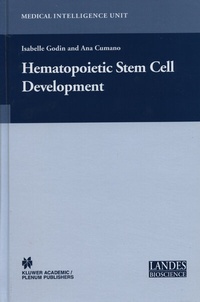
Hematopoietic Stem Cell Development
1st Edition
Published on 27. May 2010
XII, 178 pages
978-0-387-33535-3 (ISBN)
Description

Hematopoietic Stem Cells brings together articles covering the biology of hematopoietic stem cells during embryonic development, reporting particular aspects of fly, fish, avian and mammalian models. Thus, this book allows a comparative overview of hematopoietic stem cell generation in the different classes, emphasizing the conserved trends in development. This book culminates with state-of -the art knowledge on hematopoietic development in human species and discussions of the most recent breakthroughs with relevance to both researchers and clinicians.
More details
Other editions
Additional editions
Isabelle Godin | Ana Cumano
Hematopoietic Stem Cell Development
Book
12/2014
Springer
€160.49
Shipment within 15-20 days
Isabelle Godin | Ana Cumano
Hematopoietic Stem Cell Development
Book
02/2006
Kluwer Academic/Plenum Publishers
€160.49
Shipment within 10-15 days
Content
Ventral and Dorsal Contributions to Hematopoiesis in Xenopus.- Genetic Dissection of Hematopoiesis Using the Zebrafish.- Extra- and Intraembryonic HSC Commitment in the Avian Model.- Avian Lymphopoiesis and Transcriptional Control of Hematopoietic Stem Cell Differentiation.- Yolk Sac Development in Mice.- Long-Term Reconstituting Hematopoietic Stem Cell Capacity in the Embryo.- The Endothelium: The Cradle of Definitive Hematopoiesis?.- Endothelial and Hematopoietic Cells in the Intraembryonic Compartment.- Origin and Fate of Hematopoietic Precursors in the Early Mouse Embryo.- Hematopoietic Development in Drosophila: A Parallel with Vertebrates.- Intraembryonic Development of Hematopoietic Stem Cells during Human Ontogeny: Expression Analysis.- Gene and Cell Therapy Involving Hematopoietic Stem Cell.
"CHAPTER 8 Endothelial and Hematopoietic Cells in the Intraembryonic Compartment (p. 92)
Fumio Arai and Toshio Suda
Abstract The development of endothelial cells and hematopoietic cells is closely related at embryonic stages, and both cells share a common precursor, the hemangioblast. Differentiation into hematopoietic and endothelial lineages begins with proliferation ofa single layer of mesodermal cells in the yolk sac resulting in formation of cell clusters, the blood islands. Cells at the periphery of these mesodermal aggregations differentiate into angioblasts.
Blood vessels are formed by two different steps, vasculogenesisand angiogenesis. Cells in the interior of blood islands become primitive hematopoietic cells (HCs). Definitive hematopoies is develops from the P-Sp region as early as E8.5. By ElO.5, hematopoietic stem cells (HSCs) originate in the aorta-gonad-mesonephros (AGM) region. HSCs from this region colonize the fetal liver and then move to the spleen and bone marrow. In the embryo, HCs form clusters closely associated with and often adhering to endothelial cells on the ventral surface (floor) of the aorta. HCs that form these clusters also appear to be derived from the P-Sp.
In addition , hematopoietic clusters have also been identified in the vitelline and umbilical arteries, indicating that intraembryonic hematopoietic development is associatedwith the major arterial region of the embryo. Hematopoieticand endothelial lineagesexpressseveralgenesin common, such asVEGFR2, Tie2, and SCL/Tal-l. The fact that both lineages co-express common genes, many of which encode growth factor receptors or transcription factors, is not only consistent with the notion that they share a common precursor, but also suggests that similar molecular programs and growth regulatory mechanisms are involved in their development.
Moreover, it has been reponed that HSCs produce Angl, which promotes angiogenesis. Development ofVasculature Blood vessels in the embryo form through two different processes; vasculogenesis and angiogenesis (Fig. 1). The earliest stages ofvascular development, vasculogenesis, include differentiation, expansion, and coalescence of vascular endothelial cell precursors (EPCs) (angioblasrs) into the initial vascular network. 1 This initial network consists solely of vascular endothelial cells (ECs) that have formed similar sized interconnected vessels, and are thus referred to as the primary capillary plexus."
Fumio Arai and Toshio Suda
Abstract The development of endothelial cells and hematopoietic cells is closely related at embryonic stages, and both cells share a common precursor, the hemangioblast. Differentiation into hematopoietic and endothelial lineages begins with proliferation ofa single layer of mesodermal cells in the yolk sac resulting in formation of cell clusters, the blood islands. Cells at the periphery of these mesodermal aggregations differentiate into angioblasts.
Blood vessels are formed by two different steps, vasculogenesisand angiogenesis. Cells in the interior of blood islands become primitive hematopoietic cells (HCs). Definitive hematopoies is develops from the P-Sp region as early as E8.5. By ElO.5, hematopoietic stem cells (HSCs) originate in the aorta-gonad-mesonephros (AGM) region. HSCs from this region colonize the fetal liver and then move to the spleen and bone marrow. In the embryo, HCs form clusters closely associated with and often adhering to endothelial cells on the ventral surface (floor) of the aorta. HCs that form these clusters also appear to be derived from the P-Sp.
In addition , hematopoietic clusters have also been identified in the vitelline and umbilical arteries, indicating that intraembryonic hematopoietic development is associatedwith the major arterial region of the embryo. Hematopoieticand endothelial lineagesexpressseveralgenesin common, such asVEGFR2, Tie2, and SCL/Tal-l. The fact that both lineages co-express common genes, many of which encode growth factor receptors or transcription factors, is not only consistent with the notion that they share a common precursor, but also suggests that similar molecular programs and growth regulatory mechanisms are involved in their development.
Moreover, it has been reponed that HSCs produce Angl, which promotes angiogenesis. Development ofVasculature Blood vessels in the embryo form through two different processes; vasculogenesis and angiogenesis (Fig. 1). The earliest stages ofvascular development, vasculogenesis, include differentiation, expansion, and coalescence of vascular endothelial cell precursors (EPCs) (angioblasrs) into the initial vascular network. 1 This initial network consists solely of vascular endothelial cells (ECs) that have formed similar sized interconnected vessels, and are thus referred to as the primary capillary plexus."
