

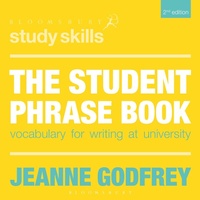
The Student Phrase Book
Vocabulary for Writing at University
2nd Edition
Published on 18. December 2019
240 pages
978-1-350-31558-7 (ISBN)
Description

The second edition of this concise phrase book is an essential tool for all students who want to communicate their ideas, arguments and evaluations clearly and precisely. Featuring over 2,000 words common to most academic disciplines, it will help students to expand their vocabulary, understand how these words are used and spot mistakes in their own academic writing. Units present the words in full sentences, enabling users to see exactly how they are used, and also include additional information on context, connotation and collocations.
This is an ideal reference guide for students of all disciplines and levels who are required to complete written assignments as part of their course. It is also a valuable resource for students looking to fine tune their vocabulary for job searches, interviews and writing for professional purposes.
New to this Edition:
- Now contains practice exercises so readers can test their understanding as they goRefreshed, more reader-friendly text design
This is an ideal reference guide for students of all disciplines and levels who are required to complete written assignments as part of their course. It is also a valuable resource for students looking to fine tune their vocabulary for job searches, interviews and writing for professional purposes.
New to this Edition:
- Now contains practice exercises so readers can test their understanding as they goRefreshed, more reader-friendly text design
More details
Series
Edition
2nd edition
Language
English
Place of publication
London
United Kingdom
Publishing group
Bloomsbury Publishing PLC
Target group
College/higher education
ISBN-13
978-1-350-31558-7 (9781350315587)
Copyright in bibliographic data and cover images is held by Nielsen Book Services Limited or by the publishers or by their respective licensors: all rights reserved.
Schweitzer Classification
Other editions
Additional editions

Book
01/2020
2nd Edition
Bloomsbury Academic
€27.50
Shipment within 15-20 days
Person
Jeanne Godfrey is a Teaching Fellow in the Language Centre at the University of Leeds, UK. She has been teaching in the field of English language for over twenty years and has been a Chair of the British Association of Lecturers in English for Academic Purposes. She set up one of the first Academic Writing Centres in a UK University and is now working with lecturers and students in many areas of learning and curriculum development, with particular emphasis on academic writing development. She is the author of Writing for University, Reading and Making Notes, The Business Student's Phrase Book, and How to Use Your Reading in Your Essays.
Content
Introduction
TOPIC, AIM AND ARGUMENT
1. Topic
2. Aim and scope
3. Proposition and argument
DEFINITIONS AND CLASSIFICATION
4. Brief definitions
5. Classification and characteristics
METHODOLOGY, METHOD AND FINDINGS
6. Methodology, model and method
7. Data, findings, problems and anomalies
AMOUNT, LEVEL AND PROPORTION
8. Amount, level, proportion and distribution
9. Adequate and inadequate amounts
CONTEXT, NORMS, RISK AND THREAT
10. Context, occurrence, norms and deviation
11. Advantage, disadvantage, risk and threat
COMMUNICATION, UNDERSTANDING AND POSITION
12. Communication, expression, signification and portrayal
13. Knowledge, understanding, way of thinking and belief
14. Position, point of view, impartiality and bias
15. Time, sequence, duration and frequency
16. Change, movement, trend and tendency
ENCOURAGEMENT, ALLOWANCE AND PREVENTION
17. Encouragement and improvement, discouragement and deterioration
18. Allowance, prevention, exclusion and elimination
ORIGIN, CAUSE, EFFECT AND LOGICAL RELATIONSHIP 19. Origin, cause and effect
20. Connection, compatibility, reciprocity and lack of relationship
COMPARISON, SIMILARITY AND DIFFERENCE21. Comparison, similarity, equivalence, convergence and balance
22. Difference, differentiation, diversity and divergence
ANALYSIS OF EVIDENCE AND ARGUMENTS,
23. Analysis of evidence and identification of argument flaws
24. Grouping of authors' ideas and identification of common themes
EVALUATION OF EVIDENCE AND ARGUMENTS
25. Authors' evaluations of each other
26. Your positive evaluation of evidence and arguments
27. Your negative evaluation of evidence and arguments
28. Your agreement, disagreement, and counterarguments
IMPORTANCE, IMPLICATIONS AND CONCLUSIONS
29. Linking evidence to theory and practice
30. Importance, significance and dominance
31. Influence and impact
CONCLUSIONS, CLARIFICATION AND FUTURE ACTION
32. Conclusions, implications and new ideas
33. Qualifying conclusions and degrees of certainty
34. Summary, clarification and restatement of position
35. Recommendations, advice and solutions
APPENDICES
Latin abbreviations and phrases
Word class: a brief explanation
Index: word table
Index: alphabetical
TOPIC, AIM AND ARGUMENT
1. Topic
2. Aim and scope
3. Proposition and argument
DEFINITIONS AND CLASSIFICATION
4. Brief definitions
5. Classification and characteristics
METHODOLOGY, METHOD AND FINDINGS
6. Methodology, model and method
7. Data, findings, problems and anomalies
AMOUNT, LEVEL AND PROPORTION
8. Amount, level, proportion and distribution
9. Adequate and inadequate amounts
CONTEXT, NORMS, RISK AND THREAT
10. Context, occurrence, norms and deviation
11. Advantage, disadvantage, risk and threat
COMMUNICATION, UNDERSTANDING AND POSITION
12. Communication, expression, signification and portrayal
13. Knowledge, understanding, way of thinking and belief
14. Position, point of view, impartiality and bias
15. Time, sequence, duration and frequency
16. Change, movement, trend and tendency
ENCOURAGEMENT, ALLOWANCE AND PREVENTION
17. Encouragement and improvement, discouragement and deterioration
18. Allowance, prevention, exclusion and elimination
ORIGIN, CAUSE, EFFECT AND LOGICAL RELATIONSHIP 19. Origin, cause and effect
20. Connection, compatibility, reciprocity and lack of relationship
COMPARISON, SIMILARITY AND DIFFERENCE21. Comparison, similarity, equivalence, convergence and balance
22. Difference, differentiation, diversity and divergence
ANALYSIS OF EVIDENCE AND ARGUMENTS,
23. Analysis of evidence and identification of argument flaws
24. Grouping of authors' ideas and identification of common themes
EVALUATION OF EVIDENCE AND ARGUMENTS
25. Authors' evaluations of each other
26. Your positive evaluation of evidence and arguments
27. Your negative evaluation of evidence and arguments
28. Your agreement, disagreement, and counterarguments
IMPORTANCE, IMPLICATIONS AND CONCLUSIONS
29. Linking evidence to theory and practice
30. Importance, significance and dominance
31. Influence and impact
CONCLUSIONS, CLARIFICATION AND FUTURE ACTION
32. Conclusions, implications and new ideas
33. Qualifying conclusions and degrees of certainty
34. Summary, clarification and restatement of position
35. Recommendations, advice and solutions
APPENDICES
Latin abbreviations and phrases
Word class: a brief explanation
Index: word table
Index: alphabetical
