

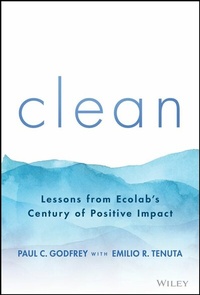
Clean
Description

In Clean: Lessons from Ecolab's Century of Positive Impact, a team of veteran sustainability experts delivers a practical toolkit for creating a forward-looking and sustainability-focused business. From Ecolab's origins in sustainability 100 years ago to its ambitious 2030 environment and social impact goals, this book lays out a roadmap for business transformation and continued growth - today and for the next 100 years.
You'll explore the principles and methods required to build and lead a sustainable company. You'll discover how to evolve your focus on sustainability over time, as your organization transforms and grows. You'll learn to:
* Build and maintain momentum for sustainability initiatives and cement your firm's commitment to new practices through iteration and aligning business units around core, shared sustainability goals.
* Embed new sustainable practices into your organization's governance and operations DNA
* Identify and leverage specific sustainability levers that impact a wide variety of key performance indicators
* Create a set of business processes that enable sustainable future and engage your employees in a higher purpose
An essential playbook for students of sustainability and business, this book is a must-read for the modern manager, executive, or director seeking to solidify their business strategy and future-proof their company. Clean: Lessons from Ecolab's Century of Positive Impact describes the holistic and comprehensive approach to responsible business that we've all been waiting for.
More details
Other editions
Additional editions
Persons
EMILIO R. TENUTA is the Chief Sustainability Officer at Ecolab, a global leader in water, hygiene and infection prevention solutions and services that help protect people and the resources vital to life. Over the past decade, Tenuta has led Ecolab's sustainability journey and has been actively involved in helping customers advance their global sustainability and ESG practices, with a focus on water stewardship and climate action.
Content
Acknowledgments
Chapter 1 The Call for a Sustainable World
Chapter 2 Perspective: The Foundation of Sustainability
Chapter 3 From Perspective to Purpose: eROI and the Three Phases of Sustainability
Chapter 4 The Tone at the Top: Executive Leadership and Management
Chapter 5 Leadership Throughout the Organization: 48,000 Strong and Counting
Chapter 6 Creating a Sustainable Product Pipeline
Chapter 7 Acquisitions: Sustainability through Addition
Chapter 8 Divestiture: Sustainability through Subtraction
Chapter 9 Catalyzing Sustainability through Multi-Stakeholder Partnerships
Chapter 10 Looking Forward to Ecolab's Second Century
About the Author
Index
Chapter 1
THE CALL FOR A SUSTAINABLE WORLD
Tó éí iiná (Water is Life)
-Navajo saying
Amid the chaos, fear, and confusion of the early days of the COVID-19 pandemic lockdowns, something unforeseen appeared: clean air. People around the globe found themselves in various states of lockdown as offices, restaurants, schools, theaters, and almost everything else shut down. With nowhere for drivers to go, the number of cars on the road plummeted. The result? Global levels of PM 2.5, the particulate matter that generates haze in both skies and lungs, declined by 30-40% and concentrations of the nasty pollutant sulfur dioxide fell 25-60% worldwide.1 In the crazy days of spring 2020, people from Tokyo to Tacoma, and from Boston to Buenos Aires breathed easier during the first months of a policy-induced global economic coma.
That global breath of fresh air reinforced two prevailing ideas about building a sustainable economy, in terms of both ecological renewal and human health. The first cemented the notion that dramatically reducing, if not eliminating, the fossil-fuel-powered internal combustion engine is an essential element. The second emerged from our collective consciousness as we experienced the outside world through Apple's Facetime, Facebook, Skype, Teams, or Zoom: digital technology would pave a golden road to a more sustainable world.
The pandemic experience validated the first idea; the second, less so. Consumer-facing apps from Amazon through Zillow can reduce travel, fuel usage, and foul air, as well as accidents, breathing disorders, and the stress and general mayhem that all come with commuting. That pristine view of the digital-economy-as-sustainable-economy gets murkier the farther we go back in the internet value chain. Movement from software to hardware reveals an expensive and extensive web of "server farms" that enable us to seamlessly connect to and transact over the web. As of 2020, there were 3 million of these farms, known as data centers, around the world, but 600 or so constitute the largest type, hyperscale data centers. These behemoths occupy up to 400,000 square feet (about 10 acres) and house up to 5,000 servers. An average data center may use up to 50MW of electricity a year, enough to power 32,500 homes in a developed country. All that electricity generates heat, and if the temperature in a center gets too high, the problems begin. At best, a center goes offline - at a cost of $8,000 per minute in lost revenue; at worst, 5,000 servers melt, at a cost of $75,000 to $100,000 each. Keeping those servers cool and functional requires massive air conditioning capacity, and an average center will use 200 million gallons of very clean water every year to keep servers cool. That's a year's worth of drinking water for up to 667,000 people, or a city the size of Portland, Oregon.2 With the amount of data being produced and stored expected to grow 50 times between 2019 and 2030, the expanding backbone of the internet presents its own sustainability challenge.
Where do the world's biggest server "farmers," from mega player Microsoft to specialist Digital Realty, turn to for help with managing their water needs? These "new economy" companies partner with a very "old economy" company for the most sophisticated and sustainable water management tools on the planet: Ecolab, founded in 1923, and its younger sister and subsidiary Nalco Water, founded in 1928. A sustainable digital economy depends very much on the deep knowledge, skills, and talents of companies with decades of experience in a sustainable industrial economy. The experience of Digital Realty, a San Francisco, California-based owner and operator of over 280 data centers in 50 metro areas around the globe, highlights the value of this knowledge and skill.
The core of the air conditioning system is a cooling tower, a very large unit that allows hot water - the heat generated by the servers - to cool by transferring that heat to the air. Digital Realty pays for the water it puts into that system and the water it discharges as sewage. The physics of a cooling tower, however, means that 80% of the input water evaporates during cooling, leaving Digital Realty to pay sewage charges for water it never returns to the system. Several US states, including California, offer an evaporation credit if a company can document its evaporation loss. Walter Leclerc, director of Environment Health and Safety for the company, brought in Nalco specialists to help document and claim those credits for one of its small centers in Los Angeles. The business result? Digital Realty now claims over $150,000 in annual evaporation credits just for that site.
That work, begun in 2015, established what is now a long-term partnership. Leclerc and Ecolab team members used tools such as the Smart Water NavigatorTM to create a global water use plan, and they deployed Nalco's 3D TRASARTM technology to implement the program along with Ecolab3DTM technology to document results. The partners worked together to create and implement a global water strategy and solution for data center management. As of 2022, Digital Realty used 30 million fewer gallons of water each year, consumed 17MW less electricity, and emitted 12,000 metric tons fewer greenhouse gases. That's good for the environment and the health of those living nearby. It's also good for the bottom line. Digital Realty has saved $8 million to date, for an ROI of 60%.3 Walter Leclerc says of his experience with Ecolab, "I could not have done it without them. Their technology is fantastic, but it's the people that make the difference."
I open with data centers because this business highlights two issues that I'll come back to throughout the book. First, the challenge of sustainability is multifaceted and complex and will require a mix of both simple and complex, industrial and digital innovations and solutions. Second, very "old line" companies like Ecolab and Nalco will play a significant role in creating a truly sustainable world. My research on water management led me to Ecolab, a 100-year-old company that developed, expanded, and nurtured a sustainable business model as it grew from a single employee to a team of over 48,000, each of whom possesses and deploys world-class expertise in environmental and human health. That expertise drives product, process, and service innovations that keep Ecolab in the vanguard of companies pioneering a sustainable future.
Sustainability may be a recent concept, but the principles that deliver it are ageless. In what follows, you'll see that Ecolab's success relies on a disciplined, integrated, long-term, and sophisticated approach to business. These aren't just one-off or timely tactics; the roots of Ecolab's success come from its application of enduring principles of business success. Whether you are online or old-line, you can adopt these principles to help your organization and people create the expertise we all need to build a truly sustainable world.
THE CHALLENGE OF SUSTAINABILITY
Neither Emilio nor I know if the sustainability movement has an undisputed birthday, but we both trace a pivot point in sustainability to the first Earth Day in the United States, April 22, 1970. A burning oil slick on Cleveland, Ohio's Cuyahoga River in the summer of 1969 dramatically illustrated the extent to which the natural environment had been used as an industrial dumping ground, and that first Earth Day catalyzed the need for change.
Fast forward to 1987; the United Nations joined the growing movement by appointing the Brundtland Commission to propel progress through a clear definition. That group defined a sustainable economy as one "that meets the needs of the present without compromising the ability of future generations to meet their own needs."4 That definition of sustainability holds today, but like most things in this space, it continues to be debated - refined by adherents and rejected by critics. At its core, a sustainable economy represents a complex compromise between two very old and deeply embedded ideas: progress and conservation.
The idea of progress, according to South African historian Jacobus Du Pisani, traces its roots back to the earliest days of the Hebrew (and eventually Christian) conception of history that portrayed time as linear and inevitably moving forward toward a clear end state. To the religious, that end state was either salvation or damnation. Progress, writ large, indicated blessing - and thus spiritual salvation. As the world secularized during the modern era, progress became embodied in the notion that economic, scientific, and social innovation would benefit people through an ever-improving material standard of living. The growth of the global population, increasing personal income, and increased longevity since the dawn of the Industrial Revolution in the late eighteenth century provide, for its advocates, powerful evidence of beneficial progress.
The need to offset the impact of progress through conservation traces back to ancient times as well. Indeed, Plato, Pliny, and other classical writers tutored their followers about the dangers of deforestation and environmental degradation caused by ever-encroaching human activity. The Industrial Revolution marked a pivot point where the scale and scope of economic activity began to seriously outstrip the planet's and its societies' ability to renew needed resources. Historians...
