

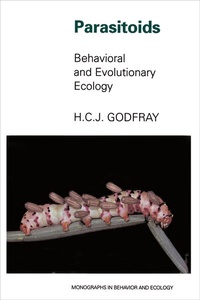
Parasitoids
Behavioral and Evolutionary Ecology
1st Edition
Published on 10. February 2020
488 pages
978-0-691-20702-5 (ISBN)
Description

Parasitoids lay their eggs on or in the bodies of other species of insect, and the parasitoid larvae develop by feeding on the host, causing its eventual death. Known for a long time to applied biologists for their importance in regulating the population densities of economic pests, parasitoids have recently proven to be valuable tools in testing many aspects of evolutionary theory. This book synthesizes the work of both schools of parasitoid biology and asks how a consideration of evolutionary biology can help us understand the behavior, ecology, and diversity of the approximately one to two million species of parasitoid found on earth.
After a general introduction to parasitoid natural history and taxonomy, the first part of the book treats the different components of the reproductive strategy of parasitoids: searching for a host, host selection, clutch size, and the sex ratio. Subsequent chapters discuss pathogens and non-Mendelian genetic elements that affect sexual reproduction; evolutionary aspects of the physiological interactions between parasitoid and host; mating strategies; life history theory and community ecology. A special effort is made to discuss the theoretical background to the subject, but without the use of mathematics.
After a general introduction to parasitoid natural history and taxonomy, the first part of the book treats the different components of the reproductive strategy of parasitoids: searching for a host, host selection, clutch size, and the sex ratio. Subsequent chapters discuss pathogens and non-Mendelian genetic elements that affect sexual reproduction; evolutionary aspects of the physiological interactions between parasitoid and host; mating strategies; life history theory and community ecology. A special effort is made to discuss the theoretical background to the subject, but without the use of mathematics.
More details
Other editions
Additional editions

Book
01/1994
Princeton University Press
€86.66
Article exhausted; check different version
Book
01/1994
Princeton University Press
€93.50
Article not available at the moment
Person
H.C.J. Godfray is Reader in Evolutionary Biology at Imperial College, University of London.
Content
- Cover
- Title
- Copyright
- Dedication
- Contents
- Acknowledgments
- 1 Introduction
- 1.1 Parasitoid Definitions
- 1.2 Parasitoid Natural History
- 1.3 Unusual Life Histories
- 1.4 Parasitoid Taxonomy
- 1.5 Evolutionary Transitions
- 1.6 Conclusions
- 2 Host Location
- 2.1 Conceptual Models of Host Location
- 2.2 Mechanisms of Host Location
- 2.3 Learning
- 2.4 Comparative Studies of Host Location
- 2.5 Patch Use
- 2.6 Conclusions
- 3 Oviposition Behavior
- 3.1 Host Acceptance
- 3.2 Clutch Size
- 3.3 Superparasitism
- 3.4 Conclusions
- 4 Sex Ratio
- 4.1 Sex Determination in Parasitoid Wasps
- 4.2 Fisher's Principle
- 4.3 Local Mate Competition and Sex Ratio in Structured Populations
- 4.4 Sex Ratio and Host Quality
- 4.5 Other Factors
- 4.6 Conclusions
- 5 Selfish Genetic Elements
- 5.1 Non-Mendelian Genetic Elements in Nasonia
- 5.2 Microorganisms and Thelytoky
- 5.3 Primary Male Production in Heteronomous Hyperparasitoids
- 5.4 Gregarious Oviposition in Muscidifurax
- 5.5 Conclusions
- 6 The Immature Parasitoid
- 6.1 Host Quality and the Juvenile Parasitoid
- 6.2 Host Defenses
- 6.3 Countermeasures
- 6.4 Host Manipulation by Endoparasitoids
- 6.5 Interactions between Immature Parasitoids
- 6.6 Conclusions
- 7 The Adult Parasitoid
- 7.1 Size and Fitness
- 7.2 Mating
- 7.3 Resource Defense and Maternal Care
- 7.4 Host Defense against the Adult Parasitoid
- 7.5 Dispersal
- 7.6 Defense from Predators
- 7.7 Host Synchronization
- 7.8 Conclusions
- 8 Life Histories and Community Patterns
- 8.1 Life History Evolution
- 8.2 Host Range and Parasitoid Species Load
- 8.3 Parasitoid Diversity
- 8.4 Conclusions
- References
- Author Index
- Subject Index
- Taxonomic Index
