

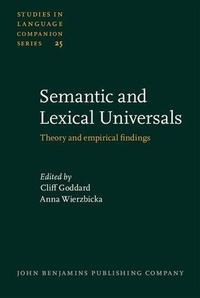
Semantic and Lexical Universals
Theory and empirical findings
1st Edition
Published on 4. May 1994
VIII, 510 pages
978-90-272-8578-2 (ISBN)
Description

This set of papers represents a unique collection; it is the first attempt ever to empirically test a hypothetical set of semantic and lexical universals across a number of genetically and typologically diverse languages. In fact the word 'collection' is not fully appropriate in this case, since the papers report research undertaken specifically for the present volume, and shaped by the same guidelines. They constitute parallel and strictly comparable answers to the same set of questions, coordinated effort with a common aim, and a common methodology.The goal of identifying the universal human concepts found in all languages, is of fundamental importance, both from a theoretical and a practical point of view, since these concepts provide the basis of the "psychic unity of mankind", underlying the clearly visible diversity of human cultures. They also allow us to better understand that diversity itself, because they provide a common measure, without which no precise and meaningful comparisons are possible at all. A set of truly universal (or even near-universal) concepts can provide us with an invaluable tool for interpreting, and explaining all the culture-specific meanings encoded in the language-and-culture systems of the world. It can also provide us with a tool for explaining meanings across cultures - in education, business, trade, international relations, and so on.
The book contains 13 chapters on individual languages including Japanese (by Masayuki Onishi), Chinese (by Hilary Chappel), Thai (by Anthony Diller), Ewe (Africa, by Felix Ameka), Miskitu languages of South America (by Kenneth Hall), Australian Aboriginal languages Aranda, Yankunytjatjara and Kayardild (by Jean Harkins & David Wilkins, Cliff Goddard, and Nicholas Evans), the Austronesian languages Samoan, Longgu, Acehnese and Mangap-Mbula (by Ulrike Mosel, Deborah Hill, Mark Durie and Robert Bugenhagen), the Papuan language Kalam (by Andrew Pawley), and, last but not least French (by Bert Peters).In addition to the chapters on individual languages the book includes three theoretical chapters; "Semantic theory and semantic universals" (by Goddard), "Introducing lexical primitives" (by Goddard and Wierzbicka), and "Semantic primitives across languages: a critical review" (by Wierzbicka).
The book contains 13 chapters on individual languages including Japanese (by Masayuki Onishi), Chinese (by Hilary Chappel), Thai (by Anthony Diller), Ewe (Africa, by Felix Ameka), Miskitu languages of South America (by Kenneth Hall), Australian Aboriginal languages Aranda, Yankunytjatjara and Kayardild (by Jean Harkins & David Wilkins, Cliff Goddard, and Nicholas Evans), the Austronesian languages Samoan, Longgu, Acehnese and Mangap-Mbula (by Ulrike Mosel, Deborah Hill, Mark Durie and Robert Bugenhagen), the Papuan language Kalam (by Andrew Pawley), and, last but not least French (by Bert Peters).In addition to the chapters on individual languages the book includes three theoretical chapters; "Semantic theory and semantic universals" (by Goddard), "Introducing lexical primitives" (by Goddard and Wierzbicka), and "Semantic primitives across languages: a critical review" (by Wierzbicka).
More details
Other editions
Additional editions
Book
05/1994
John Benjamins Publishing Co
€164.30
Shipment within 10-15 days
Persons
Content
- SEMANTIC AND LEXICAL UNIVERSALS
- Editorial page
- Title page
- Copyright page
- Table of contents
- Acknowledgements
- Opening Statement
- References
- Part 1: General
- Semantic Theory and Semantic Universals
- 1.1 Semantic Theory: Main Principles
- 1.2 Semantic Universals in the Twentieth Century
- 1.3 The NSM Search for Universal Semantic Primitives
- 1.4 Goals and Methods of the Present Project
- Notes
- References
- Introducing Lexical Primitives
- 2.1 Methodological Issues
- 2.1.1 The Problem of Polysemy
- 2.1.2 Formal versus Semantic Complexity
- 2.1.3 Allomorphy and Allolexy
- 2.1.4 Differences in Range of Use
- 2.1.5 Resonance
- 2.1.6 Non-Compositional Relationships
- 2.2 The Proposed Primitive Inventory
- 2.2.1 Substantives: I, YOU, SOMEONE, SOMETHING, PEOPLE
- 2.2.2 Mental Predicates: THINK, SAY, KNOW, FEEL, WANT
- 2.2.3 Determiners and Quantifiers: THIS, THE SAME, OTHER, ONE, TWO, MANY, ALL
- 2.2.4 Actions and Events: DO, HAPPEN (TO)
- 2.2.5 Meta-Predicates: NO, IF, CAN, LIKE, BECAUSE, VERY
- 2.2.6 Time and Place: WHEN, WHERE, AFTER, BEFORE, UNDER, ABOVE
- 2.2.7 Taxonomy and Partonomy: KIND OF, HAVE PARTS
- 2 2.8 Evaluators and Descriptors: GOOD, BAD, BIG, SMALL
- Notes
- References
- Appendix: Canonical Contexts for Lexical Primitives
- Part 2: Individual Language Studies
- Ewe
- 3.1 Substantives
- 3.2 Mental Predicates
- 3.3 Determiners and Quantifiers
- 3.4 Actions and Events
- 3.5 Meta-Predîcates
- 3.6 Time and Place
- 3.7 Taxonomy and Partonomy
- 3.8 Evaluators and Descriptors
- 3.9 Conclusion
- Notes
- References
- Ewe Texts
- The Exponents of Semantic Primitives in Mangap-Mbula
- 4.1 Substantives: I, YOU, SOMEONE, SOMETHING, PEOPLE
- 4.2 Mental Predicates: KNOW, FEEL, THINK, SAY, WANT
- 4.3 Determiners and Quantifiers: THIS, THE SAME, OTHER, Two, ALL
- 4.4 Actions and Events: Do, HAPPEN
- 4.5 Meta-Predicates: DON'T WANT, IF, COULD, LIKE, BECAUSE, VERY
- 4.6 Time and Place: WHEN, WHERE, AFTER, BEFORE, UNDER, ABOVE
- 4.7 Partonomy and Taxonomy: PART OF, KIND OF
- 4.8 Descriptors and Evaluators: GOOD, BAD
- 4.9 Evaluation and Problem Areas
- Notes
- References
- Mandarin Semantic Primitives
- 5.1 Substantives: I, You, SOMEONE, SOMETHING, PEOPLE
- 5.1.1 Wo I and Ni YOU (SG)
- Pronouns
- 5.1.2 Shéi SOMEONE
- Indefinite Pronoun
- 5.1.3 Shénme SOMETHING
- Indefinite Pronoun
- 5.1 4 Rénmen and Rén PEOPLE
- Nouns
- 5.2 Mental Predicates: THINK, KNOW, SAY, FEEL, WANT
- 5.2.1 Xiang THINK
- Cognitive Verbs
- 5.2.2 Zhidao KNOW
- Verb
- 5.2.3 Shuo SAY
- Verb
- 5.2.4 Expressions for FEEL: Ganjué and Gandào
- Verbs
- 5.2.5 Yào WANT
- Verb
- 5.3 Determiners and Quantifiers: THIS, THE SAME, OTHER, ONE, Two, ALL, MANY
- 5.3.1 Zhè(ge) THIS
- Demonstrative Pronoun
- 5.3.2 Tóng THE SAME
- 5.3.3 Lìng(wài) OTHER
- 5.3.4 Yi(ge) ONE and Liang(ge) TWO
- Numerals
- 5 3.5 Dou ALL
- Adverb
- 5.3.6 Xüduö MANY
- Adjective
- 5.4 Actions and Events: DO, HAPPEN TO (IN)
- 5.4.1 Zuò DO: Verb
- 5.4.2 HAPPEN Semantics in Mandarin: Adversity and Fàshëng
- 5.5 Meta-Predicates: NOT WANT, IF, COULD, LIKE, BECAUSE, VERY
- 5.5.1 Bù NOT WANT (NO)
- Negative Adverb
- 5.5.2 Conditional Hypotaxis: IF in Mandarin
- 5.5.3 Mandarin Irrealis: Kenéng COULD (POSSIBLY)
- Adverb
- 5.5.4 LIKE: A Case of Allosyntax
- 5.5.5 Causation: Yinwei BECAUSE
- Conjunction
- 5.5.6 Intensifier: Hen VERY
- Adverb of Degree
- 5.6 Time and Place: WHEN, WHERE, AFTER, BEFORE, ABOVE, BELOW
- 5.6.1 Shíhou TIME (WHEN)
- Noun
- 5.6.2 Dìfang PLACE (WHERE)
- Noun
- 5.6.3 Yihòu AFTER and Yiqián BEFORE
- Clause-Final Subordination Markers
- 5.6.4 Shàng ABOVE and Xià BELOW
- Postpositions
- 5.7 Meronymy and Taxonomy: A PART OF, A KIND OF
- 5.7.1 Possession and Meronymy: A Case of Allosyntax
- 5.7.2 Zhong A KIND OF
- Classifier
- 5.8 Evaluators and Descriptors: GOOD, BAD, BIG, SMALL
- 5.8.1 Hao GOOD and Huài BAD
- Stative Verbs
- 5.8.2 Dà BIG and Xiao SMALL
- Stative Verbs
- 5.9 Conclusion
- Notes
- References
- Thai
- 6.1 Substantives
- 6.2 Mental Predicates
- 6.3 Determiners and Quantifiers
- 6.4 Actions and Events
- 6.5 Meta-Predicates
- 6.6 Time and Place
- 6.7 Partonomy and Taxonomy
- 6.8 Evaluators and Descriptors
- 6.9 Conclusion
- Notes
- References
- Acehnese
- 7.1 Substantives
- 7.2 Mental Predicates
- 7.3 Determiners and Quantifiers
- 7.4 Actions and Events
- 7.5 Meta-Predicates
- 7.6. Time and Place
- 7.7 Partonomy and Taxonomy
- 7.8 Evaluators and Descriptors
- Notes
- References
- Kayardild
- 8.1 Substantives: I, YOU, SOMEONE, SOMETHING, PEOPLE
- 8.1.1 I and YOU
- 8.1.2 SOMEONE (WHO) and SOMETHING (WHAT)
- 8.1.3 PEOPLE
- 8.2 Mental Predicates: KNOW, WANT, THINK, FEEL, SAY
- 8.2.1 KNOW
- 8.2.2 WANT
- 8.2.3 THINK
- 8.2.4 FEEL
- 8.2.5 SAY
- 8.3 Determiners and Quantifiers: THIS, THE SAME, OTHER, ONE, Two, MUCH/MANY, ALL
- 8.3.1 THIS
- 8.3.2 THE SAME
- 8.3.3 OTHER
- 8.3.4 ONE, TWO and MUCH/MANY
- 8.3.5 ALL
- 8.4 Actions and Events: DO, HAPPEN (TO/IN)
- 8.4.1 DO
- 8.4.2 HAPPEN
- 8.5 Meta-Predicates: No, IF, COULD, LIKE, BECAUSE, VERY
- 8.5.1 NO
- 8.5.2 IF
- 8.5.3 COULD/CAN
- 8.5.4 LIKE
- 8.5.5 BECAUSE
- 8.5.6 VERY
- 8.6 Time and Place: WHEN, WHERE, AFTER, BEFORE, UNDER, ABOVE
- 8.6.1 WHEN and WHERE
- 8.6.2 AFTER and BEFORE
- 8.6.3 UNDER and ABOVE
- 8.7 Partonomy and Taxonomy: PART OF, KIND OF
- 8.7.1 PART (OF)/HAVING AS A PART
- 8.7.2 KIND (OF
- 8.8 Evaluative and Descriptive: GOOD, BAD, BIG, SMALL
- 8.9 Conclusion
- Notes
- References
- Lexical Primitives in Yankunytjatjara
- 9.1 Substantives
- 9.1.1 I and YOU
- 9.1.2 SOMEONE, SOMETHING and PEOPLE
- 9.1.3 Case Allolexy
- 9.2 Mental Predicates
- 9.2.1 KNOW and THINK
- 9.2.2 WANT
- 9.2.3 SAY
- 9.2.4 FEEL
- 9.3 Determiners and Quantifiers
- 9.3.1 ONE, TWO and ALL
- 9.3.2 MANY
- 9.3.3 OTHER
- 9.3.4 THIS
- 9.3.5 THE SAME
- 9.4 Actions and Events
- 9.4.1 HAPPEN (TO)
- 9.4.2 DO
- 9.5 Meta-Predicates
- 9.5.1 NO
- 9.5.2 BECAUSE
- 9.5.3 LIKE
- 9.5.4 CAN
- 9.5.5 IF
- 9.5.6 VERY
- 9.6 Time and Place
- 9.6.1 WHERE and WHEN
- 9.6.2 AFTER
- 9.6.3 UNDER and ABOVE
- 9.7 Partonomy and Taxonomy
- 9.7.1 HAVE PARTS
- 9.7.2 KIND OF
- 9.8 Evaluators and Descriptors
- 9.9 Concluding Remarks
- Notes
- References
- Preliminary Observations on Lexical and Semantic Primitives in the Misumalpan Languages of Nicaragua
- 10.1 Substantives: I, You, SOMEONE, SOMETHING, PEOPLE
- 10.2 Mental Predicates: THINK, KNOW, SAY, FEEL, WANT
- 10.3 Determiners and Quantifiers: THIS, THE SAME, OTHER, ONE, Two, ALL
- 10.4 Actions and Events: Do, HAPPEN
- 10.5 Meta-Predicates: IF, CAN, NO, BECAUSE, LIKE, VERY
- 10.6 Time and Place: WHEN, AFTER, BEFORE, WHERE, UNDER, ABOVE
- 10.7 Partonomy and Taxonomy: PART OF, KIND OF
- 10.8 Evaluators: GOOD, BAD
- 10.9 A Remark on Lexical and Semantic Universais
- Note
- References
- Mparntwe Arrernte and the Search for Lexical Universals
- 11.1 Substantives
- 11.2 Mental Predicates
- 11.3 Determiners and Quantifiers
- 11.4 Actions and Events
- 11.5 Meta-Predicates
- 11.6 Time and Place
- 11.7 Taxonomy and Partonomy
- 11.8 Evaluators and Descriptors
- Notes
- References
- Appendix: Summary of Proposed Equivalents
- Longgu
- 12.1 Substantives
- 12.2 Mental Predicates
- 12.3 Determiners and Quantifiers
- 12.4 Actions and Events
- 12.5 Meta-Predicates
- 12.6 Time and Place
- 12.7 Partonomy and Taxonomy
- 12.8 Evaluators and Descriptors
- 12.9 Conclusion
- Note
- References
- Samoan
- 13.1 Substantives
- 13.2 Mental Predicates
- 13.3 Determiners and Quantifiers
- 13.4 Actions and Events
- 13.5 Meta-Predicates
- 13.6 Time and Place
- 13.7 Partonomy and Taxonomy
- 13.8 Evaluators and Descriptors
- 13.9 Conclusion
- Notes
- References
- Semantic Primitives in Japanese
- 14.1 Substantives
- 14.2 Mental Predicates
- 14.3 Determiners and Quantifiers
- 14.4 Actions and Events: Sum Do and Okiru (Okoru) HAPPEN
- 14.5 Meta-Predicates
- 14.6 Time and Place: Itu WHEN (Itu-ka SOMETIME, Toki TIME), Doko WHERE (Doko-ka SOMEWHERE, Tokoro PLACE), AtoAFTER, Mae BEFORE, Sita UNDER and Ue ABOVE
- 14.7 Partonomy and Taxonomy: Bubun PART and Syurui KIND
- 14.8 Evaluators and Descriptors: Ii GOOD, Warui BAD, Ookii BIG and Tiisai SMALL
- 14.9 Conclusion
- Notes
- References
- Kalam Exponents of Lexical and Semantic Primitives
- 15.1 Substantives
- 15.1.1 I and YOU
- 15.1.2 SOMEONE, SOMETHING and PEOPLE
- 15.2 Mental Predicates
- 15.2.1 KNOW, THINK and FEEL
- 15.2.2 KNOW
- 15.2.3 THINK
- 15.2.4 FEEL
- 15.2.5 SAY
- 15.2.6 WANT
- 15.3 Determiners and Quantifiers
- 15.3.1 THIS
- 15.3.2 THE SAME
- 15.3.3 OTHER
- 15.3.4 ONE and TWO
- 15.3.5 MANY
- 15.3.6 ALL
- 15.4 Actions and Events
- 15.4.1 HAPPEN
- 15.4.2 DO
- 15.5 Meta-Predicates
- 15.5.1 NO/NOT
- 15.5.2 IF
- 15.5.3 BECAUSE
- 15.5.4 LIKE
- 15.5.5 CAN
- 15.5.6 VERY
- 15.6 Time and Place
- 15.6.1 WHERE and WHEN
- 15.6.2 AFTER (BEFORE
- 15.6.3 ABOVE and BELOW
- 15.7 Partonomy and Taxonomy
- 15.7.1 PART OF
- 15.7.2 KIND OF
- 15.8 Evaluators and Descriptors
- 15.8.1 GOOD and BAD
- 15.8.2 BIG and SMALL
- 15.9 Conclusion
- Notes
- References
- Semantic and Lexical Universals in French
- 16.1 Substantives
- 16.2 Mental Predicates
- 16.3 Determiners and Quantifiers
- 16.4 Actions and Events
- 16.5 Meta-Predicates
- 16.6 Time and Place
- 16.7 Partonomy and Taxonomy
- 16.8 Descriptors and Evaluators
- 16.9 Conclusion
- Note
- References
- Part 3: Review
- Semantic Primitives Across Languages: A Critical Review
- 17.1 Substantives
- 17.1.1 I and YOU
- 17.1.2 SOMEONE, SOMETHING and PEOPLE
- 17.2 Mental Predicates
- 17.2.1 KNOW
- 17.2.2 THINK
- 17.2.3 WANT
- 17.2.4 FEEL
- 17.2.5 SAY
- 17.3 Determiners and Quantifiers
- 17.3.1 THIS
- 17.3.2 THE SAME and OTHER
- 17.3.3 ONE and TWO
- 17.3.4 ALL
- 17.3.5 MUCH/ MANY
- 17.4 Actions and Events (Do and HAPPEN)
- 17.5 Meta-Predicates
- 17.5.1 NO (DON'T WANT)
- 17.5.2 LIKE
- 17.5.3 BECAUSE
- 17.5.4 IF
- 17.5.5 CAN and MAYBE
- 17.5.6 VERY
- 17.6 Time and Place
- 17.6.1 TIME (WHEN)
- 17.6.2 WHERE
- 17.6.3 AFTER and BEFORE
- 17.6.4 UNDER and ABOVE
- 17.7 Partonomy and Taxonomy
- 17.7.1 PART
- 17.7.2 KIND
- 17.8 Evaluators and Descriptors
- 17.8.1 BIG and SMALL (and VERY)
- 17.8.2 GOOD and BAD
- 17.9 Conclusion
- Notes
- References
- Notes on Contributors
- Index
- The series Studies in Language Companion Series
