

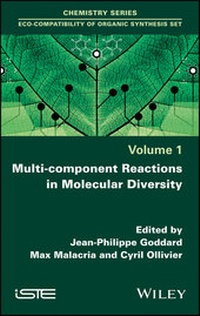
Multi-component Reactions in Molecular Diversity
1st Edition
Published on 14. April 2020
208 pages
978-1-119-68738-2 (ISBN)
Description

While very useful for studying syntheses of molecular diversity, multi-component reactions also offer rapid access to a variety of complex molecules that are relevant for biological applications.
Multi-component Reactions in Molecular Diversity analyzes these reactions, whether they are realized by organometallic, ionic or even radical processes. It highlights popular methods based on monotype reactions (cascade, tandem, domino) and their efficiency and academic industrial domain are illustrated. This book also investigates the most efficient ways to prepare complex molecules.
Multi-component reactions are in tune with the concepts of atom and steps economy, which are of prior importance in all the reported processes ? from the laboratory to the pilot scale. The essential criteria for green chemistry are also examined in the book in detail.
Multi-component Reactions in Molecular Diversity analyzes these reactions, whether they are realized by organometallic, ionic or even radical processes. It highlights popular methods based on monotype reactions (cascade, tandem, domino) and their efficiency and academic industrial domain are illustrated. This book also investigates the most efficient ways to prepare complex molecules.
Multi-component reactions are in tune with the concepts of atom and steps economy, which are of prior importance in all the reported processes ? from the laboratory to the pilot scale. The essential criteria for green chemistry are also examined in the book in detail.
More details
Other editions
Additional editions
Jean-Philippe Goddard | Max Malacria | Cyril Ollivier
Multi-component Reactions in Molecular Diversity
Book
02/2020
1st Edition
Wiley-ISTE
€165.50
Shipment within 3-4 weeks
Persons
Jean-Philippe Goddard is Professor of Molecular Chemistry at the University of Upper Alsace, France, and Deputy Director of LIMA (Laboratory of Molecular Innovation and Applications), Strasbourg, France.
Max Malacria is Emeritus Professor at Sorbonne University, Paris, France, where he researches the fields of catalysis, radical chemistry and aromaticity.
Cyril Ollivier is a CNRS Research Director at the IPCM (Parisian Institute of Molecular Chemistry) at Sorbonne University.
Max Malacria is Emeritus Professor at Sorbonne University, Paris, France, where he researches the fields of catalysis, radical chemistry and aromaticity.
Cyril Ollivier is a CNRS Research Director at the IPCM (Parisian Institute of Molecular Chemistry) at Sorbonne University.
Content
Chapter 1. Organometallic Multicomponent Reactions 1
Nuno MONTEIRO
1.1. Introduction 1
1.2. Multicomponent reactions: concept and applications 2
1.2.1. Concept and correlation with the principles of green chemistry 2
1.2.2. Origins and areas of application 5
1.3. Merging multicomponent and organometallic transformations 9
1.3.1. History: the predominant role of palladium 9
1.3.2. Contribution of catalysis in multicomponent reactions 12
1.3.3. Multicomponent catalytic reactions: design and applications 24
1.4. Conclusion 48
1.5. References 49
Chapter 2. Use of 1,3-Dicarbonyl Derivatives in Stereoselective Domino and Multicomponent Reactions 59
Damien BONNE, Thierry CONSTANTIEUX, Yoann COQUEREL and Jean RODRIGUEZ
2.1. Introduction 59
2.2. Domino reactions 61
2.2.1. Diastereoselective domino reactions 61
2.2.2. Enantioselective domino-domino reactions 69
2.3. Multicomponent reactions 81
2.3.1. Diastereoselective multicomponent reactions 81
2.3.2. Enantioselective multicomponent reactions 92
2.4. Conclusion 104
2.5. References 105
Chapter 3. Multicomponent Radical Processes: Recent Developments 121
Yannick LANDAIS
3.1. Polar effects: electrophilic and nucleophilic radical scales 122
3.2. Multicomponent radical reactions 123
3.2.1. Three-component radical reactions: radical additions to olefins 123
3.2.2. Three-component radical reactions: radical additions on imines 135
3.2.3. Four- and five-component radical reactions: carbonylation reactions 140
3.3. Multi-component radical-ionic reactions 145
3.3.1. Multi-component radical-anionic reactions 145
3.3.2. Multi-component radical-cationic reactions 157
3.4. Sequential multicomponent radical reactions 160
3.4.1. Organometallic-radical sequential reactions 160
3.4.2. Ugi reactions: radical reactions 161
3.4.3. Passerini reaction using radicals 163
3.5. Multicomponent reactions by photoredox catalysis 166
3.6. Conclusion 172
3.7. References 172
List of Authors 183
Index 185
Nuno MONTEIRO
1.1. Introduction 1
1.2. Multicomponent reactions: concept and applications 2
1.2.1. Concept and correlation with the principles of green chemistry 2
1.2.2. Origins and areas of application 5
1.3. Merging multicomponent and organometallic transformations 9
1.3.1. History: the predominant role of palladium 9
1.3.2. Contribution of catalysis in multicomponent reactions 12
1.3.3. Multicomponent catalytic reactions: design and applications 24
1.4. Conclusion 48
1.5. References 49
Chapter 2. Use of 1,3-Dicarbonyl Derivatives in Stereoselective Domino and Multicomponent Reactions 59
Damien BONNE, Thierry CONSTANTIEUX, Yoann COQUEREL and Jean RODRIGUEZ
2.1. Introduction 59
2.2. Domino reactions 61
2.2.1. Diastereoselective domino reactions 61
2.2.2. Enantioselective domino-domino reactions 69
2.3. Multicomponent reactions 81
2.3.1. Diastereoselective multicomponent reactions 81
2.3.2. Enantioselective multicomponent reactions 92
2.4. Conclusion 104
2.5. References 105
Chapter 3. Multicomponent Radical Processes: Recent Developments 121
Yannick LANDAIS
3.1. Polar effects: electrophilic and nucleophilic radical scales 122
3.2. Multicomponent radical reactions 123
3.2.1. Three-component radical reactions: radical additions to olefins 123
3.2.2. Three-component radical reactions: radical additions on imines 135
3.2.3. Four- and five-component radical reactions: carbonylation reactions 140
3.3. Multi-component radical-ionic reactions 145
3.3.1. Multi-component radical-anionic reactions 145
3.3.2. Multi-component radical-cationic reactions 157
3.4. Sequential multicomponent radical reactions 160
3.4.1. Organometallic-radical sequential reactions 160
3.4.2. Ugi reactions: radical reactions 161
3.4.3. Passerini reaction using radicals 163
3.5. Multicomponent reactions by photoredox catalysis 166
3.6. Conclusion 172
3.7. References 172
List of Authors 183
Index 185
