

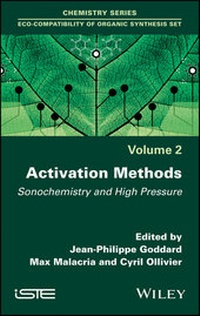
Activation Methods
Description

A straightforward method to use, sonochemistry allows chemical reactions to be carried out under ultrasound without the need for external heat, reagents or catalysts leading to high yields and the production of a minimum amount of waste. This book presents an overview of the main applications of sonochemistry in green organic chemistry, with an emphasis on texts published within the last few years.
High-pressure chemical reactions offer innovative solutions to problems relating to synthesis. They allow access to new products and a further understanding of reaction mechanisms. This book presents the characteristics of hyperbaric activation, which allow the integration of an arsenal of tools for green chemistry, such as the lowering of energy costs and of by-products, as well as the possibility of using substrates that are sterically congested and generally inert.
More details
Other editions
Additional editions
Persons
Max Malacria is Emeritus Professor at Sorbonne University, Paris, France, where he researches the fields of catalysis, radical chemistry and aromaticity.
Cyril Ollivier is a CNRS Research Director at the IPCM (Parisian Institute of Molecular Chemistry) at Sorbonne University.
Content
Micheline DRAYE, Julien ESTAGER and Nathalie KARDOS
1.1. Introduction: history of ultrasound, organic sonochemistry and early work 2
1.1.1. The history of ultrasound and organic sonochemistry 2
1.1.2. Pioneering work in organic sonochemistry 4
1.2. Some elements of ultrasound theory 14
1.2.1. Bubble dynamics 17
1.2.2. Factors affecting cavitation 21
1.2.3. Estimation of ultrasonic parameters 23
1.3. Laboratory and industrial equipment 28
1.3.1. Ultrasonic bath 29
1.3.2. Ultrasonic probes 31
1.3.3. High frequency reactors 32
1.3.4. Cup-horn reactors 32
1.3.5. Continuous reactors 33
1.4. Green organic sonochemistry 34
1.4.1. True and false sonochemistry 34
1.4.2. Synthesis in a homogeneous and heterogeneous system 35
1.4.3. Synthesis in a heterogeneous system 37
1.5. Sonochemistry in unconventional environments 53
1.5.1. Physical activator 53
1.5.2. Solvent-free chemistry 54
1.5.3. Ionic liquids and ultrasound 55
1.5.4. Sonochemistry in water 60
1.5.5. Sonochemistry in glycerol 64
1.5.6. Enzymatic chemistry under ultrasound 66
1.5.7. Sonoelectrosynthesis 74
1.6. Conclusion 74
1.7. References 76
Chapter 2. High-Pressure Synthesis: An Eco-friendly Chemistry 95
Isabelle CHATAIGNER and Jacques MADDALUNO
2.1. High pressures in synthetic chemistry 95
2.2. Important concepts 97
2.2.1. Physicochemistry of high pressures 97
2.2.2. Activation volume 101
2.2.3. Effect of high pressures on the solvent 104
2.3. Instrumentation 105
2.3.1. How can we generate high pressures? 105
2.3.2. Choice of equipment 108
2.3.3. Safety of the installations 112
2.4. Applications 114
2.4.1. Cycloaddition and annulation reactions 114
2.4.2. Nucleophilic addition reactions 125
2.4.3. Substitution reactions 136
2.4.4. Metallocatalyzed reactions 138
2.5. Conclusion 139
2.6. References 140
List of Authors 151
Index 153
1
Organic Sonochemistry: Ultrasound in Green Organic Synthesis
The evolution of chemistry, particularly organic chemistry, has had a serious impact in the 20th Century, from the health sector for the production of medicines, to the perfumes and clothing sector for the manufacture of dyes and textiles. While chemistry is at the root of extraordinary improvements in people's living conditions, its image has gradually deteriorated as a result of incidents and accidents with dramatic ecological and/or human consequences. A global awareness of the impact of human activities on the environment has given rise to the neologism of sustainability. The concept of "green chemistry" or "sustainable chemistry" was first developed in the United States in the early 1990s with the objective of defining rules to pollution prevention related to chemical activities. These concepts led to the edition of 12 principles - often refered to as "the twelve principles of Green Chemistry".
Among the activation techniques available to meet this new paradigm, the extraordinary properties of ultrasound and sonochemistry play an important role. Indeed, sonochemistry is simple to use, and allows chemical reactions to be carried out under ultrasound, sometimes preventing the need for external heat, reagents or catalysts, leading to high yields and the production of a minimum amount of waste.
From the discovery of ultrasound to its use in green organic chemistry, this chapter provides an overview of the main applications of sonochemistry in organic chemistry and especially in "green organic chemistry", with a particular focus on the work published in the literature in recent years including some elements on ultrasound theory and the equipment used to produce it.
1.1. Introduction: history of ultrasound, organic sonochemistry and early work
While some butterflies imagine escaping their vampire predators by engaging in complicated aerial figures, others produce ultrasounds that repel these fearsome chiroptera, thus informing them that dinner looks detestable (Gouaillier 2001). While this story is 56 million years old between butterflies and bats, humankind did not learn to use ultrasound reliably until the early 20th Century.
1.1.1. The history of ultrasound and organic sonochemistry
Between 1793 and 1798, Father Lazzaro Spallanzani (1729-1799) and his colleague Doctor Louis Jurine (1751-1819) suspected the existence of ultrasound by observing that bats orient themselves in darkness without any difficulty. In 1880, Marcellin Berthelot wrote that "a multitude of chemical transformations are attributed today to the energy of ethereal matter, animated by these vibratory and other movements that produce calorific, luminous and electrical phenomena" (Berthelot 1880). In 1883, physiologist Francis Galton (1822-1911) discovered them by inventing the "ultrasonic whistle". Nevertheless, it was the discovery of piezoelectricity in 1880 by the brothers Pierre (1859-1906) and Jacques (1856-1941) Curie, which made it possible after 1883 to produce and to use ultrasound easily and repeatedly. Paul Langevin (1872-1946) then had the idea of applying the phenomenon of piezoelectricity to the production and reception of ultrasound. After the tragedy of the Titanic in 1912, he proposed their use for iceberg detection. Then, in 1915, during the First World War, he developed a way to detect submarines by means of ultrasound; and in 1917, together with the engineer Constantin Chilowski, he invented the ASDIC (Anti-Submarine Detection Investigation Committee), an ancestor of Sonar, thus opening a field of industrial applications to these vibrations undetected by the human ear. The large number of fundamental discoveries between 1920 and 1939, as well as the technical improvements made, particularly concerning vibration converters, paved the way for the industrial development of ultrasound in cleaning, welding, drilling and medical applications. In 1951, J.J. Wild (1914-2009) and J. Reid (1926) developed the first ultrasound scanner for brain tumor research; it is now mainly used in obstetrics.
At the same time, studies have shown that ultrasound can change the medium in which it propagates and the work of Robert William Wood (1868-1955) and Alfred Lee Loomis (1887-1975) in biology and that of Theodore William Richards (1868-1928) and Alfred Lee Loomis in chemistry are generally considered as the first sonochemical experiments (Richards and Loomis 1927; Woods and Loomis 1927).
In 1928, Edmund Newton Harvey (1887-1959) and Alfred Lee Loomis observed, among other things, the destruction of frog blood cells irradiated by high frequency ultrasound (Harvey and Loomis 1928).
In 1933, Sándor Szalay showed that at an ultrasound frequency of 722 kHz can depolymerize starch, gum arabic and gelatin, thus reducing their viscosity (Szalay 1933; Szent-György 1933).
The same year, Earl Flosdorf and Leslie Chambers (1933) described the action of ultrasound for instant coagulation of proteins, oxidation of inorganic halides to dihalogens and hydrogen sulfide to sulfur by molecular oxygen.
They continued this work by studying the denaturation of proteins under ultrasound (Chambers and Flosdorf 1936), which they explained via the direct transfer of energy from the gases present to the protein molecules, without chemical intervention.
One year later, H. Frenzel and H. Schultes observed the luminescence emitted by water subjected to ultrasound during an experiment on Sonar (Frenzel and Schultes 1934).
E. Newton Harvey (Harvey 1939), P.O. Prudhomme (Prudhomme 1957) and R.H. Busso (Prudhomme and Busso 1952) and many others (for instance Griffing and Sette 1955) later carried out research dedicated to understanding this phenomenon.
In 1937, Sven Brohult carried out the partial fractionation of the hemocyanins of Helix pomatia, a Burgundy snail, by subjecting diluted solutions of their metalloproteins to ultrasound at a frequency of 250 kHz. He thus obtained uniform fragments 1/2 and 1/8 length of the initial molecule and observed an increase in the temperature of the medium (Brohult 1937).
In 1960, J. Giuntini and his collaborators (Hannoun et al. 1960) studied the action of ultrasound on the influenza virus, inactivating its infectious power while activating the vaccinating power.
1.1.2. Pioneering work in organic sonochemistry
It was not until the 1950s, with the development of more reliable ultrasonic generators, that researchers became interested in the effect of ultrasound for organic synthesis. Indeed, the main objective of the first studies carried out in organic sonochemistry was to study the effect of ultrasound on organic molecules in an aqueous medium (Zechmeister and Wallcave 1955; Zechmeister and Curelle 1958; Currelle et al. 1963) and not their use for organic chemical reactions.
For example, S. Prakash and J.D. Pandey (Prakash and Pandey 1965) studied the sonolysis of aliphatic and aromatic halogen compounds. They observed that iodobenzene and ortho-dichlorobenzene produce hydrogen halides while ethyl iodide releases molecular iodine. They also studied the kinetics of ultrasonic cleavage reactions and showed that the amount of halogen released increases with the duration of ultrasonic irradiation. In addition, the amount of free halogen increases up to a certain irradiation time beyond which a plateau is reached or a decrease is observed. Based on the knowledge of the phenomenon of transient acoustic cavitation (section 1.2.1.2), the authors proposed a mechanism for the formation of the various products of halocarbon sonolysis in aqueous media (Figure 1.1). The decomposition of water molecules is the main cause of the transformation of solute molecules. When ethyl iodide, iodobenzene and orthodichlorobenzene are decomposed, two primary reactions occur simultaneously (1). The decomposition of water mainly leads to the production of H. and OH. radicals. (1). Hydrogen peroxide is formed by the recombination of OH. radicals but also via the mechanism (2) in an oxygenated environment. The release of halogen radicals can occur according to mechanisms (3), (4) and (5). Since the energy of the C-I bond is lower than the ones of the C-Br and C-Cl bonds, the C-I bond is probably easily cleaved by the available ultrasonic energy. The activated oxygen generated oxidizes the alcohol to an aldehyde, which is then over-oxidized to a carboxylic acid (6). Acetylene and diacetylene being formed, as already observed by other authors (Zechmeister and Wallcave 1955; Zechmeister and Curelle 1958; Currell et al. 1963), are from the decomposition, caused by acoustic cavitation, of iodobenzene, phenol and o-dichlorobenzene, or from their depolymerization (7). Dichlorobenzene leads to the formation of chlorophenol, hydrochloric acid and catechol (5).
Subsequently, experiments were carried out by L.A. Spurlock and S.B. Reifsneider (1970) to investigate and understand the mechanisms of chemical transformations of simple molecules such as dibutyl sulfide when subject to ultrasound. The irradiation of dibutyl sulfide, in water and under argon atmosphere, at a frequency of 800 kHz primarily leads to the formation of dibutylsulfoxide, n-butane-sulfonic acid and traces of butanoic acid in the aqueous phase. The analysis of the gas phase reveals the presence of carbon monoxide, methane, ethylene and acetylene, of which butanal would be the probable...
