

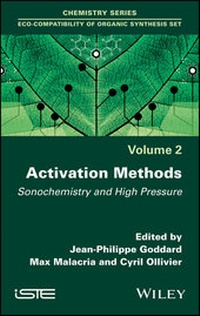
Activation Methods
Sonochemistry and High Pressure
1st Edition
Published on 30. December 2019
176 pages
978-1-119-68741-2 (ISBN)
Description

Activation Methods examines recent improvements in the utilization of ultrasonic waves and pressurized gases to generate reactions.
A straightforward method to use, sonochemistry allows chemical reactions to be carried out under ultrasound without the need for external heat, reagents or catalysts leading to high yields and the production of a minimum amount of waste. This book presents an overview of the main applications of sonochemistry in green organic chemistry, with an emphasis on texts published within the last few years.
High-pressure chemical reactions offer innovative solutions to problems relating to synthesis. They allow access to new products and a further understanding of reaction mechanisms. This book presents the characteristics of hyperbaric activation, which allow the integration of an arsenal of tools for green chemistry, such as the lowering of energy costs and of by-products, as well as the possibility of using substrates that are sterically congested and generally inert.
A straightforward method to use, sonochemistry allows chemical reactions to be carried out under ultrasound without the need for external heat, reagents or catalysts leading to high yields and the production of a minimum amount of waste. This book presents an overview of the main applications of sonochemistry in green organic chemistry, with an emphasis on texts published within the last few years.
High-pressure chemical reactions offer innovative solutions to problems relating to synthesis. They allow access to new products and a further understanding of reaction mechanisms. This book presents the characteristics of hyperbaric activation, which allow the integration of an arsenal of tools for green chemistry, such as the lowering of energy costs and of by-products, as well as the possibility of using substrates that are sterically congested and generally inert.
More details
Other editions
Additional editions
Jean-Philippe Goddard | Max Malacria | Cyril Ollivier
Activation Methods
Sonochemistry and High Pressure
Book
01/2020
1st Edition
Wiley-ISTE
€164.50
Shipment within 3-4 weeks
Persons
Jean-Philippe Goddard is Professor of Molecular Chemistry at the University of Upper Alsace, France, and Deputy Director of LIMA (Laboratory of Molecular Innovation and Applications), Strasbourg, France.
Max Malacria is Emeritus Professor at Sorbonne University, Paris, France, where he researches the fields of catalysis, radical chemistry and aromaticity.
Cyril Ollivier is a CNRS Research Director at the IPCM (Parisian Institute of Molecular Chemistry) at Sorbonne University.
Max Malacria is Emeritus Professor at Sorbonne University, Paris, France, where he researches the fields of catalysis, radical chemistry and aromaticity.
Cyril Ollivier is a CNRS Research Director at the IPCM (Parisian Institute of Molecular Chemistry) at Sorbonne University.
Content
Chapter 1. Organic Sonochemistry: Ultrasound in Green Organic Synthesis 1
Micheline DRAYE, Julien ESTAGER and Nathalie KARDOS
1.1. Introduction: history of ultrasound, organic sonochemistry and early work 2
1.1.1. The history of ultrasound and organic sonochemistry 2
1.1.2. Pioneering work in organic sonochemistry 4
1.2. Some elements of ultrasound theory 14
1.2.1. Bubble dynamics 17
1.2.2. Factors affecting cavitation 21
1.2.3. Estimation of ultrasonic parameters 23
1.3. Laboratory and industrial equipment 28
1.3.1. Ultrasonic bath 29
1.3.2. Ultrasonic probes 31
1.3.3. High frequency reactors 32
1.3.4. Cup-horn reactors 32
1.3.5. Continuous reactors 33
1.4. Green organic sonochemistry 34
1.4.1. True and false sonochemistry 34
1.4.2. Synthesis in a homogeneous and heterogeneous system 35
1.4.3. Synthesis in a heterogeneous system 37
1.5. Sonochemistry in unconventional environments 53
1.5.1. Physical activator 53
1.5.2. Solvent-free chemistry 54
1.5.3. Ionic liquids and ultrasound 55
1.5.4. Sonochemistry in water 60
1.5.5. Sonochemistry in glycerol 64
1.5.6. Enzymatic chemistry under ultrasound 66
1.5.7. Sonoelectrosynthesis 74
1.6. Conclusion 74
1.7. References 76
Chapter 2. High-Pressure Synthesis: An Eco-friendly Chemistry 95
Isabelle CHATAIGNER and Jacques MADDALUNO
2.1. High pressures in synthetic chemistry 95
2.2. Important concepts 97
2.2.1. Physicochemistry of high pressures 97
2.2.2. Activation volume 101
2.2.3. Effect of high pressures on the solvent 104
2.3. Instrumentation 105
2.3.1. How can we generate high pressures? 105
2.3.2. Choice of equipment 108
2.3.3. Safety of the installations 112
2.4. Applications 114
2.4.1. Cycloaddition and annulation reactions 114
2.4.2. Nucleophilic addition reactions 125
2.4.3. Substitution reactions 136
2.4.4. Metallocatalyzed reactions 138
2.5. Conclusion 139
2.6. References 140
List of Authors 151
Index 153
Micheline DRAYE, Julien ESTAGER and Nathalie KARDOS
1.1. Introduction: history of ultrasound, organic sonochemistry and early work 2
1.1.1. The history of ultrasound and organic sonochemistry 2
1.1.2. Pioneering work in organic sonochemistry 4
1.2. Some elements of ultrasound theory 14
1.2.1. Bubble dynamics 17
1.2.2. Factors affecting cavitation 21
1.2.3. Estimation of ultrasonic parameters 23
1.3. Laboratory and industrial equipment 28
1.3.1. Ultrasonic bath 29
1.3.2. Ultrasonic probes 31
1.3.3. High frequency reactors 32
1.3.4. Cup-horn reactors 32
1.3.5. Continuous reactors 33
1.4. Green organic sonochemistry 34
1.4.1. True and false sonochemistry 34
1.4.2. Synthesis in a homogeneous and heterogeneous system 35
1.4.3. Synthesis in a heterogeneous system 37
1.5. Sonochemistry in unconventional environments 53
1.5.1. Physical activator 53
1.5.2. Solvent-free chemistry 54
1.5.3. Ionic liquids and ultrasound 55
1.5.4. Sonochemistry in water 60
1.5.5. Sonochemistry in glycerol 64
1.5.6. Enzymatic chemistry under ultrasound 66
1.5.7. Sonoelectrosynthesis 74
1.6. Conclusion 74
1.7. References 76
Chapter 2. High-Pressure Synthesis: An Eco-friendly Chemistry 95
Isabelle CHATAIGNER and Jacques MADDALUNO
2.1. High pressures in synthetic chemistry 95
2.2. Important concepts 97
2.2.1. Physicochemistry of high pressures 97
2.2.2. Activation volume 101
2.2.3. Effect of high pressures on the solvent 104
2.3. Instrumentation 105
2.3.1. How can we generate high pressures? 105
2.3.2. Choice of equipment 108
2.3.3. Safety of the installations 112
2.4. Applications 114
2.4.1. Cycloaddition and annulation reactions 114
2.4.2. Nucleophilic addition reactions 125
2.4.3. Substitution reactions 136
2.4.4. Metallocatalyzed reactions 138
2.5. Conclusion 139
2.6. References 140
List of Authors 151
Index 153
