

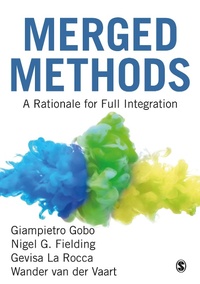
Merged Methods
A Rationale for Full Integration
1st Edition
Published on 27. October 2021
312 pages
978-1-5297-6581-6 (ISBN)
Description

A new turn in mixed methods research is here: merged methods. This provocative book offers a novel analysis of current mixed methods research, complicating traditional approaches and challenging existing techniques.
Moving beyond the binary quantitative-qualitative distinction, the book presents methodologically grounded ways to merge methods in social research and integrate interpretive and structural approaches in one instrument or procedure.
The book:
Considers the importance of merging both epistemologies and methodologies.
Showcases eight merged methods research approaches, from the Delphi method to multimodal content analysis.
Explores the opportunities for merging methods using computational techniques, such as text mining.
This innovative book is a must-read for any postgraduate student or researcher across the social sciences wanting to develop their understanding of mixed methods research.
Moving beyond the binary quantitative-qualitative distinction, the book presents methodologically grounded ways to merge methods in social research and integrate interpretive and structural approaches in one instrument or procedure.
The book:
Considers the importance of merging both epistemologies and methodologies.
Showcases eight merged methods research approaches, from the Delphi method to multimodal content analysis.
Explores the opportunities for merging methods using computational techniques, such as text mining.
This innovative book is a must-read for any postgraduate student or researcher across the social sciences wanting to develop their understanding of mixed methods research.
Reviews / Votes
A ground-breaking text that dismantles the concepts of qualitative and quantitative, demonstrating how their distinction is both artificial and limiting, instead proposing research techniques that harness their points of interface and maximise their various strengths. An asset to the field. -- Felicity BoardmanMore details
Edition
1. Auflage
Language
English
Place of publication
London
United Kingdom
Publishing group
Sage Publications Ltd (Digital)
Target group
College/higher education
Product notice
Reflowable
ISBN-13
978-1-5297-6581-6 (9781529765816)
Copyright in bibliographic data and cover images is held by Nielsen Book Services Limited or by the publishers or by their respective licensors: all rights reserved.
Schweitzer Classification
Other editions
Additional editions
Giampietro Gobo | Nigel G. Fielding | Gevisa La Rocca
Merged Methods
A Rationale for Full Integration
Book
10/2021
1st Edition
SAGE Publications Ltd
€191.90
Shipment within 15-20 days
Giampietro Gobo | Nigel G. Fielding | Gevisa La Rocca
Merged Methods
A Rationale for Full Integration
Book
10/2021
1st Edition
SAGE Publications Ltd
€80.50
Shipment within 15-20 days
Persons
Giampietro Gobo is Professor of Methodology of Social Research and Sociology of Science at the University of Milan (Italy). He was one of the founders of the 'Qualitative Methods' Research Network of the European Sociological Association.
His interests concern scientific controversies on health issues and workplace studies. He is currently undertaking projects on immunization and COVID-19 policies, and ethnographic experiments in the area of cooperation in small teamwork. His books include Doing Ethnography (Sage, 2008), Qualitative Research Practice (co-edited with C. Seale, J. F. Gubrium and D. Silverman, Sage, 2004) and Constructing Survey Data: An Interactional Approach (with S. Mauceri, Sage, 2014). Nigel Fielding, BA (Sussex) MA (Kent) PhD (LSE), is Emeritus Professor of Sociology at the University of Surrey, a Fellow of the Academy of Social Sciences, and a member of the Community of Experts of the European Science Foundation, and served on the Mixed Methods Research Association's presidential task force on the future of mixed methods.
His interests in research methodology include mixed methods, socio-spatial methods, qualitative software, interview methods, field observation, and digitally-mediated fieldwork. Nigel has authored/edited 27 books, many in research methodology, including The SAGE Handbook of Online Research Methods, Sage, 2018 (second edition), with Grant Blank and Ray Lee.
Gevisa La Rocca is Associate Professor of Sociology of Communication at the University Kore of Enna (Italy) and a member of the Scientific Council of the Processes and Cultural Institutions Group of the Italian Association of Sociology. She has a background in sociology, communication, quantitative and qualitative research methods.
Her research interests cover communication research, hashtags studies, textual data analysis, risk studies. On these topics, she has written several articles for national and international journals (Sage Open, Revue Internationale De Sociologie, Barataria. Revista Castellano-Manchega de Ciencias Sociales) and co-edited the book Technological and Digital Risk: Research Issues (with J. Martinez-Torvisco, Peter Lang, 2020). Wander van der Vaart is Associate Professor of Social Research Methodology at the University of Humanistic Studies, Utrecht (The Netherlands) and serves as a Vice-President of RC33, the Research Committee on Logic and Methodology of the International Sociological Association. He has a background in quantitative and qualitative research methods, political science and psychology.
His interests are in flexible surveys and study designs for hard-to-study populations and phenomena. His publications appear in methods oriented journals (Field Methods, Journal of Official Statistics, Quality and Quantity, International Journal of Public Opinion Research) and substantive journals (Journal of Aging and Environment, Applied Cognitive Psychology).
His interests concern scientific controversies on health issues and workplace studies. He is currently undertaking projects on immunization and COVID-19 policies, and ethnographic experiments in the area of cooperation in small teamwork. His books include Doing Ethnography (Sage, 2008), Qualitative Research Practice (co-edited with C. Seale, J. F. Gubrium and D. Silverman, Sage, 2004) and Constructing Survey Data: An Interactional Approach (with S. Mauceri, Sage, 2014). Nigel Fielding, BA (Sussex) MA (Kent) PhD (LSE), is Emeritus Professor of Sociology at the University of Surrey, a Fellow of the Academy of Social Sciences, and a member of the Community of Experts of the European Science Foundation, and served on the Mixed Methods Research Association's presidential task force on the future of mixed methods.
His interests in research methodology include mixed methods, socio-spatial methods, qualitative software, interview methods, field observation, and digitally-mediated fieldwork. Nigel has authored/edited 27 books, many in research methodology, including The SAGE Handbook of Online Research Methods, Sage, 2018 (second edition), with Grant Blank and Ray Lee.
Gevisa La Rocca is Associate Professor of Sociology of Communication at the University Kore of Enna (Italy) and a member of the Scientific Council of the Processes and Cultural Institutions Group of the Italian Association of Sociology. She has a background in sociology, communication, quantitative and qualitative research methods.
Her research interests cover communication research, hashtags studies, textual data analysis, risk studies. On these topics, she has written several articles for national and international journals (Sage Open, Revue Internationale De Sociologie, Barataria. Revista Castellano-Manchega de Ciencias Sociales) and co-edited the book Technological and Digital Risk: Research Issues (with J. Martinez-Torvisco, Peter Lang, 2020). Wander van der Vaart is Associate Professor of Social Research Methodology at the University of Humanistic Studies, Utrecht (The Netherlands) and serves as a Vice-President of RC33, the Research Committee on Logic and Methodology of the International Sociological Association. He has a background in quantitative and qualitative research methods, political science and psychology.
His interests are in flexible surveys and study designs for hard-to-study populations and phenomena. His publications appear in methods oriented journals (Field Methods, Journal of Official Statistics, Quality and Quantity, International Journal of Public Opinion Research) and substantive journals (Journal of Aging and Environment, Applied Cognitive Psychology).
Content
Introduction: Setting the Scene for Merged Methods
Part I: Epistemology and Methodology
Chapter 1: Merged Methods: Development and Emergence of a New Paradigm
Chapter 2: Merged Epistemology: Assumptions, Experience, Knowledge
Chapter 3: Merged Methodology: A Rationale for Merged Methods
Chapter 4: Designing Merged Methods Research
Part II: Methods
Chapter 5: The Delphi Method: Forecasting Scenarios
Chapter 6: The Event History Calendar and Intervey Methods
Chapter 7: Q-Methodology: Studying People's Viewpoints
Chapter 8: Multimodal Content Analysis: Texts and Sentiments
Chapter 9: Text Mining: From Tacit to Explicit Knowledge
Chapter 10: The SYMLOG Method: How to Analyze Behavior and Group Dynamics
Chapter 11: Conclusion: The Ways Ahead
Part I: Epistemology and Methodology
Chapter 1: Merged Methods: Development and Emergence of a New Paradigm
Chapter 2: Merged Epistemology: Assumptions, Experience, Knowledge
Chapter 3: Merged Methodology: A Rationale for Merged Methods
Chapter 4: Designing Merged Methods Research
Part II: Methods
Chapter 5: The Delphi Method: Forecasting Scenarios
Chapter 6: The Event History Calendar and Intervey Methods
Chapter 7: Q-Methodology: Studying People's Viewpoints
Chapter 8: Multimodal Content Analysis: Texts and Sentiments
Chapter 9: Text Mining: From Tacit to Explicit Knowledge
Chapter 10: The SYMLOG Method: How to Analyze Behavior and Group Dynamics
Chapter 11: Conclusion: The Ways Ahead
