

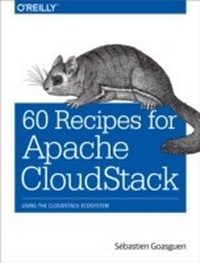
60 Recipes for Apache CloudStack
Using the CloudStack Ecosystem
1st Edition
Published on 3. October 2014
156 pages
978-1-4919-1012-2 (ISBN)
Description

Planning to deploy and maintain a public, private, or hybrid cloud service? This cookbooks handy how-to recipes help you quickly learn and install Apache CloudStack, along with several API clients, API wrappers, data architectures, and configuration management technologies that work as part of CloudStacks ecosystem.Youll learn how to use Vagrant, Ansible, Chef, Fluentd, Libcloud, and several other open source tools that let you build and operate CloudStack better and faster. If youre an experienced programmer, system administrator, or DevOps practitioner familiar with bash, Git, package management, and some Python, youre ready to go.Learn basic CloudStack installation from source, including features such as DevCloud, the CloudStack sandboxGet a step-by-step guide for installing CloudStack from packages on Ubuntu 14.04 using KVMWrite your own applications on top of the CloudStack API, using CloudMonkey, Libcloud, jclouds, and CloStackExpose different APIs on CloudStack with the EC2Stack, Boto, and Eutester API wrappersDeploy applications easily, using Puppet, Salt, Ansible, Chef, and VagrantDive into cloud monitoring and storage with RiakCS, Fluentd, and Apache Whirr
More details
Other editions
Additional editions
Book
11/2014
O'Reilly
€32.00
Shipment within 10-20 days
Content
- Intro
- Copyright
- Table of Contents
- Preface
- Why I Wrote This Book
- CloudStack Within the Cloud Computing Picture in 500 Words
- How This Book Is Organized
- Technology You Need to Understand
- Online Content
- Conventions Used in This Book
- Safari® Books Online
- How to Contact Us
- Acknowledgments
- Part I. Installation
- Chapter 1. Installing from Source
- 1.1. Installing the Prerequisites for Ubuntu 14.04
- Problem
- Solution
- Discussion
- 1.2. Installing the Prerequisites for CentOS 6.5
- Problem
- Solution
- Discussion
- 1.3. Installing from Source
- Problem
- Solution
- Discussion
- 1.4. Using the CloudStack Simulator
- Problem
- Solution
- Discussion
- 1.5. Using the CloudStack Sandbox: DevCloud
- Problem
- Solution
- Discussion
- 1.6. Vagrant-Based CloudStack Testing Deployment
- Problem
- Solution
- Discussion
- 1.7. Building CloudStack Binary Packages
- Problem
- Solution
- Discussion
- Chapter 2. Installing from Packages
- 2.1. Installing the Prerequisites on the Management Server
- Problem
- Solution
- Discussion
- 2.2. Setting Up the Management Server
- Problem
- Solution
- Discussion
- 2.3. Setting Up an Image Catalog and Seeding it with the SystemVM Template
- Problem
- Solution
- Discussion
- 2.4. Preparing a KVM Hypervisor
- Problem
- Solution
- Discussion
- 2.5. Configuring libvirt
- Problem
- Solution
- Discussion
- 2.6. Basic Zone Network Configuration and NAT Router Setup
- Problem
- Solution
- Discussion
- 2.7. Configuring a Basic Zone
- Problem
- Solution
- Discussion
- 2.8. Troubleshooting Your First CloudStack Deployment
- Problem
- Solution
- Discussion
- Part II. Clients and API Wrappers
- Chapter 3. API Clients
- 3.1. The CloudStack API
- Problem
- Solution
- Discussion
- 3.2. Signing an API Request
- Problem
- Solution
- Discussion
- 3.3. Installing CloudMonkey, the CloudStack Interactive Shell
- Problem
- Solution
- Discussion
- 3.4. Configuring CloudMonkey
- Problem
- Solution
- Discussion
- 3.5. Using CloudMonkey as an Interactive Shell
- Problem
- Solution
- Discussion
- 3.6. Starting a Virtual Machine Instance with CloudMonkey
- Problem
- Solution
- Discussion
- 3.7. Using Apache Libcloud with CloudStack
- Problem
- Solution
- Discussion
- 3.8. Managing Key Pairs and Security Groups Using Libcloud
- Problem
- Solution
- Discussion
- 3.9. Hybrid Cloud Applications Using Libcloud
- Problem
- Solution
- Discussion
- 3.10. IPython Interactive Shell with Libcloud
- Problem
- Solution
- Discussion
- 3.11. Installing and Configuring jclouds CLI
- Problem
- Solution
- Discussion
- 3.12. Using jclouds CLI with CloudStack
- Problem
- Solution
- Discussion
- 3.13. Using CloStack: A Clojure Client for CloudStack
- Problem
- Solution
- Discussion
- 3.14. Starting a Virtual Machine with CloStack
- Problem
- Solution
- Discussion
- 3.15. Use CloStack Within Your Own Clojure project
- Problem
- Solution
- Discussion
- 3.16. StackerBee, a Ruby Client for CloudStack
- Problem
- Solution
- Discussion
- Chapter 4. API Interfaces
- 4.1. Installing and Configuring EC2Stack
- Problem
- Solution
- Discussion
- 4.2. Using the AWS CLI with EC2Stack
- Problem
- Solution
- Discussion
- 4.3. Improving the EC2Stack API Coverage
- Problem
- Solution
- Discussion
- 4.4. Using Python Boto with EC2Stack
- Problem
- Solution
- Discussion
- 4.5. Installing Eutester to Test the AWS Compatibility of Your CloudStack Cloud
- Problem
- Solution
- Discussion
- 4.6. Using Eutester with EC2Stack to Write Functional tests
- Problem
- Solution
- Discussion
- 4.7. Installing and Configuring gstack: The CloudStack GCE Interface
- Problem
- Solution
- Discussion
- 4.8. Using gstack with the gcutil Tool
- Problem
- Solution
- Discussion
- 4.9. Supporting the OCCI Standard in CloudStack
- Problem
- Solution
- Discussion
- Part III. Configuration Management and Advanced Recipes
- Chapter 5. Configuration Management
- 5.1. Installing Veewee
- Problem
- Solution
- Discussion
- 5.2. Using Veewee to Create a Vagrant Base Box
- Problem
- Solution
- Discussion
- 5.3. Introducing Packer to Build Cloud Images
- Problem
- Solution
- Discussion
- 5.4. Installing Vagrant to Build and Test Cloud Images
- Problem
- Solution
- Discussion
- 5.5. Using the Vagrant CloudStack Plug-In
- Problem
- Solution
- Discussion
- 5.6. Introducing Ansible to Configure Cloud Instances
- Problem
- Solution
- Discussion
- 5.7. Provisioning with Ansible Playbooks
- Problem
- Solution
- Discussion
- 5.8. Ansible Provisioning with Vagrant CloudStack Plug-In
- Problem
- Solution
- Discussion
- 5.9. Installing knife-cloudstack
- Problem
- Solution
- Discussion
- 5.10. Starting an Instance with Knife
- Problem
- Solution
- Discussion
- 5.11. Bootstrapping Instances with Hosted Chef
- Problem
- Solution
- Discussion
- Chapter 6. Advanced Recipes
- 6.1. Installing Fluentd to Collect CloudStack Logs and Events
- Problem
- Solution
- Discussion
- 6.2. Configuring the CloudStack Fluentd Plug-In
- Problem
- Solution
- Discussion
- 6.3. Using MongoDB as a Fluent Data Store
- Problem
- Solution
- Discussion
- 6.4. Playing with Basho Riak CS Object Store
- Problem
- Solution
- Discussion
- 6.5. Installing RiakCS on Ubuntu 12.04
- Problem
- Solution
- Discussion
- 6.6. Using Python Boto to Store Data in RiakCS
- Problem
- Solution
- Discussion
- 6.7. Using RiakCS as Secondary Storage for CloudStack
- Problem
- Solution
- Discussion
- 6.8. Installing Apache Whirr
- Problem
- Solution
- Discussion
- 6.9. Using Apache Whirr to Deploy a Hadoop Cluster
- Problem
- Solution
- Discussion
- Part IV. Summary
- Chapter 7. Summary
- What We Covered
- Other Areas to Explore
- Final Words
- Index
- About the Author
