

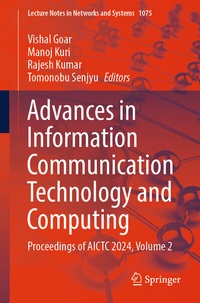
Advances in Information Communication Technology and Computing
Description

The book is a collection of best selected research papers presented at the International Conference on Advances in Information Communication Technology and Computing (AICTC 2024), held in NJSC South Kazakhstan State Pedagogical University, Shymkent City, Kazakhstan, during April 29-30, 2024. The book covers ICT-based approaches in the areas of ICT for energy efficiency, life cycle assessment of ICT, green IT, green information systems, environmental informatics, energy informatics, sustainable HCI, or computational sustainability.
More details
Other editions
Additional editions
Persons
Dr. Vishal Goar is currently working as the dean of Research at Bikaner Technical University, Bikaner. He has published 46 research papers in international journals (SCI/Scopus/WoS) and presented 45 papers at national/international conferences. He has editor/ authored 13 books including reference, text, and edited books of Springer, Singapore, ACM USA, and Scholars-Press, Germany. He has published two patents and 3 patent grants in his credit. He supervised 6 Ph.D. research scholars in the areas of cloud computing, software development, neural networks, and deep learning. He also served as an organizing chair, convener, and publicity chair of various Springer/IEEE/ACM international conferences. His research areas include security, cloud computing, IoT, sensors, and deep learning. He is a life member of Professional Bodies such as IEANG, ACM, ISTE, IACSIT, UACEE, CSTA, SDIWC, and CSI.
Manoj Kuri is presently working as a principal at Govt. Engineering College Bikaner, Rajasthan (India). He has teaching and research experience of 19 years. He has held many administrative and academic responsibilities in the past, such as Head (Computer Science and IT department), Head (Electronics and Communication Engineering) In charge of (Technology Business Incubation center) Registrar of the institute, etc. He has many research publications in esteemed journals and renowned conferences. He is a member of many scientific and professional societies/bodies such as IEEE, ISTE, ISRS, and IGRSS. He is also a member elected of the IEEE Rajasthan Subsection (2019-20). He has traveled to China, Spain, and Dubai and presented research papers. Beyond this, he is an active member and Paul Harris Fellow of the Rotary International Service Organization.
Dr. Rajesh Kumar received the Bachelor of Technology in Engineering degree with honors in Electrical Engineering from the Department of Electrical Engineering, National Institute of Technology, Kurukshetra, India, in 1994, Master of Engineering with honors in Power Engineering from the Department of Electrical Engineering, Malaviya National Institute of Technology, Jaipur, India, in 1997 and Ph.D. degree in Intelligent Systems from Department of Electrical Engineering, Malaviya National Institute of Technology (MREC, University of Rajasthan), India, in 2005. He is currently a professor at Department of Electrical Engineering and an adjunct professor at Centre of Energy and Environment at Malaviya National Institute of Technology, Jaipur, India. He has been a research fellow (A) at the Department of Electrical and Computer Engineering at National University of Singapore from 2009-2011.
Professor Tomonobu Senjyu was born in Saga Prefecture, Japan, in 1963. He received the B.S. and M.S. degrees in electrical engineering from University of the Ryukyus, Nishihara, Japan, in 1986 and 1988, respectively, and the Ph.D. degree in electrical engineering from Nagoya University, Nagoya, Japan, in 1994. He is currently a full professor with the Department of Electrical and Electronics Engineering, University of the Ryukyus. His research interests are in the areas of renewable energy, power system optimization and operation, power electronics, and advanced control of electrical machines.
Content
Chapter 1: Artificial Intelligence and Decent Work: Balancing Efficiency with Human-Centric Values.- Chapter 2: Development Framework for Virtual Reality and UAV Technologies for the Adoption of Sustainable Heritage & Cultural Virtual Tourism in Melaka, Malaysia.- Chapter 3: A Critical Review in Building Trust in Financial Services and Management in the Digital Era: Impli-cations and Opportunities for Decision Making.- Chapter 4: Universal Representation Theory - Rigour II.- Chapter 5: Revolutionizing Smart Cities: A Data-Driven Traffic Monitoring System for Real-time Traffic Density Estimation and Visualization.- Chapter 6: ASSESSING THE INFLUENCE OF SELF-SERVICE TECHNOLOGY ON WoM: THE ROLE OF CUSTOMER SATISFACTION.- Chapter 7: Universal Representation Theory - Applications II.- Chapter 8: Enhancing Performance of Machine Learning Models in Healthcare: An Analytical Framework for Assessing and Improving Data Quality.- Chapter 9: Evaluating the enhancement of cognitive skills and acquisition of new skills in an environment of different video game genres.- Chapter 10: HySeg-Net: A Robust Interactive Hybrid Technique for Image Segmentation and Classification in Hand Gesture Recognition. etc.
